

Can an insurance company refuse to pay a claim?
Yes. An insurer can decline a claim where the policy, facts or applicable law support that outcome. For example, the loss may fall outside the cover, an exclusion may apply, or the evidence may not establish what happened. Ask the insurer to explain its decision and check it against the policy and evidence.
The FCA requires insurers to handle claims promptly and fairly, give reasonable claim guidance and progress information, not unreasonably reject a claim, and settle promptly once terms are agreed. That does not mean every claim must be paid.
Why might an insurance claim be refused?
The graphic is a starting point, not a policy decision. A listed issue does not automatically allow an insurer to refuse the whole claim; policy wording, the connection to the loss and the evidence matter.
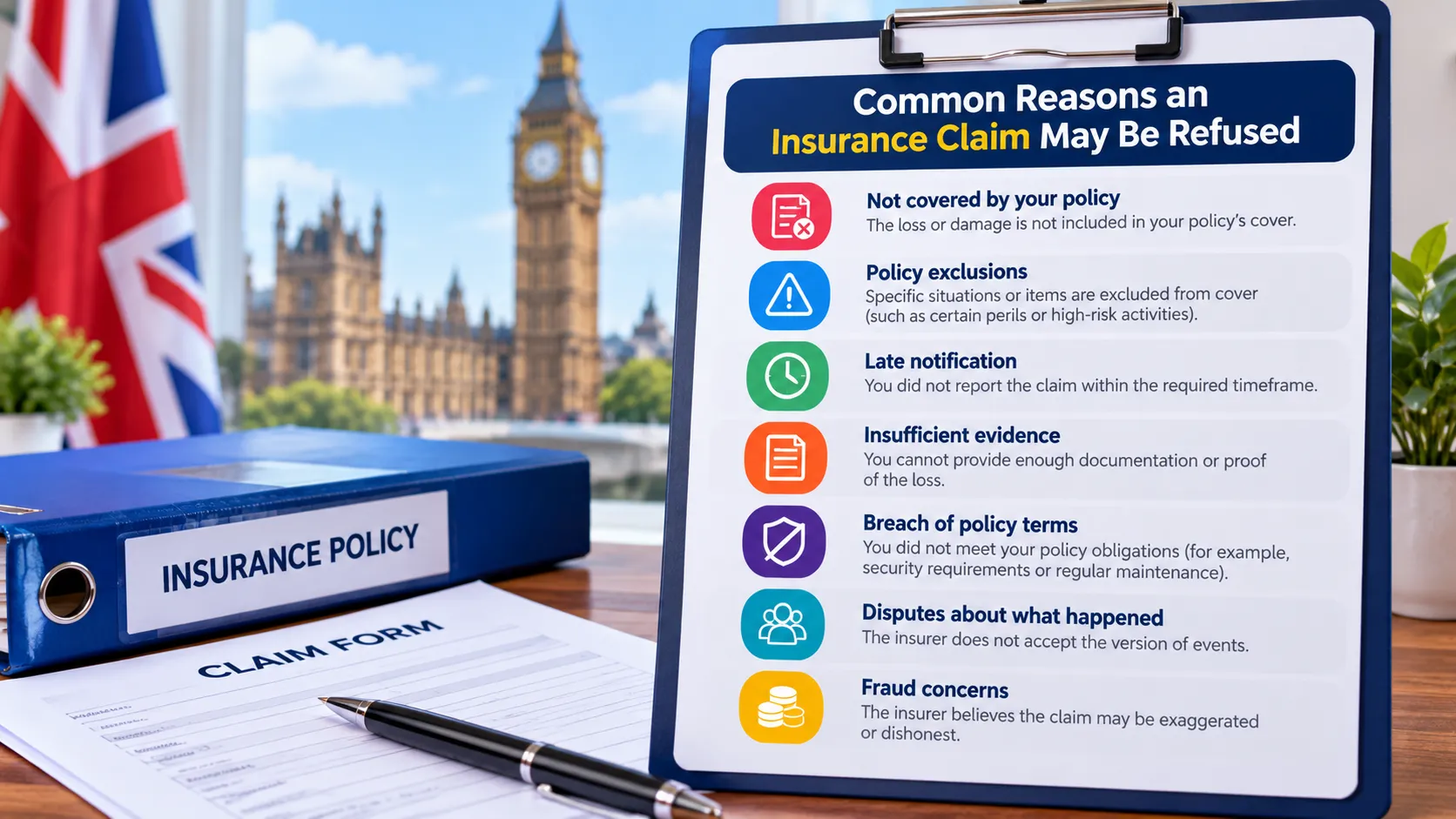
The loss is not covered by the policy
The event, item or type of loss may not fall within the insuring clauses. Insurance is contract-specific, so compare the stated reason with the policy schedule, wording and any endorsements rather than relying on a general description of the cover.
A policy exclusion may apply
Policies commonly contain exclusions and limitations. An insurer should identify the exclusion it relies on and explain how it applies to the particular facts. An exclusion heading alone may not answer every question about causation, extent of loss or another part of a claim.
The insurer says a policy condition was not met
An insurer may raise a condition, such as a notification or security requirement. Late notification or a breach of a condition does not automatically decide every claim. For consumer policies, FCA rules include protections against unreasonable rejection for breach of a condition or warranty where the circumstances of the claim are not connected to that breach, subject to the applicable rules and law.
There is not enough evidence
The insurer may say it cannot establish the loss, value, cause or timing from the material available. That can be a reason to ask what information it needs and to provide relevant records, rather than guessing which evidence will change the outcome.
The insurer disputes what happened
There can be a genuine disagreement about cause, timing, damage or value. Reports, photographs, invoices, witness evidence or specialist opinions may assist, depending on the claim. They are evidence for the insurer to assess, not a promise that it will accept the claim.
Information given when buying or changing the policy is disputed
For consumer insurance, the Consumer Insurance (Disclosure and Representations) Act 2012 is relevant to pre-contract or variation misrepresentation. Its test and remedies are not a blanket rule that any inaccurate answer voids cover. FCA rules describe a qualifying misrepresentation by reference to reasonable care and what the insurer would have done with accurate information.
The insurer suspects fraud
Fraud concerns can lead to investigation and may have serious consequences, but suspicion is not the same as a proven fraudulent claim. Keep communications accurate and preserve documents; do not alter evidence or make assumptions about the allegation.
Does a rejected claim mean the insurer is right?
No automatic conclusion follows either way. A refusal may be correct, or it may need clarification or reconsideration. Check the insurer’s policy interpretation, the facts and evidence it used, and whether the cited term applies to this loss.
What should you do if your insurance claim is refused?
The exact path can vary by insurer, policy and dispute. The image shows a practical sequence rather than a guaranteed escalation route or eligibility decision.
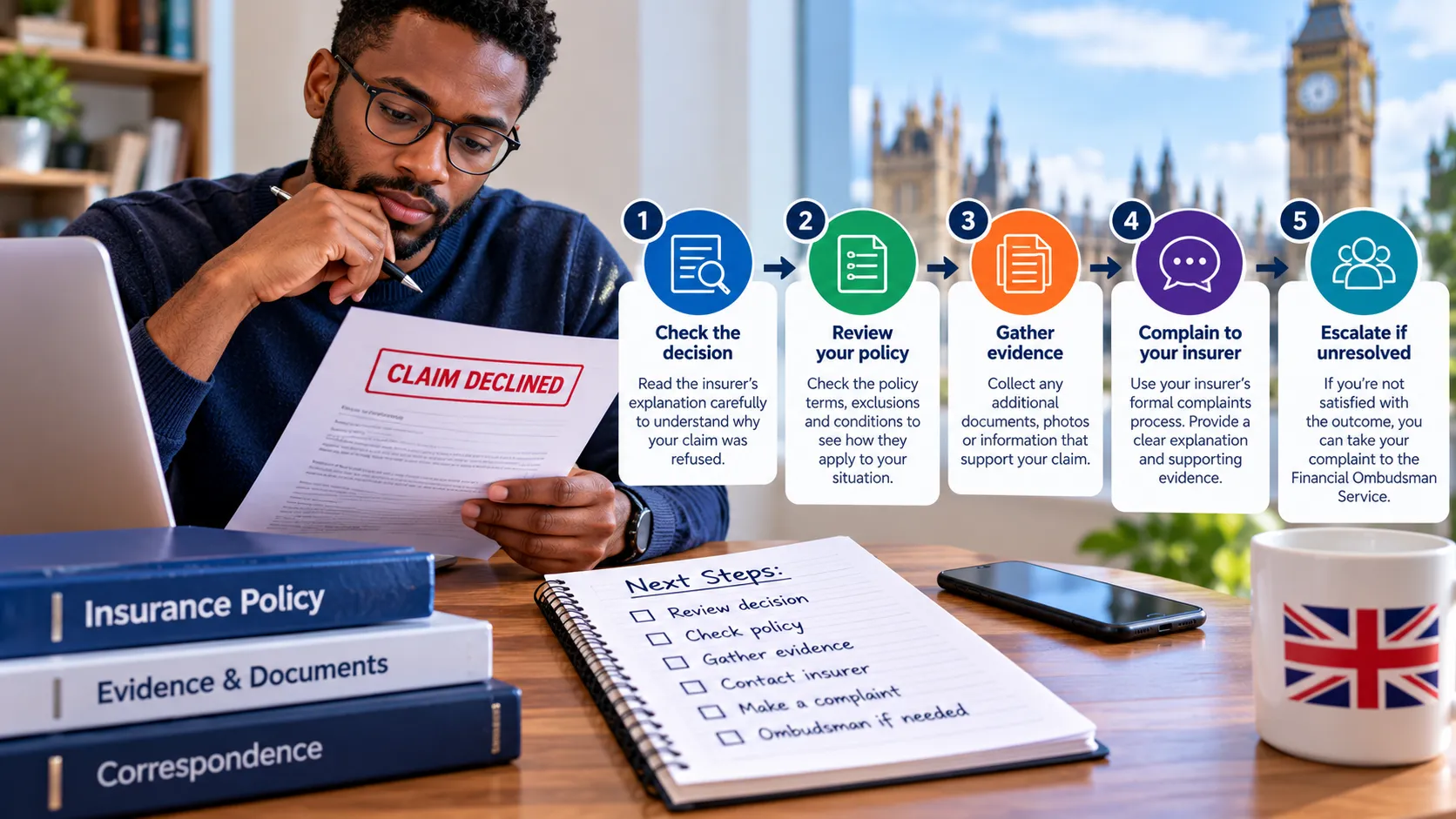
- Read the decision carefully and keep a copy.
- Identify the exact term, exclusion, condition or factual reason the insurer relies on.
- Check the policy wording, schedule and relevant endorsements.
- Gather records that directly relate to the disputed issue.
- Ask questions or request a reconsideration if information is missing, inaccurate or unclear.
- If the matter remains unresolved, make a formal complaint to the insurer.
- Consider the Financial Ombudsman Service if the complaint is eligible.
Ask the insurer why the claim was declined
An ordinary conversation with a claims handler can clarify a decision, but it is not necessarily a formal complaint. Ask the insurer to identify the policy term it relies on, the facts and evidence that led to the decision, whether it needs further evidence, and whether any part of the claim is accepted. It can also be useful to ask how to start the insurer’s formal complaints process if a review does not resolve the issue.
What evidence could help when challenging a refused claim?
Useful evidence depends on the loss and disputed point. It might include policy documents, decision letters, photographs or video, receipts and invoices, valuations, repair or expert reports, a police reference where relevant, appropriate medical information, and a timeline. Keep original records where possible and provide only relevant information.
How do you complain to a UK insurer?
A formal complaint is distinct from the original claim and from asking a question about it. Tell the insurer that you are making a complaint, explain the decision or handling you dispute, and attach the relevant documents. Follow its published complaint route and retain proof of submission.
The insurer’s final response should explain the outcome and, where applicable, how to take the complaint to the Financial Ombudsman Service. A complaint does not turn an insurer’s original claim decision into an automatic payment obligation.
How long does an insurer have to respond to a complaint?
The often-mentioned eight weeks concerns a formal complaint, not an automatic deadline for deciding or paying the original insurance claim. Under the FCA’s current DISP framework, for most complaints a firm must send a final response or another prescribed written response by the end of eight weeks after receiving the complaint. Different rules can apply to some complaint types.
The Financial Ombudsman Service explains that, for most complaints, a business has eight weeks to consider the complaint. If the applicable period expires without the required final response, a consumer may be able to refer an eligible complaint to the Service. That is not the same as saying every claim must be settled in eight weeks.
Can you take a rejected insurance claim to the Financial Ombudsman Service?
Usually, the consumer must first complain to the financial business. If they remain unhappy with the final response, or the applicable response period has passed without the required response, an eligible complaint may generally be referred to the Financial Ombudsman Service. The Service has jurisdiction rules and time limits, and it may not be able to investigate every dispute.
The Service weighs evidence from the consumer, business and relevant third parties alongside applicable law, rules, guidance and, where appropriate, good industry practice. It does not guarantee that it will agree with the consumer.
UK insurance complaint and Ombudsman process
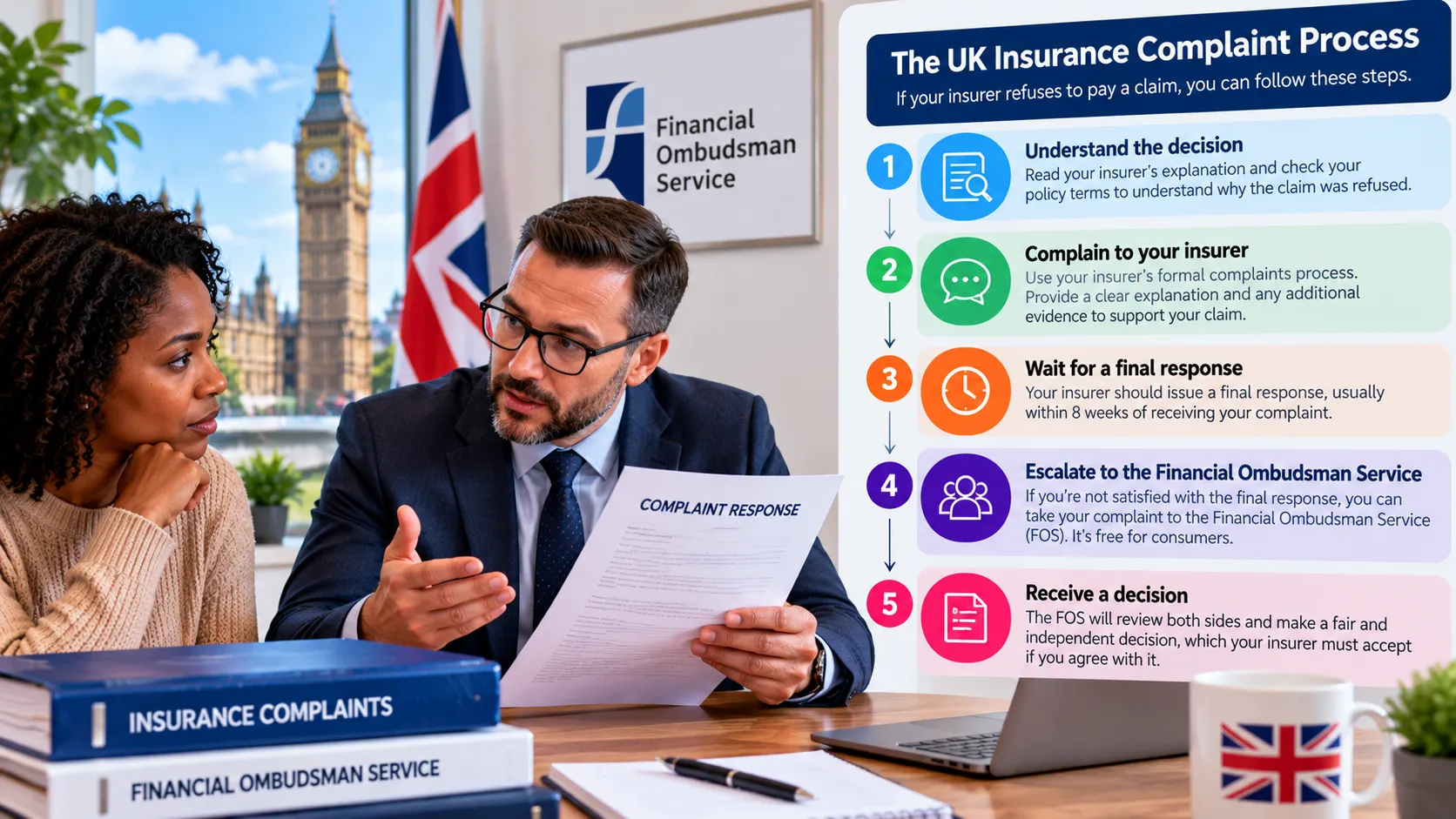
The infographic simplifies an important process. Its reference to eight weeks describes the complaints timetable for most complaints, not a universal claim-settlement deadline. It also does not replace the Service’s eligibility and time-limit checks.
An investigator or case-handler may first give an assessment after reviewing the evidence. That is not the same as an ombudsman’s final decision. If the case proceeds and the complainant accepts an ombudsman’s final decision within the required FOS process and time, it becomes final and binding on the financial business. If the complainant rejects it, or does not accept it as required, the business does not have to comply with that final decision in the same way. Independent legal advice may be appropriate for someone considering court action or whether to accept a final decision.
What can the Financial Ombudsman Service do?
If the Service decides a business did not treat a customer fairly, it can set out how the business should put matters right within its powers. Depending on the case, that might involve compensation, costs or interest, or a non-monetary remedy such as reinstating an insurance policy. An upheld complaint does not necessarily mean the full original claim will be paid.
What if the insurer still refuses to pay after a complaint?
Where eligible, a referral to the Financial Ombudsman Service may be an option after the insurer’s complaints process. Other routes, including court proceedings, may exist, but this article cannot advise whether they are appropriate or predict an outcome. Anyone considering legal action should obtain independent legal advice.
Can an insurer refuse only part of a claim?
Yes, a decision can distinguish between different items, heads of loss, causes of damage or amounts. For example, an insurer may accept one part of a loss while disputing valuation, a particular repair, an excluded item or the cause of another part. Ask for a clear breakdown so that any challenge is directed at the actual point in dispute.
Can an insurer reduce a claim instead of refusing it?
Potential outcomes are not always all-or-nothing. A policy excess, limits, valuation terms, underinsurance provisions or a partial acceptance can affect what is paid. Consumer misrepresentation has its own statutory framework and remedies; it is not a general rule that an insurer can simply lower a claim because information was inaccurate.
How can you reduce the risk of a claim dispute?
Read the cover and exclusions, answer application questions carefully, tell the insurer about changes where the policy requires it, keep appropriate records, follow reasonable policy conditions, report losses as the policy requires, and retain communications and claim documents. These steps can make the facts easier to establish, but they do not guarantee that a claim will be paid.
Frequently asked questions
Can an insurer legally refuse to pay a claim in the UK?
It can, where the refusal is supported by the policy, facts and applicable law. FCA rules require insurers not to unreasonably reject claims; they do not require payment of every claim.
Can I challenge a rejected insurance claim?
You can ask the insurer to explain or reconsider a decision and provide relevant evidence. If that does not resolve the issue, you can use its formal complaints process. The appropriate route depends on the facts and policy.
How do I complain if my insurer refuses my claim?
Use the insurer’s published complaints procedure, make clear that your communication is a complaint, and keep copies of what you submit. Explain the decision or handling you dispute and include relevant supporting material.
Is the eight-week rule a deadline for paying an insurance claim?
No. For most complaints, it concerns the business’s complaints-response timetable. It is not an automatic deadline for settling the original insurance claim.
Can I go straight to the Financial Ombudsman Service?
Usually you need to complain to the business first. After a final response, or after the applicable response period, the Service may be able to consider an eligible complaint subject to its rules and time limits.
Does it cost money to complain to the Financial Ombudsman Service?
The Service describes its consumer service as free to use.
Does the Financial Ombudsman always side with consumers?
No. It considers the evidence and the applicable rules, law and good industry practice to decide what is fair and reasonable in the circumstances.
Is a Financial Ombudsman decision binding?
An investigator’s view is not an ombudsman’s final decision. If a complainant accepts an ombudsman’s final decision through the required process, it is final and binding on the business. A rejected or unaccepted final decision does not bind the business in the same way.
Bottom line
A refused insurance claim is not necessarily the end of the process, but it does not by itself show that the insurer acted wrongly. Understand the reason, check the policy and evidence, use the insurer’s formal complaint procedure where appropriate, and consider the Financial Ombudsman Service if the dispute remains unresolved and eligible.