
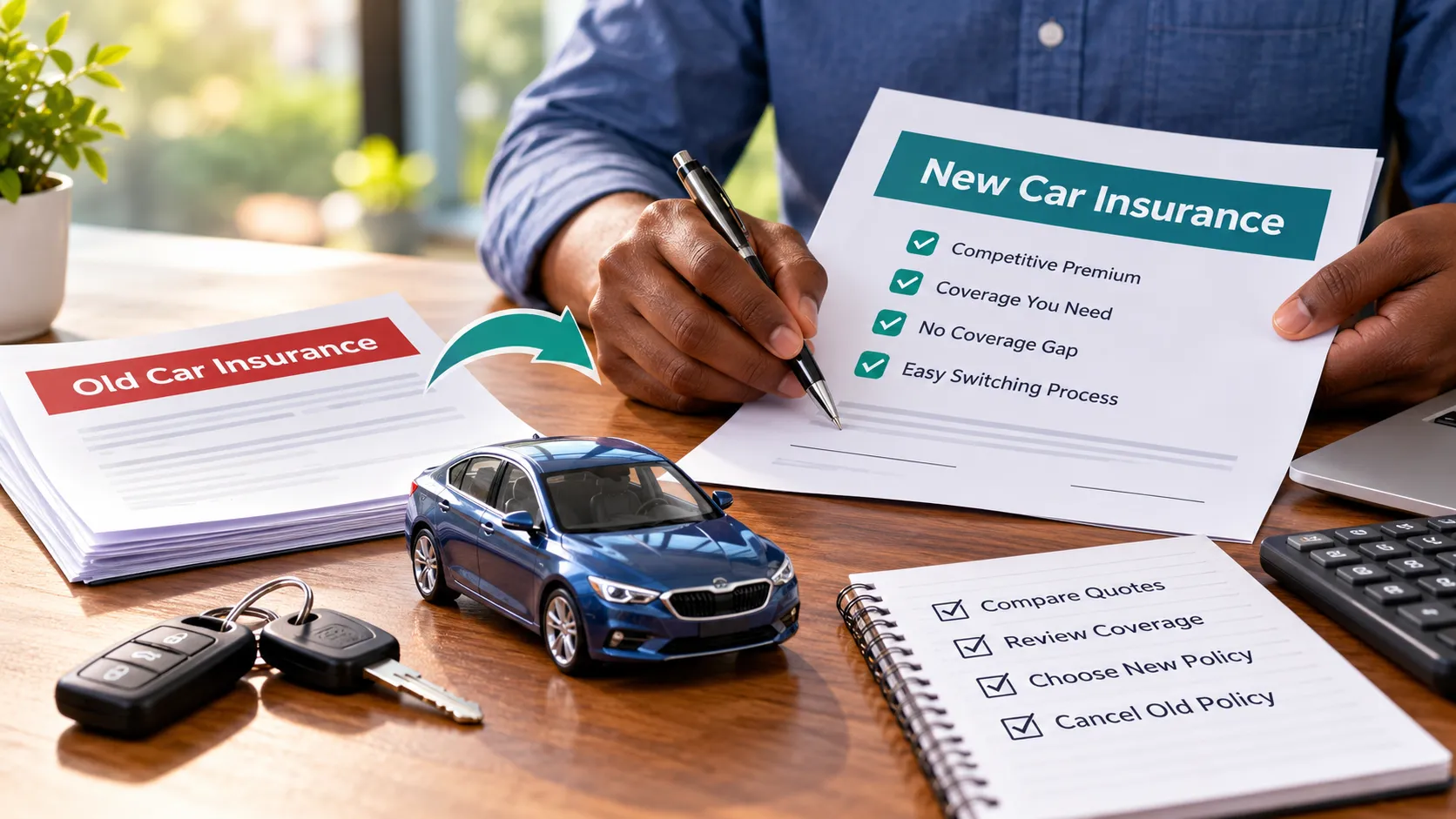
Can you switch car insurance companies?
In many situations, a driver can seek a different insurer during an existing policy term. Switching does not automatically mean a lower premium, and it is not only a price decision. If cost is one reason you are comparing insurers, see our guide to practical ways to lower car insurance. A replacement policy can have different limits, deductibles, exclusions, drivers, payment terms, or optional coverages.
It is worth switching only after you understand what is changing. Start with your current declarations page and policy documents. They show the vehicles, listed drivers, coverages, limits, deductibles, policy period, and insurer information that you need to compare.
How to switch car insurance step by step
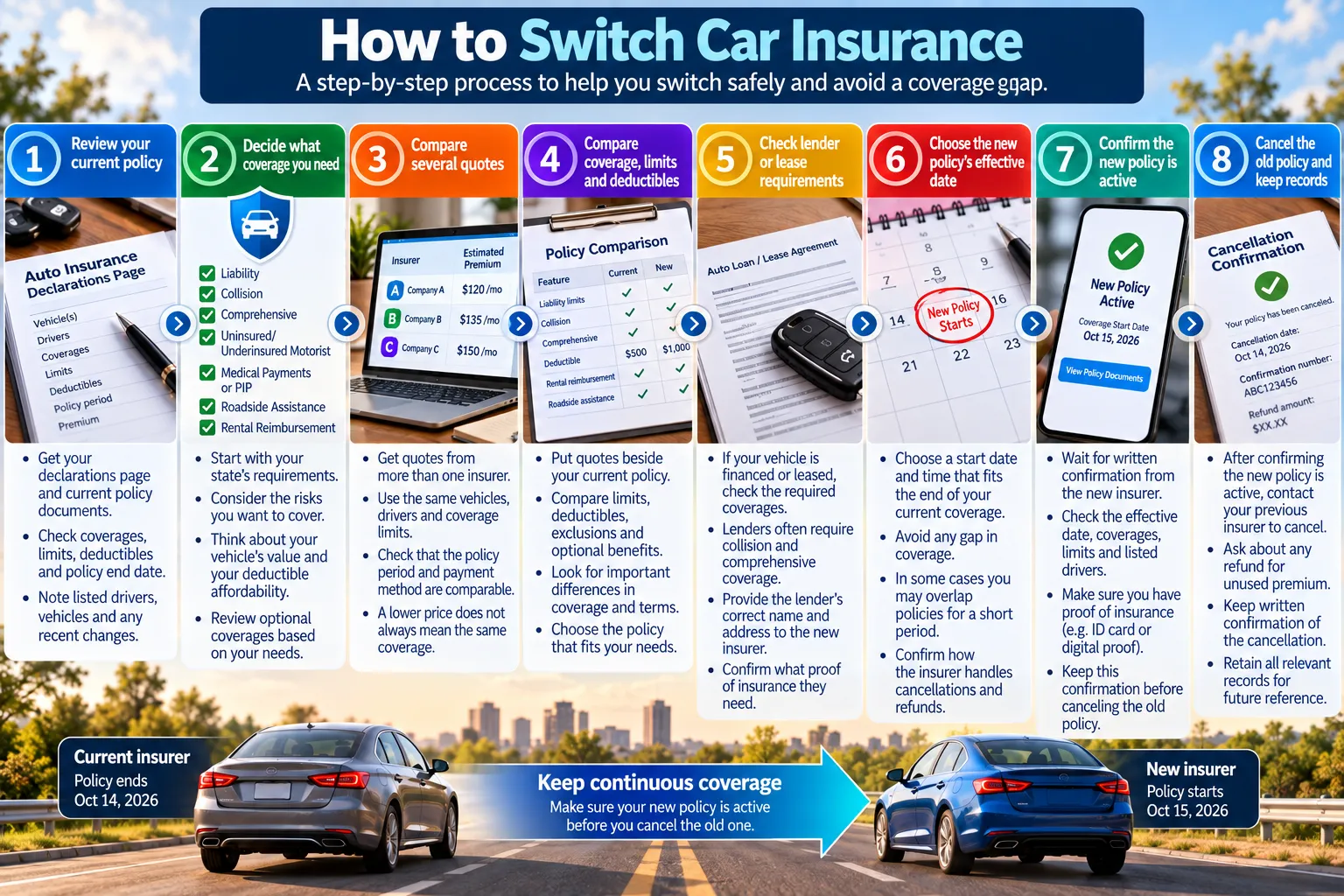
1. Review your current policy
Collect your declarations page, current premium and payment schedule, policy end date, and any recent renewal notice. Note the coverages you have now, including liability, collision, comprehensive, uninsured or underinsured motorist coverage, medical payments or personal injury protection, roadside assistance, rental reimbursement, and any endorsements.
Also check who and what is listed. A quote can change if a vehicle, address, annual mileage, driver, or driving history is recorded differently. Giving a new insurer complete and accurate information is more useful than trying to compare an estimate to a policy with different assumptions.
2. Decide what coverage you need
Your state may require particular coverages or minimum limits, but those requirements are a starting point rather than a complete personal decision. The National Association of Insurance Commissioners notes that states have their own auto-insurance rules and that many drivers choose more than the minimum required coverage.
Think about the risks you want the policy to address, the value of the vehicle, your ability to pay a deductible after a loss, and whether a lower limit would leave you exposed. If you are uncertain about a coverage decision, read the policy wording and ask the insurer or a qualified adviser to explain it.
3. Compare several quotes
Ask more than one insurer for a quote using the same information. A quote is an estimate based on the information supplied; it is not necessarily the final policy price or proof that every requested coverage is available.
When comparing quotes, make sure the policy period and payment method are comparable. A lower monthly payment can reflect a different total premium, a different down payment, fewer coverages, a higher deductible, or a different billing arrangement.
4. Compare coverage, limits, and deductibles — not price alone
Put the quotes beside your existing declarations page. Check the liability limits, deductibles, exclusions, optional benefits, vehicle use, listed drivers, and any conditions that matter to you. For example, two policies may both include collision coverage but have different deductibles or rental reimbursement limits.
The goal is not to duplicate every detail automatically. It is to make an informed choice about what you are gaining, reducing, or giving up before you bind the new policy.
5. Check lender or lease requirements
If a vehicle is financed or leased, the loan or lease agreement may require certain coverages, often including physical-damage coverage such as collision and comprehensive. The NAIC consumer guide notes that lenders may require insurance to protect their interest in a financed vehicle.
Read the agreement and ask the lender or leasing company what evidence of coverage it needs. A new insurer may need the lender’s correct name and address, and the lender may need updated proof after the policy is issued.
6. Choose the new policy’s effective date
Choose an effective date and time for the replacement policy that fits the end of the old coverage. Avoid assuming that a policy begins just because you received a quote or made a payment. Confirm the effective date shown in the policy documents or binder.
An overlap may be preferable to an unintended gap, but whether it makes sense and how it affects a refund or billing should be checked with the insurer. Do not assume every company handles an overlap in the same way.
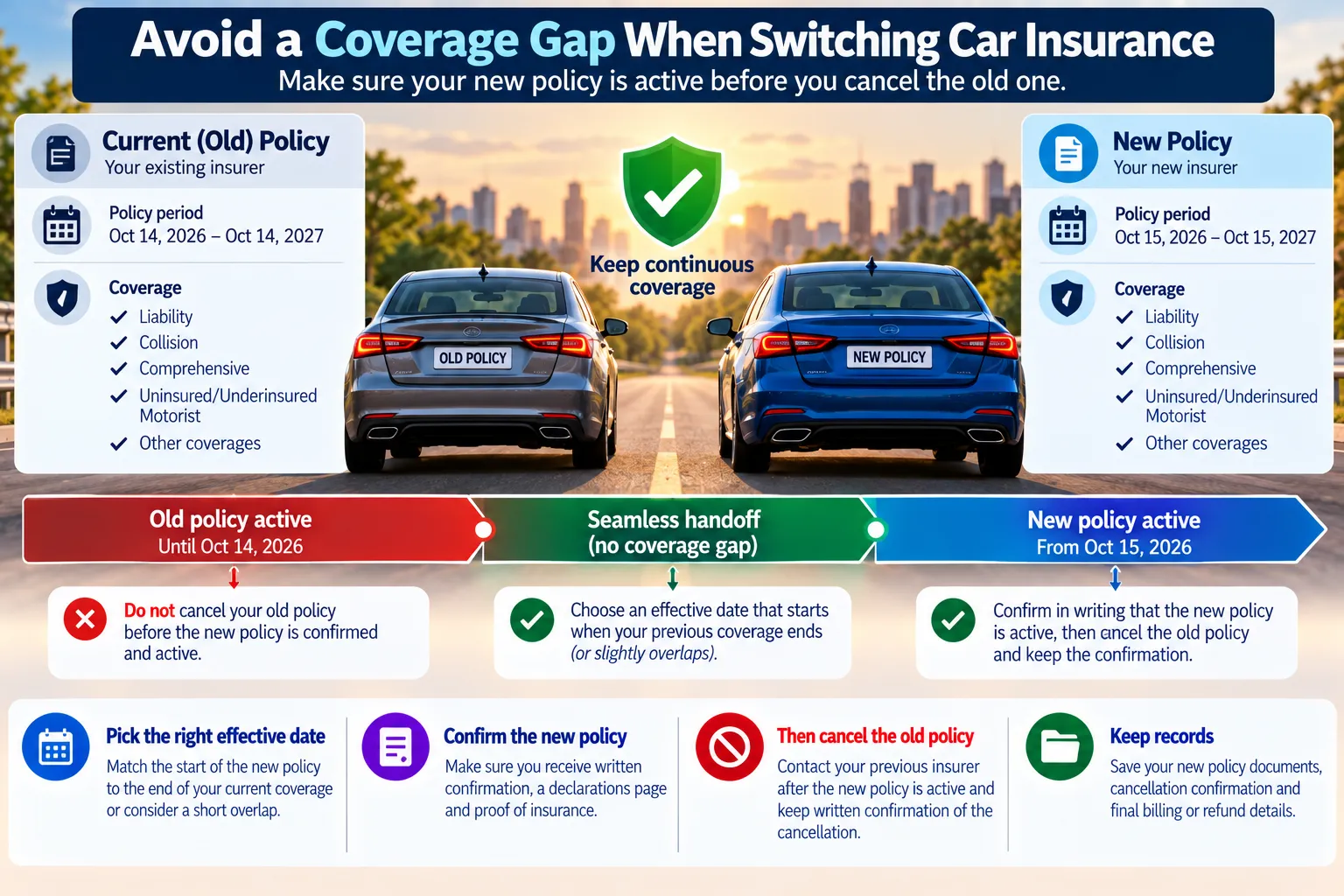
7. Confirm the replacement policy
Before ending the old policy, confirm the new policy is active and review the issued documents. Check the named insured, drivers, vehicle identification number, coverages, limits, deductibles, effective date, and any lender or leaseholder information.
Keep a copy of the declarations page, proof of insurance, payment confirmation, and any binder. Correct errors promptly with the new insurer; a small data error can affect the policy you thought you bought.
8. Cancel the previous policy
Once the replacement coverage is confirmed, follow the old insurer’s stated cancellation process. It may require a phone call, signed request, online action, or other documentation. Ask for confirmation of the cancellation date and whether any further action is needed.
Do not assume a new insurer will cancel the old policy for you. Equally, do not assume cancellation procedures are identical across the United States. The old policy, the insurer’s process, and state rules can affect what is required.
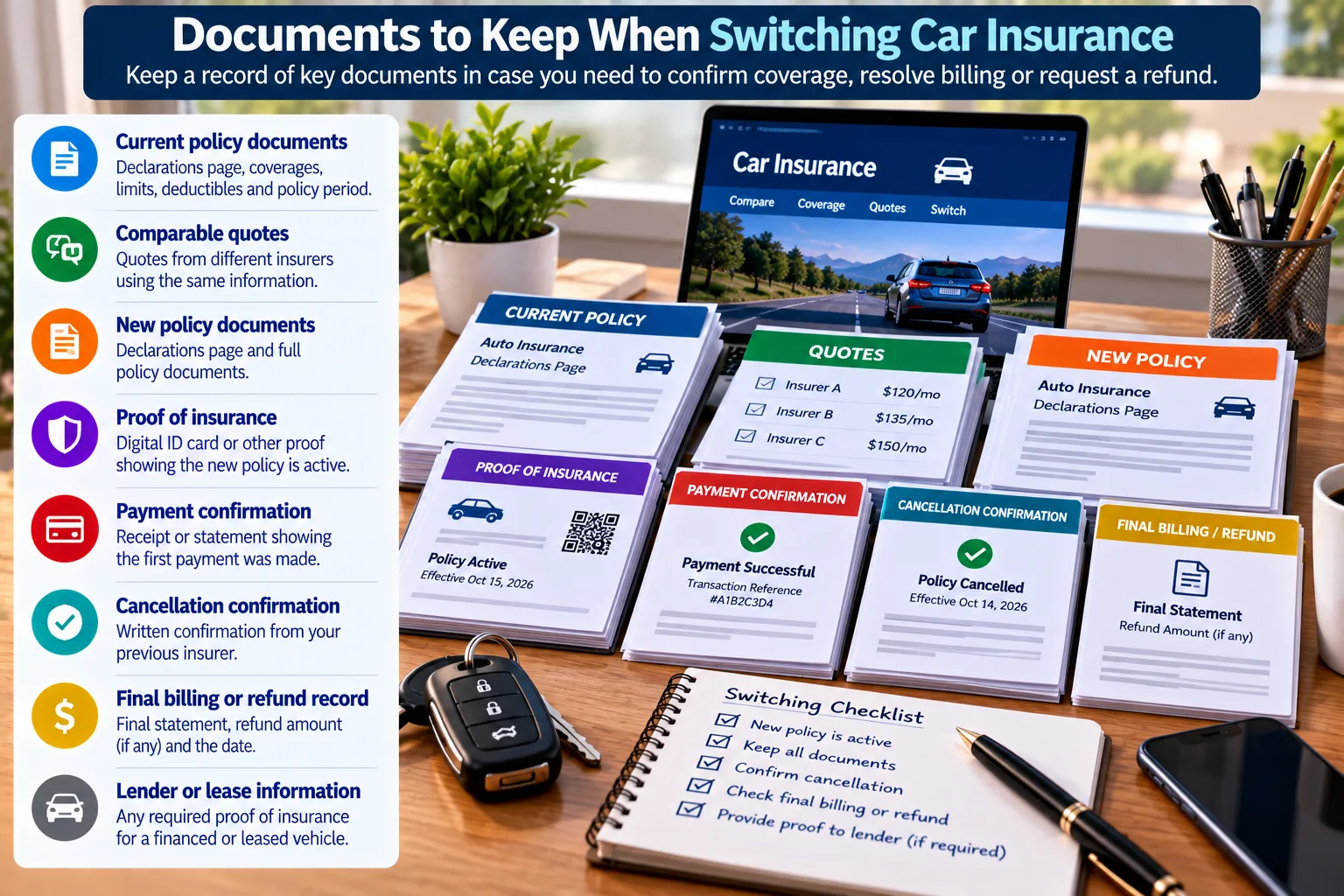
9. Keep cancellation and policy records
Save the old declarations page, cancellation confirmation, final billing or refund information, and new policy documents. These records can help if there is a question about dates, payments, a prior claim, or continuous coverage.
Can you switch car insurance at any time?
Many drivers compare or change auto insurance before renewal, after a life change, or when a vehicle or household changes. You may also want to look at alternatives after a premium increase or a change in coverage needs. But the ability to request a change does not answer every practical question about ending the existing policy.
Check the policy’s cancellation terms, contact the insurer, and review your state insurance department’s consumer information. The procedure, notice needed, and financial outcome can differ.
What happens to prepaid premium?
If you have paid ahead, there may be an adjustment after cancellation. The amount and timing can depend on the cancellation date, how premium was earned under the policy, payment status, and applicable state or policy terms. Some situations may result in money being returned; others may involve a balance or a different adjustment.
Ask the old insurer how it will calculate the final amount and request the answer in writing if possible. Do not plan a switch on the assumption that every prepaid premium will be refunded in the same way.
Can insurers charge cancellation fees?
Fees and charges are not handled uniformly. Your policy documents, insurer, and state rules may determine whether a fee, short-rate calculation, or other charge applies. Ask before you cancel, and compare that answer with the potential cost and coverage differences of the new policy.
Why avoiding an unintended coverage gap matters
A coverage gap can leave you without protection for an accident or other covered loss occurring while no policy is in force. It may also create problems with a lender or leaseholder and may affect how a future insurer views prior coverage. The exact consequences depend on the facts and state rules, but the practical safeguard is simple: confirm the replacement policy is active before the old one ends.
Switching when your vehicle is financed or leased
Financed and leased vehicles deserve an extra check because the contract may set insurance conditions beyond the state minimum. Confirm required coverages, deductibles, and lender or leaseholder details before binding the replacement policy. Then send proof of the new coverage if the agreement or lender requires it.
Switching when you have an open claim
An open claim is a reason to be especially careful with records, not necessarily a reason to delay every switch. The policy in force when the loss happened, the claim facts, and the policy terms can all matter. Contact the insurer handling the claim before making changes, keep claim correspondence, and ask what information it needs from you. Do not assume a new policy changes how an earlier claim will be handled.
Common mistakes when switching insurers
- Canceling old car insurance before the new policy is confirmed active.
- Comparing premiums without comparing coverage limits, deductibles, and exclusions.
- Forgetting to list a driver, vehicle, lender, or leaseholder accurately.
- Assuming a quote is the final issued policy.
- Overlooking an open claim, automatic payment, refund question, or cancellation instruction.
- Treating a state-specific requirement as though it applies nationwide.
A practical switching checklist
- Read the current declarations page and cancellation terms.
- Decide which coverages, limits, and deductibles you want to compare.
- Obtain comparable quotes from several insurers.
- Check loan or lease requirements, if any.
- Choose a replacement effective date that avoids an unintended gap.
- Review and confirm the new policy, proof of insurance, and payment status.
- Cancel the old policy using its required process.
- Save confirmation, final billing information, and both sets of policy records.
State-specific rules and where to verify them
For a United States car-insurance question, start with your own state insurance department and the policy documents. The NAIC explains that states set their own rules, including minimum coverage requirements. Its consumer guide also distinguishes between coverages required in most states and those required only in some states.
State regulator material is useful as an example of why local verification matters. California’s Department of Insurance explains cancellation as an early end to a policy and provides a consumer-assistance route for cancellation and non-renewal concerns. New York’s Department of Financial Services describes state-specific limits on when an insurer may cancel or non-renew a personal automobile policy. Those California and New York materials describe their own state contexts; they are not nationwide cancellation rules for a customer switching insurers.
For broader car-insurance education, visit MyCoverScope’s car insurance hub. For more United States-focused material as it is published, visit the United States hub.