

Why car insurance premiums differ
An auto-insurance premium is not based on one number alone. Insurers generally consider the coverage and deductible selected, the vehicle, where and how it is used, miles driven, driving and claims history, and other factors allowed where you live. Their methods and the weight given to each factor can differ, which is why comparable quotes can vary. For a closer explanation of those pricing factors, read How Much Is Car Insurance?
Start by identifying what has changed since your last policy review: a move, a new vehicle, a change in commute, a driver joining or leaving the household, a claim, or a renewal. Then compare choices without assuming that a lower price means equivalent protection.
1. Shop around and compare equivalent policies
Get quotes from more than one insurer using the same vehicles, drivers, coverage limits, deductibles, and policy term. A lower quoted premium can reflect less coverage, a higher deductible, different payment terms, or different information—not necessarily a better value.
Read the declarations page and compare liability limits, collision and comprehensive coverage, uninsured or underinsured motorist coverage, medical payments or personal injury protection where applicable, exclusions, and optional benefits. If you decide to replace a policy, keep the old policy active until the new coverage is confirmed. Our guide to switching car insurance explains how to avoid an unintended coverage gap.
2. Ask about discounts you actually qualify for
An insurer may offer discounts for situations such as bundling policies, insuring multiple vehicles, completing eligible driver training, or having certain safety or anti-theft equipment. Availability, eligibility, documentation, and the effect on price vary by insurer and state.
Ask an insurer which discounts apply to the people and vehicles on your policy, and ask whether a discount changes at renewal. Do not assume a discount advertised by one company is available from another or that it will outweigh differences in coverage and base price.

3. Consider a higher deductible carefully
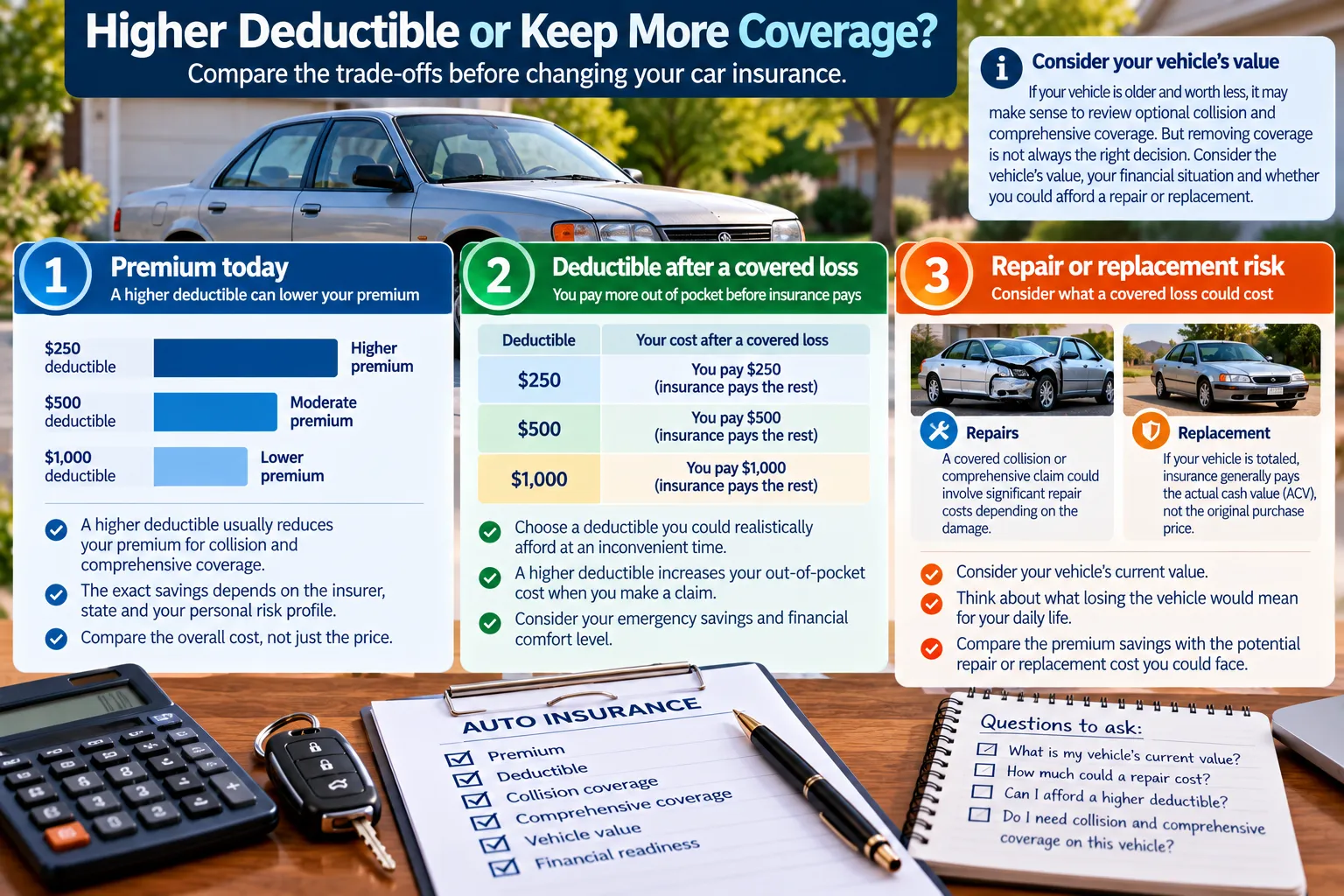
A higher deductible can reduce the premium for coverages that have a deductible, such as collision or comprehensive. It also increases the amount you may have to pay yourself after a covered loss before the insurance payment applies.
Choose a deductible you could realistically pay at an inconvenient time. Compare the premium difference with the additional out-of-pocket risk, rather than selecting the highest deductible simply because it produces the lowest quote.
4. Review optional collision and comprehensive coverage on an older vehicle
Collision and comprehensive coverage can be worth reviewing when a vehicle’s value has fallen, but removing them is not automatically the right decision. Consider the vehicle’s current value, what a covered loss would mean for your transportation, and whether you could absorb a repair or replacement cost.
State law may not require these coverages, but a lender or lease agreement may. Do not remove required coverage on a financed or leased vehicle, and check any deductible, valuation, or policy terms before making a decision.
5. Check multi-policy and multi-vehicle options
Putting more than one eligible policy or vehicle with the same insurer may change the price. It can also make administration simpler, but it is still worth comparing the combined cost and coverage with alternatives.
Do not retain an unsuitable policy just to preserve a possible bundle. Compare each policy’s terms and ask whether moving a vehicle or another policy would change discounts, deductibles, or eligibility.
6. Make sure the information on your policy is accurate
Review your declarations page for the correct address, vehicle identification number, listed drivers, annual mileage, vehicle use, garaging location, and coverage choices. Information that is incomplete or outdated can make a quote inaccurate and can cause problems later.
Tell the insurer about changes promptly. Accuracy is not a tactic for producing a lower quote; it is necessary for the insurer to rate the policy on the correct facts and for you to understand the coverage you are buying.
7. Understand how mileage and vehicle use can affect pricing
For some policies, how far and how a vehicle is driven can be a rating factor. A shorter commute, a change from business to personal use, or a reduction in annual mileage may be relevant—but only report the use that is true now and update it if circumstances change.
Ask how the insurer defines commuting, business use, ridesharing, delivery work, and occasional use. Personal auto policies may have limitations for business activity, so a lower premium is not a reason to misstate the vehicle’s use.
8. Consider usage-based insurance carefully
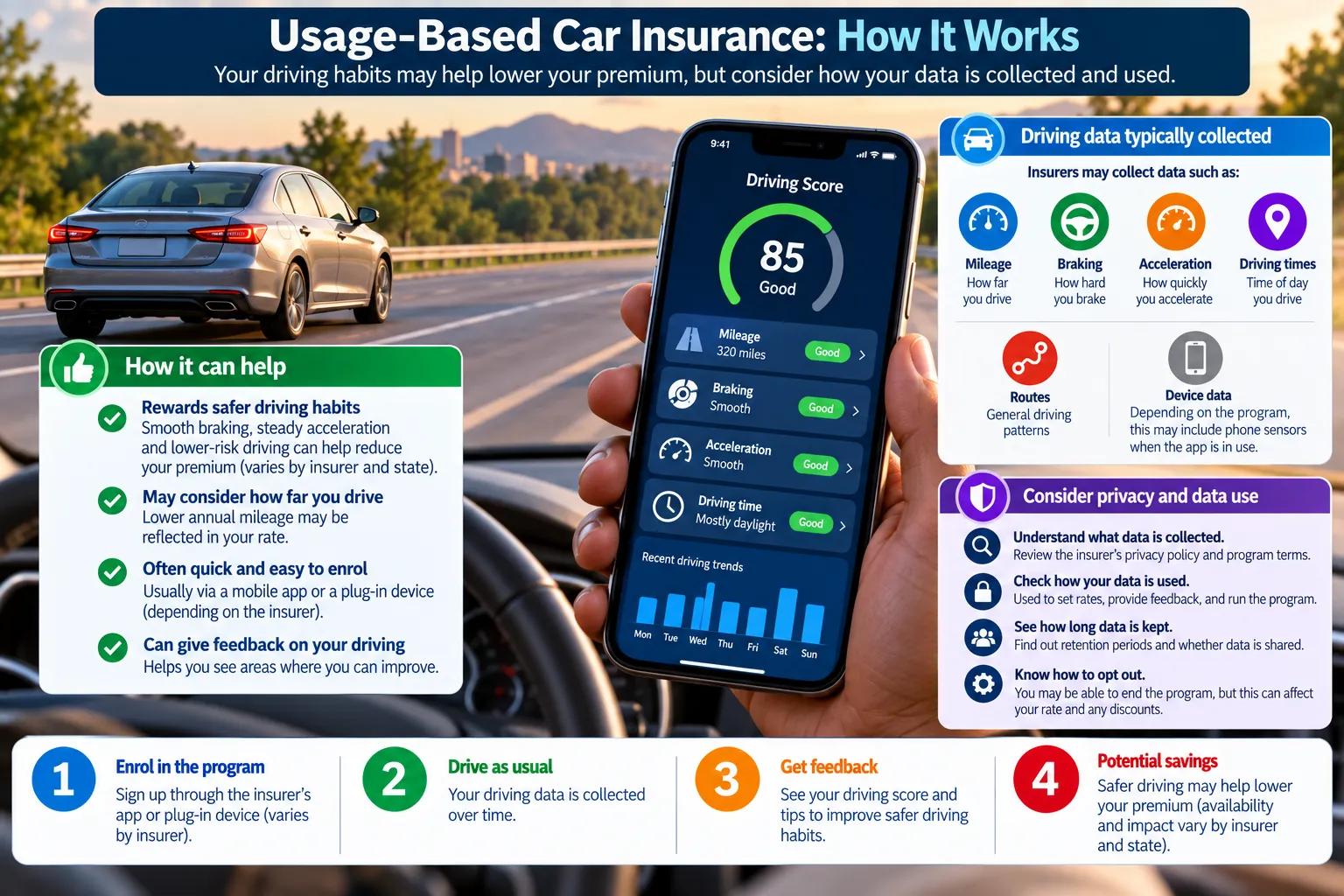
Usage-based insurance may use mileage, driving behavior, or both when determining a price. Depending on the program, information may include driving times, hard braking, acceleration, or other telematics data. It may fit some drivers, but it does not promise savings for everyone.
Before enrolling, read what information the insurer collects, how it uses and shares that information, how long it retains it, and whether your price can change. Consider the privacy and data trade-off alongside the possible effect on cost.
9. Maintain a safer driving record over time
Driving and claims history can be part of an insurer’s assessment of risk. Avoiding unsafe driving and maintaining continuous coverage may matter over time, but the timing and effect of any change depend on the insurer, the event, and state rules.
Do not rely on a promise that a particular course, device, or period without a claim will reduce your price. If defensive-driving or driver-training discounts are available, ask the insurer about eligibility and documentation before paying for a course.
10. Understand credit-based insurance scoring where permitted
Insurers may use credit-based insurance scores in underwriting or rating where state law allows. An insurance score is not the same as an ordinary lending credit score: both may use credit-report information, but they are designed for different purposes and may weigh information differently.
State restrictions differ, and some states restrict or prohibit particular uses. If you believe a credit report contains inaccurate information, review it and use the appropriate dispute process. Ask the insurer and verify your own state’s rules rather than assuming that a credit-related change will lower your insurance premium.
11. Consider insurance cost when choosing a vehicle
Vehicle type can affect insurance costs. Before buying or leasing, obtain insurance estimates for the specific vehicle and the coverage you expect to carry. Repair costs, theft exposure, safety features, availability of parts, vehicle use, and your other rating details can all influence the result.
An insurance estimate is only one part of a vehicle decision. Compare it with the purchase price, financing terms, maintenance, fuel or charging costs, and the coverage required by a lender or leaseholder.
What not to do just to lower your premium
Do not cancel coverage before replacement coverage is active, misstate drivers or vehicle use, choose limits you do not understand, or buy only a state minimum simply because it is cheaper. Required minimums are a legal starting point, not a universal recommendation for the protection you need.
Also avoid dropping coverage solely because the premium increased. First identify why the price changed, compare equivalent alternatives, and assess what you would pay after a loss if you accepted less coverage or a higher deductible.
Which changes can you make immediately?
You can review your policy, correct inaccurate information, request comparable quotes, ask about available discounts, and compare deductible options now. If a current policy no longer fits your needs, you can ask the insurer how a change would affect the price and coverage before making it.
Changes that involve a new insurer need care. Confirm the new policy’s effective date, coverage, and payment status before ending the old one.
Which factors take time to change?
Driving history, claims history, a change in annual mileage, and a household or vehicle change may take time to be reflected in a renewal or new quote. Rating practices and notice requirements are not identical across the United States.
Focus on accurate information and choices you can sustain, rather than trying to manipulate a rating factor. An insurer can explain which information it uses for a quote and when it will review a policy change.
A car-insurance savings checklist
- Read your current declarations page and note limits, deductibles, optional coverage, drivers, and vehicle use.
- Get comparable quotes using the same information and protection levels.
- Ask each insurer about discounts you may actually qualify for.
- Compare a deductible change with the amount you could pay after a covered loss.
- Check any financing or lease requirements before changing collision or comprehensive coverage.
- Confirm mileage, garaging, listed drivers, and vehicle use are correct.
- Review the data practices and price terms before joining a usage-based program.
- Confirm replacement coverage is active before canceling an old policy.
State-specific rules matter
Auto-insurance requirements and rating restrictions are primarily set at the state level. The National Association of Insurance Commissioners notes that state rules and insurer rating practices can differ. California’s Department of Insurance provides shopping guidance for California consumers; it is a useful example of a state regulator’s consumer resources, not a nationwide rule.
For information that applies where you live, start with your policy documents, the insurer, and your state insurance department. You can also explore MyCoverScope’s car insurance hub and United States hub for related educational guides.