

How much does home insurance cost?
There is no universal home insurance price. Premiums can differ by state, location, insurer, property characteristics, coverage selections, and deductible. Averages can provide broad context, but they are not personalized quotes and can combine different policy forms, homes, locations, and coverage amounts.
The useful comparison is a quote for the same property using equivalent protection. Before comparing prices, it helps to understand what a homeowners policy can cover, because a lower premium may reflect different limits, exclusions, valuation terms, or optional coverage rather than a simple pricing difference.
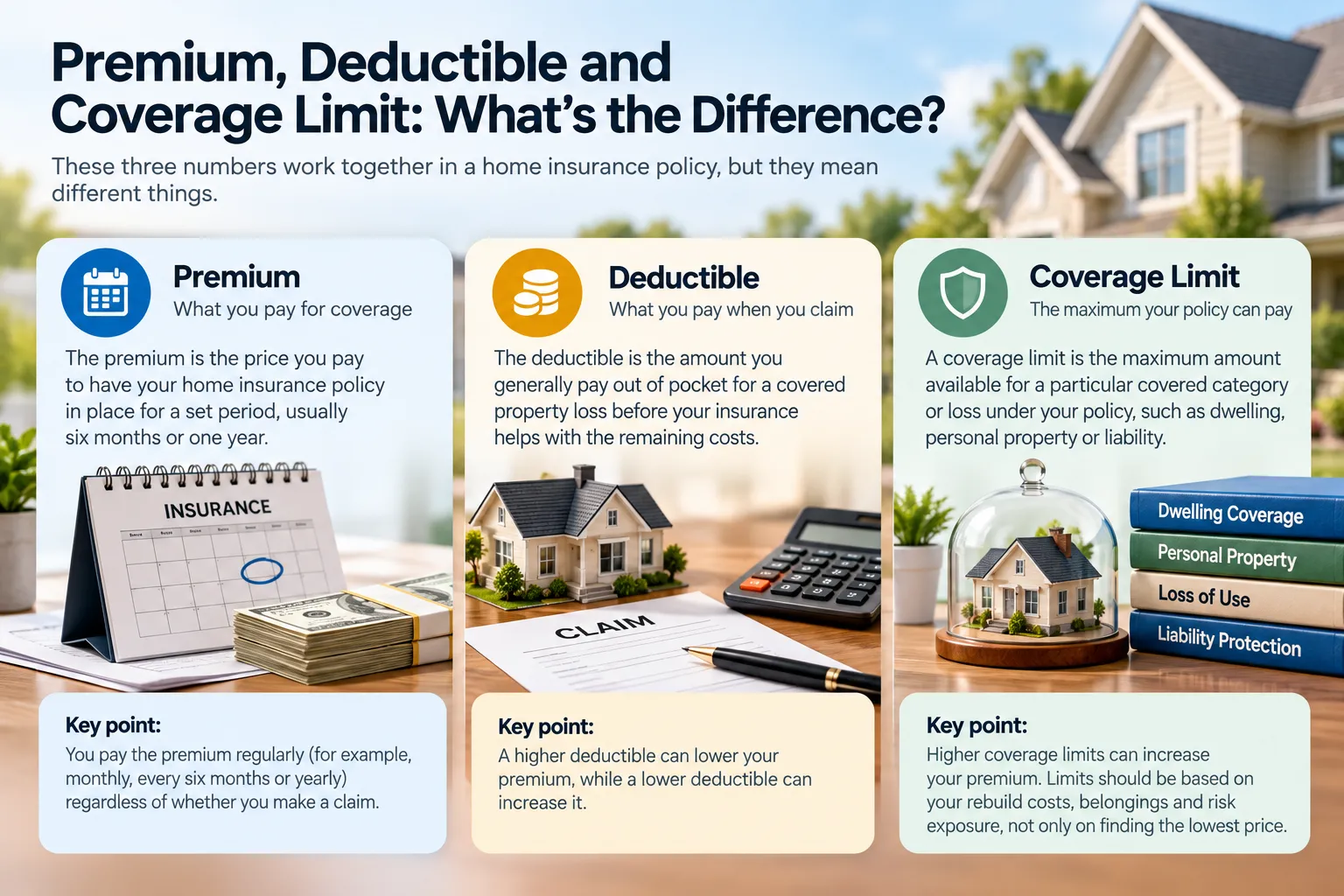
What is a home insurance premium?
A premium is the price charged for an insurance policy for its term. It is different from a deductible, which is generally the amount the policyholder bears for a covered property loss before applicable insurance payment. It is also different from a coverage limit, which is the maximum amount available for a particular covered category or loss under the policy.
These three figures belong together when evaluating a quote. A lower premium may accompany a higher deductible, lower coverage limit, different valuation method, or different policy terms. Comparing one number without the others can make policies look more alike than they are.
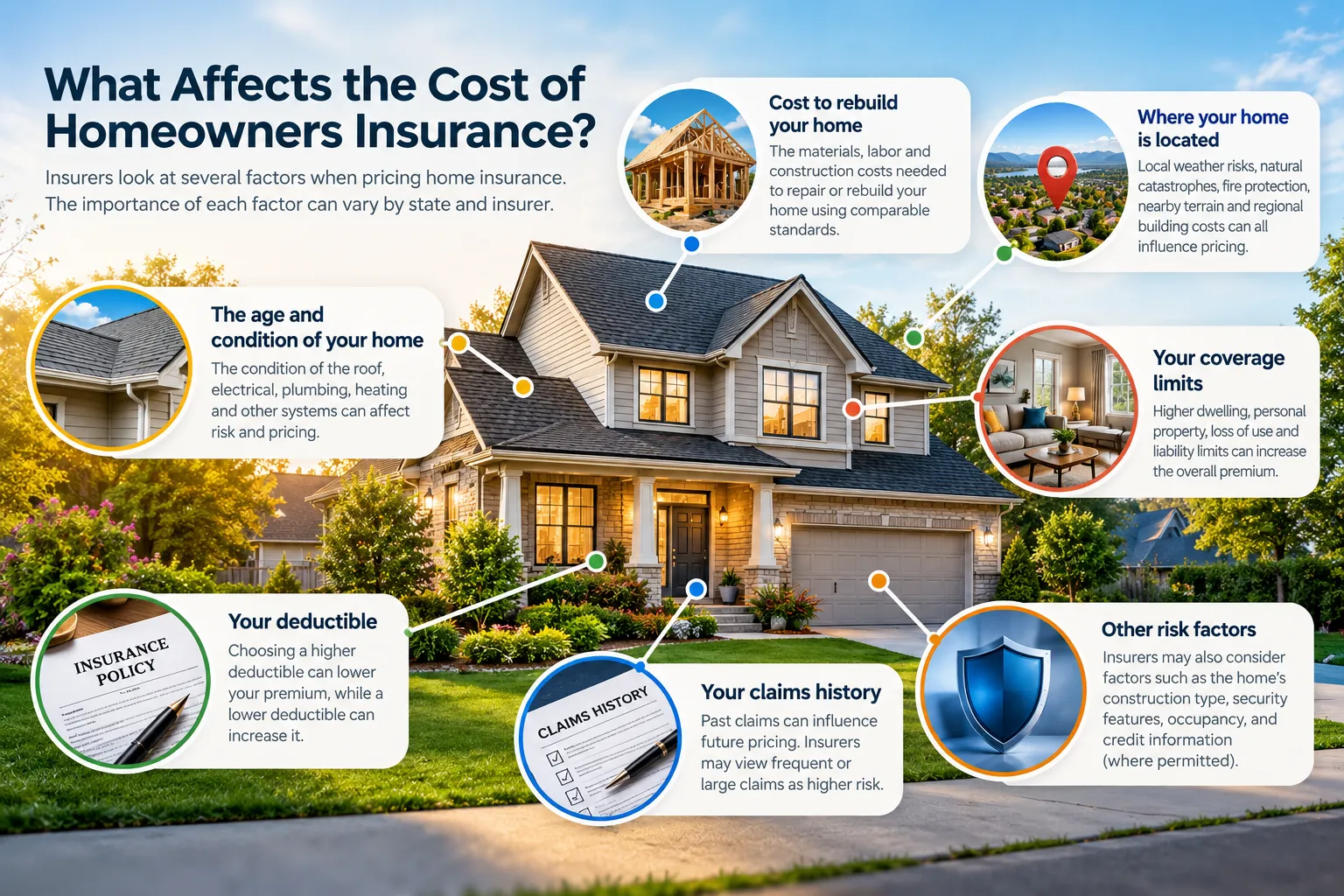
What affects the cost of homeowners insurance?
Insurers use multiple factors to evaluate the property and the coverage being requested. The rules for using those factors and the weight placed on them can differ by state and insurer.
The cost to rebuild your home
Insurers are concerned with reconstruction or replacement cost: what it may cost to repair or rebuild covered property using comparable materials and labor. That is not the same as a home’s purchase price, market value, or land value. Land is not rebuilt after a covered property loss.
Construction materials, square footage, roof and foundation characteristics, custom features, local labor, and the availability and cost of materials can influence a rebuilding estimate. A house in a lower-priced real-estate market can still be expensive to rebuild, and the reverse can also be true.
Where your home is located
Location can affect pricing or availability through local weather and catastrophe exposure, fire protection, proximity to fire services or water sources where relevant, local loss experience, and construction or rebuilding costs. The relevance of any one factor is not identical for every insurer or community.
For example, two homes of similar size can have different risk characteristics because of their distance from fire protection, nearby terrain, regional building costs, or loss patterns. A location factor is not a statement that a particular loss will happen; it is one part of an insurer’s broader rating and underwriting process.
The age and condition of the home
The age, condition, and characteristics of a home’s systems and materials may affect underwriting or pricing. Roof condition, electrical systems, plumbing, heating, and the quality of maintenance can matter in a quote. That does not mean every older home automatically costs more to insure. Updates, construction type, location, and insurer practices can lead to different outcomes.
Accurate information is important. A quote based on outdated details about a roof, renovation, or occupancy can change when the insurer reviews the property or the application.
Your coverage limits
Purchasing more insurance protection can affect premium. Dwelling coverage, personal-property coverage, loss of use, liability, and optional protections may each shape the overall price. The limits should be reviewed as part of the complete policy, not selected only because they produce the lowest premium.
Our guide to understanding what home insurance covers explains the coverage sections that a quote may include. Knowing what each section does makes it easier to compare the protection behind two prices.
Your deductible
A higher deductible can reduce premium, but it leaves the policyholder responsible for more of a covered property loss before applicable insurance payment. The premium difference should be considered alongside the amount that could be paid out of pocket after a loss.
Some policies and locations can have separate or percentage deductibles for certain risks. Read the policy’s deductible terms rather than assuming that every covered event uses the same amount or calculation.
Your claims history
Prior claims can affect underwriting or pricing, but the effect depends on the claim, insurer, state rules, and other circumstances. One claim does not automatically produce the same result for every homeowner. Insurers may also consider the claims history associated with the property or the surrounding area where permitted.
When asking for a quote, give complete and accurate claims information. An estimate based on incomplete facts is not a dependable basis for comparing insurance cost.
Credit-based insurance scores where permitted
Credit-based insurance scoring is permitted and regulated differently across states. It is not used everywhere, and state law may restrict how it can be used. An insurance score is not simply a consumer’s ordinary credit score, even though both can use information from a credit report.
If credit-based insurance information is relevant to a quote, ask the insurer what information it needs and check the rules that apply in your state. Review credit-report inaccuracies through the appropriate consumer-reporting process instead of assuming that any one change will affect an insurance premium.
Home safety and protective features
Smoke alarms, security systems, sprinklers, and certain mitigation or protective features may affect a quote or qualify for discounts. Availability, eligibility, documentation, and the price effect vary by insurer and state. A feature should be reported accurately, with any required proof, rather than assumed to create a discount.
Some improvements can also affect the insurer’s view of property condition or rebuilding risk. Ask before beginning a project if it will materially change the home, its use, or its safety systems.
Features that can change liability or property risk
Property characteristics such as a swimming pool, trampoline, certain home businesses, or other features can change the questions an insurer asks about liability or property risk. They do not automatically mean a policy will be denied, but they may affect eligibility, terms, required precautions, or premium.
Describe the property and its use accurately. Policy terms can be different for business activity, rental use, or changes that are not reflected in the application.
Optional coverage and endorsements
Adding protection beyond a base policy can affect price. Depending on the insurer and policy, examples may include scheduled personal property, water-backup protection, ordinance or law coverage, or other endorsements. Not every endorsement exists from every insurer, and the extra protection comes with its own terms and limits.
Compare the endorsement itself, not just its name. Similar labels can have different limits, deductibles, exclusions, and eligibility requirements.
Why can two similar homes have different insurance costs?
Similar homes are rarely identical for insurance purposes. Insurers can use different rating models and rebuilding estimates. The policies may also differ in deductibles, limits, endorsements, claims history, discounts, location-specific characteristics, or other legally permitted rating variables.
Comparing only the premium can therefore be misleading. Put the declarations pages or quote summaries side by side and check the dwelling basis, deductible, personal-property coverage, loss-of-use limit, liability limit, and exclusions. A cheaper policy is not automatically equivalent protection.
Does a more expensive house always cost more to insure?
Not necessarily. A higher real-estate price does not translate mechanically into the same increase in insurance cost. Market value can reflect land, location, neighborhood demand, and other factors that are not reconstruction cost. Insurance pricing is generally concerned with the covered property risk and the cost to rebuild or repair under the policy.
Two homes with very different purchase prices can have closer rebuilding estimates than expected, while similar-priced homes can have different construction and location characteristics. The policy’s dwelling limit and valuation terms are more informative than a listing price alone.
Does your mortgage affect the cost of home insurance?
A mortgage lender may require homeowners insurance and may impose coverage requirements, including how it is named on the policy. But the mortgage balance itself should not be treated as the basic formula an insurer uses to price property risk. The insurance quote is generally built around the home, coverage selected, and the insurer’s permitted rating approach.
Check both the loan documents and policy documents if a lender is involved. Lender requirements can affect what coverage you need to carry, while the insurance contract explains the coverage and price offered.
Does a higher deductible lower home insurance costs?
Generally, selecting a higher deductible can lower premium, but it increases the amount the policyholder bears when a covered property loss occurs. The tradeoff is between the ongoing policy cost and the out-of-pocket amount that could apply after a loss.
There is no single deductible that suits every homeowner. Review the deductible structure, any separate catastrophe deductible, the premium difference, and the amount you could bear before making a choice.
Why do home insurance premiums increase?
Premiums can change for several reasons, including rebuilding and construction costs, changes in expected losses, catastrophe or weather exposure, claims experience, coverage changes, property changes, and insurer or state-specific rating changes where approved or allowed. The combination matters; an increase is not always explained by one event or one household decision.
Review the renewal documents and ask the insurer what changed in the policy or rating information. Check whether the dwelling limit, deductible, discounts, endorsements, property details, or payment plan changed before deciding how to respond.
How to compare home insurance costs accurately
Use this like-for-like process when reviewing quotes:
- Compare the same dwelling or rebuilding-coverage basis.
- Compare the same deductibles.
- Compare personal-property coverage.
- Compare loss-of-use coverage.
- Compare liability limits.
- Check endorsements.
- Check exclusions.
- Check discounts and their conditions.
- Review replacement-cost versus actual-cash-value provisions where relevant.
- Compare the complete policy proposition, not just the premium.
Use the homeowners coverage guide alongside this list if a coverage term is unclear. Quotes are most useful when the underlying property information and requested protection are the same.

Ways homeowners may be able to reduce insurance costs
Homeowners may be able to investigate lower costs by comparing insurers, reviewing available discounts, considering deductible tradeoffs, checking policy information for accuracy, qualifying protective measures, reviewing coverage as circumstances change, or asking whether a bundle is offered. None of these approaches guarantees savings, and a lower premium can come with different coverage or more out-of-pocket risk.
Before changing a policy, compare equivalent terms and confirm that any new policy is active before ending an old one. Read the issued documents, not just an initial quote.
Home insurance cost checklist
- Gather the current declarations page and any renewal notice.
- Confirm the dwelling or rebuilding basis used for each quote.
- Match deductibles, limits, and endorsements before comparing premium.
- Verify home details, safety features, and occupancy information are accurate.
- Ask which discounts are available and what conditions apply.
- Review replacement-cost or actual-cash-value treatment.
- Read exclusions and water, wind, or catastrophe deductible terms.
- Confirm the insurer or agent is licensed in your state.
For additional context, visit MyCoverScope’s Home Insurance hub and United States hub.
The bottom line
There is no single price that accurately answers “how much is home insurance” for every homeowner. The premium depends on the property, location, rebuilding cost, selected coverage, deductible, insurer, and legally permitted rating factors. Compare like for like so that a lower price is evaluated alongside the protection it actually provides.