

Is homeowners insurance required by law?
Government requirements and mortgage-contract requirements are different questions. There is no single nationwide rule requiring every homeowner to buy a standard homeowners policy merely because they own a home. State or local law and specific circumstances may create additional requirements, so an absolute statement about every property is not reliable.
For many homeowners, the practical requirement comes from the loan agreement rather than a general law. A mortgage contract can require hazard or property insurance for the home securing the loan. Read the mortgage documents, policy documents, and any notices from the loan servicer to understand the requirement that applies to a particular property.
Other arrangements can also matter. A condominium association, co-op, homeowners association, lease, or local program may set separate insurance expectations, even when the owner has no conventional mortgage. Those requirements are not a substitute for reading the individual agreement. They may address a building, common property, an owner’s unit, or a particular risk differently from a standard homeowners policy.
Why do mortgage lenders require homeowners insurance?
A mortgage lender has money secured by the property. If an uninsured home is badly damaged or destroyed, the collateral securing the loan can be impaired. Lenders therefore generally require borrowers to maintain property or hazard insurance that meets the loan agreement’s requirements.
The Consumer Financial Protection Bureau explains that lenders generally require proof of homeowners insurance when a borrower has a mortgage. This requirement is aimed at protecting the lender’s interest in the property; it does not mean every policy protects against every loss. The selected policy still has limits, deductibles, covered causes of loss, and exclusions.
The lender may also need to be identified correctly in the policy records so that it receives required notices about cancellation, nonrenewal, or changes in coverage. That administrative detail does not make the lender the owner of the policy, but it can be part of complying with the loan agreement. Ask the servicer what evidence of insurance it needs if the loan has been transferred or the policy has changed.

How much home insurance can a mortgage lender require?
The mortgage documents, the lender’s requirements, and applicable rules determine the insurance that must be maintained. There is no universal formula that always equals the mortgage balance, market value, or purchase price. Property coverage is often connected to rebuilding and hazard-insurance considerations, while market value can include land and location.
Check the loan agreement and any servicing notices for the coverage the lender expects. For the factors that can influence a policy’s price and rebuilding basis, see our guide to home insurance cost. That article explains why the value of a home in a real-estate transaction is not automatically the insurance reconstruction figure.
The loan agreement may also address deductibles, special hazards, proof of renewal, or the timing for sending documents to the servicer. A borrower can compare policies, but a lower-priced policy that does not meet the loan terms may not satisfy the contract. If a requirement is unclear, request an explanation from the servicer and review the exact loan language rather than relying on a general rule.
What happens if your homeowners insurance lapses?
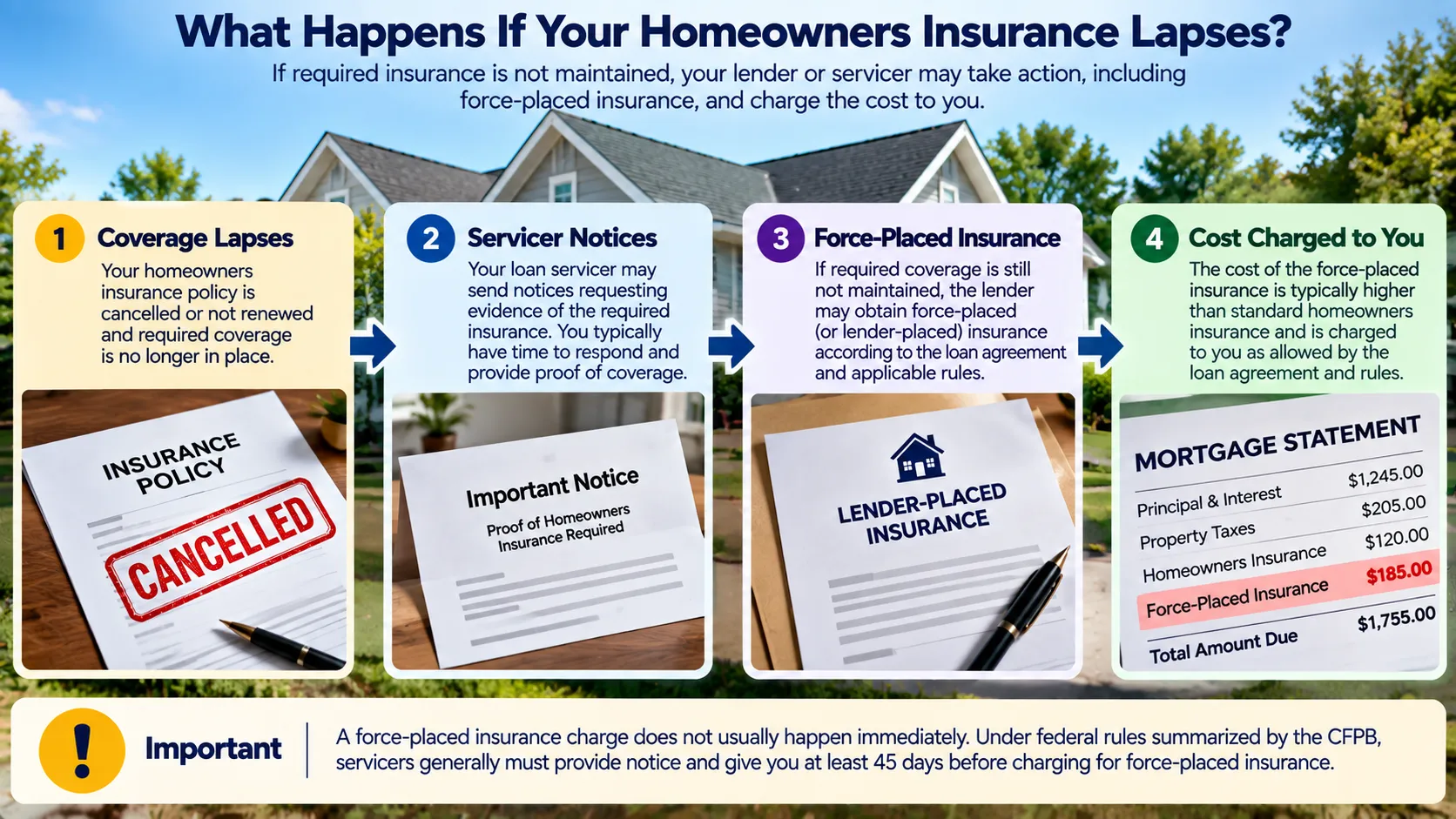
A lapse may put the borrower out of compliance with the mortgage contract. The servicer may request evidence that the required insurance is in place. If adequate required coverage is not maintained, the lender or servicer may obtain force-placed or lender-placed insurance under the loan agreement and applicable rules, then charge the borrower.
This does not necessarily happen the moment a payment is missed or a policy ends. Federal servicing rules require procedures before a servicer charges a borrower for force-placed insurance. Read any notice promptly, confirm the stated effective date, and provide evidence of qualifying insurance if you have it.
A perceived lapse can sometimes be an information problem rather than a true absence of insurance—for example, if the servicer has not received updated declarations information. Keep a copy of the policy declarations page, renewal notice, payment confirmation, and the servicer’s correspondence. If you believe the servicer’s insurance records are incorrect, use the contact information and process listed in its notice or periodic statement.
What is force-placed insurance?
Force-placed, or lender-placed, insurance is hazard insurance a mortgage lender or servicer obtains when the borrower’s required property insurance is absent or considered insufficient under the mortgage requirements. It is primarily intended to protect the lender’s interest in the property.
The CFPB says force-placed insurance is usually more expensive than coverage purchased by the homeowner and generally protects only the lender, not the homeowner. It may provide less protection to the homeowner than a homeowners policy they select themselves; the actual scope depends on the policy. It should not be assumed to provide zero homeowner protection or to match a regular homeowners policy.
Under Regulation X, a servicer must have a reasonable basis to believe the borrower failed to maintain the required hazard insurance before assessing a force-placed charge. The rule requires written notice at least 45 days before a charge and a reminder notice before charging, subject to the regulation and applicable law. This is a high-level summary, not legal advice about an individual loan or notice.
The notices are intended to give a borrower an opportunity to provide evidence of qualifying coverage. Regulation X also describes information a servicer may request, such as a declarations page, certificate, policy, or similar written confirmation. A borrower who receives a notice should compare the requested coverage with the policy they have and respond through the method the servicer identifies.
Can you own a home without homeowners insurance?
If there is no mortgage or other contractual requirement, a homeowner may be able to own the property without a homeowners policy, subject to applicable law and circumstances. “May not be contractually required” is not the same as “financially protected.”
Without insurance, the owner generally bears losses that a policy might otherwise address, such as repair or rebuilding costs after certain events, loss of belongings, qualifying temporary living costs, or liability claims. That does not mean a homeowners policy covers every catastrophe or expense. It means the owner must understand which risks remain self-borne without a policy.
Do you need homeowners insurance after paying off your mortgage?
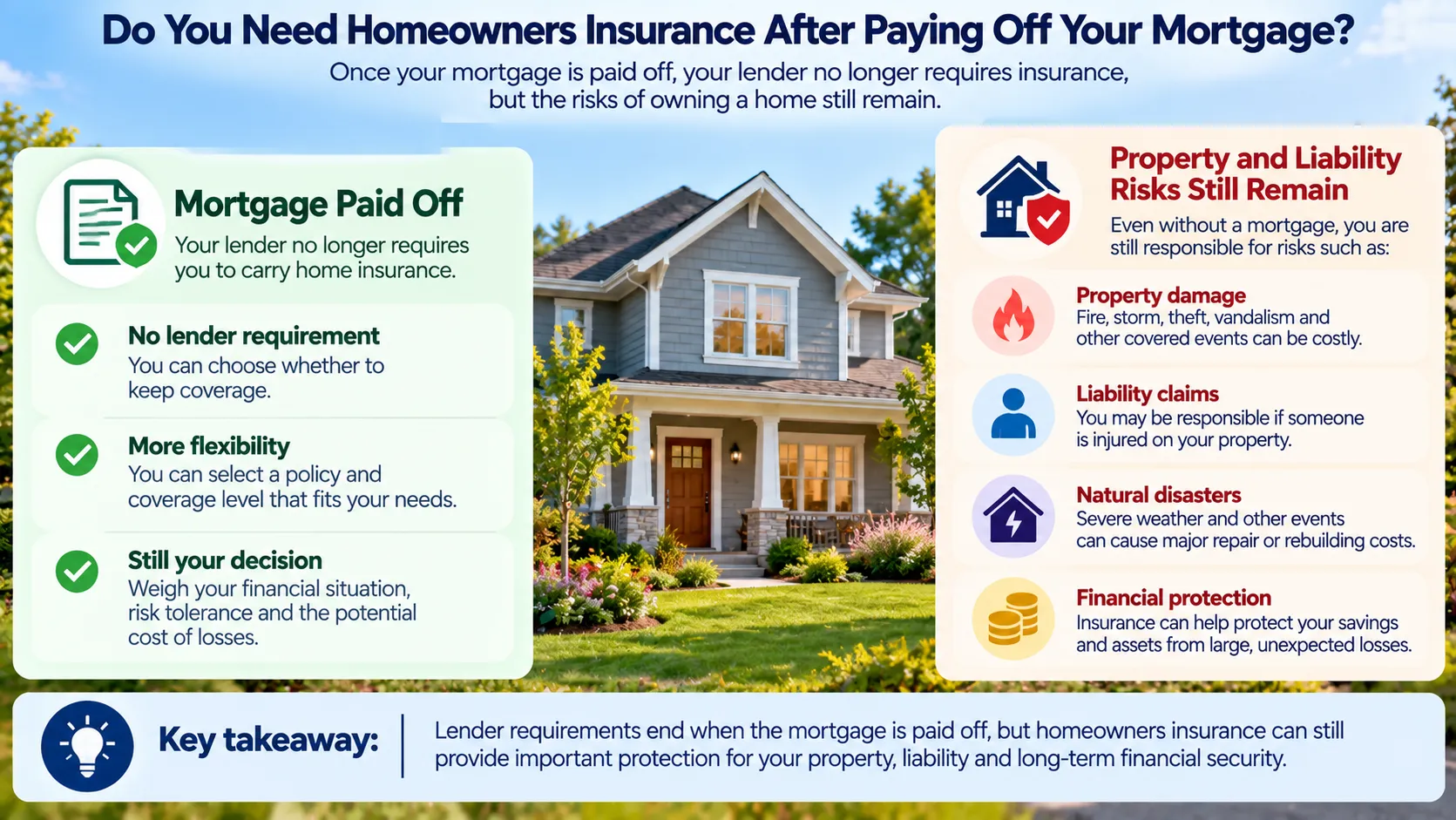
Once a mortgage is fully satisfied, the former lender’s contractual insurance requirement generally ends. Property and liability risks do not disappear with the loan. Fire, theft, certain storm losses, personal property loss, liability, and additional living expenses can still create substantial expenses, depending on the event and any policy terms.
For an overview of the protection a homeowners policy may provide, see our guide to what home insurance covers. It is important not to read that coverage list as a guarantee: the actual contract determines whether a particular loss is covered.
What are the risks of owning a home without insurance?
An uninsured owner may need to absorb repair or rebuilding costs, loss of belongings, temporary living costs, and personal liability exposure from their own resources. A homeowners policy may also provide legal-defense protection for some covered liability claims, but the policy terms determine when that applies.
The practical financial impact can depend on the home, the loss, other available resources, and whether a claim would have fit the coverage purchased. Insurance is not a substitute for maintenance, and it does not cover every possible event. The point is to distinguish being free of a lender requirement from being free of property and liability risk.
Separate risks can require separate coverage or may remain excluded even when a homeowners policy is in force. Flood, earthquake, water backup, business use, and high-value property are examples of topics that can call for closer review depending on the policy and situation. Going without a homeowners policy does not remove those exposures; it changes who would bear the cost if they occur.
Does homeowners insurance cover your mortgage?
Homeowners insurance protects against covered property and liability losses. It is not the same as mortgage insurance. Mortgage insurance generally protects the lender against certain borrower-default risk; it does not replace a homeowners policy for damage to the home.
The names can be confusing because both products may appear in housing-related paperwork. Review the loan documents and insurance declarations page separately to see what each payment and coverage actually represents.
Is homeowners insurance included in your mortgage payment?
Many homeowners pay insurance premiums through a mortgage escrow account. The monthly mortgage payment may include an amount collected for insurance, and the lender or servicer pays the insurance bill from that escrow account when due. The homeowners policy remains a separate insurance contract.
Escrow arrangements vary. Some loans do not have an escrow account, and some borrowers pay the insurer directly. Check the loan statement, escrow analysis, and policy renewal notice rather than assuming that an insurance payment has been made because the mortgage payment was sent.
Can your lender choose your homeowners insurance company?
Borrowers commonly shop for their own homeowners policy, provided it satisfies applicable mortgage requirements. The lender may require proof of coverage, certain information on the declarations page, or particular hazard-insurance terms under the loan agreement. It does not follow that every lender can select any insurer or policy for every borrower.
If required coverage is not maintained, lender-placed insurance can become relevant. That is another reason to provide the servicer prompt proof of qualifying replacement insurance when a policy changes.
What if your insurer cancels or doesn’t renew your policy?
Read the notice and determine the effective date. Contact the insurer or agent if clarification is needed, begin shopping before coverage ends, understand the lender requirements, and provide proof of replacement coverage to the mortgage servicer. These steps can help avoid an unintended coverage gap, but they do not guarantee replacement coverage will be available.
Keep the cancellation or nonrenewal notice, the current declarations page, quote information, and the new policy documents. If a servicer’s records appear wrong, follow the contact or error-resolution process shown on its statement or notice.
Home insurance requirement checklist
- Do you have a mortgage?
- What does the mortgage contract require?
- What property coverage must be maintained?
- Does the lender require proof of insurance?
- Is insurance paid through escrow?
- When does the current policy renew?
- Do lender records show the correct policy?
- Are there additional hazards requiring separate coverage?
- What happens under the loan contract if coverage lapses?
- If mortgage-free, what losses would you have to absorb yourself?
For broader education, visit MyCoverScope’s Home Insurance hub and United States hub.
The bottom line
Owning a home does not create one universal nationwide requirement to buy a standard homeowners policy. But homeowners with mortgages typically have contractual insurance requirements imposed by their lenders. Mortgage-free homeowners may not face that lender requirement, but they still bear the financial consequences of uninsured property and liability losses. Actual requirements depend on the mortgage contract, applicable law, and the property.