
When does home insurance cover mold?
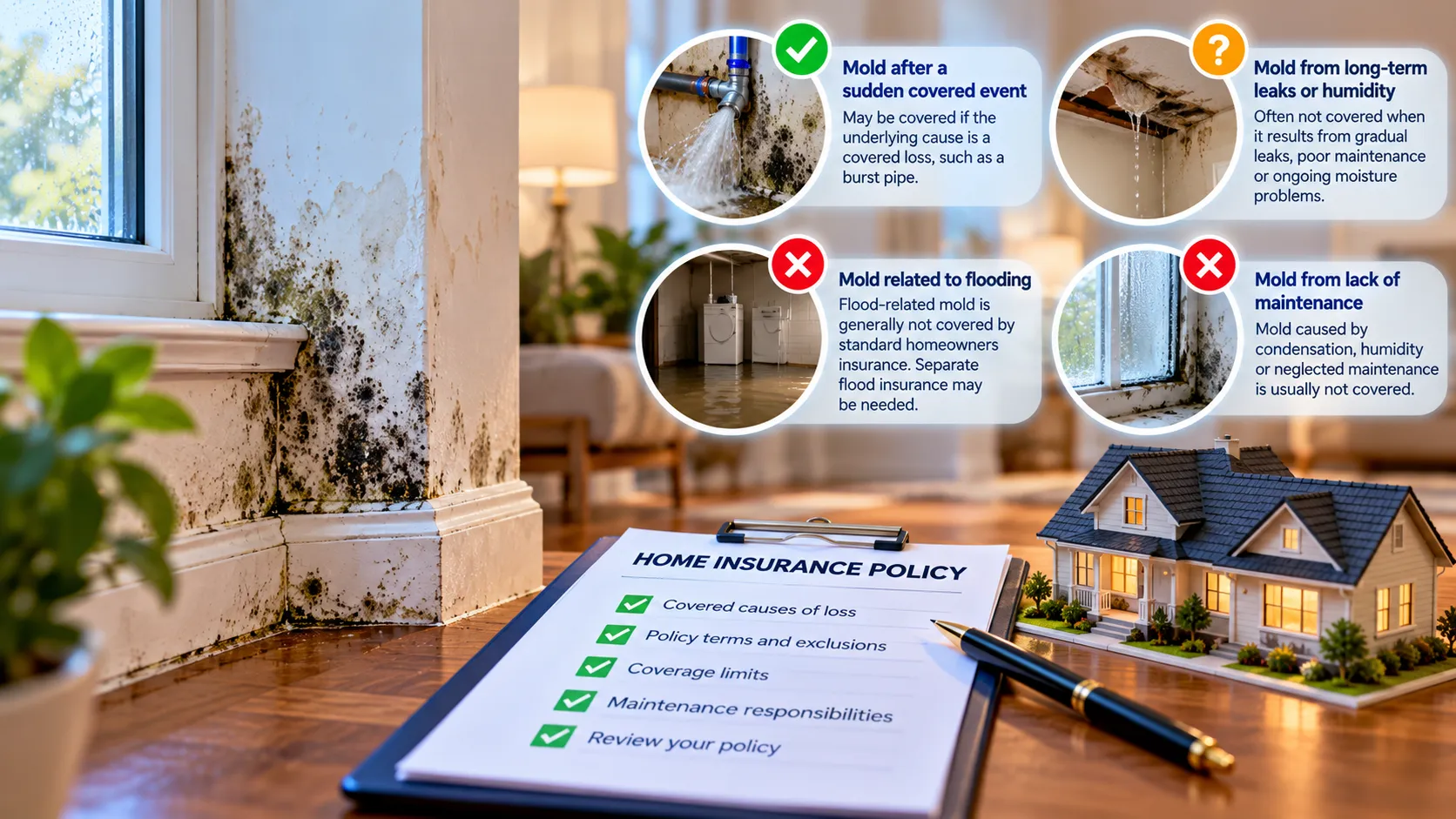
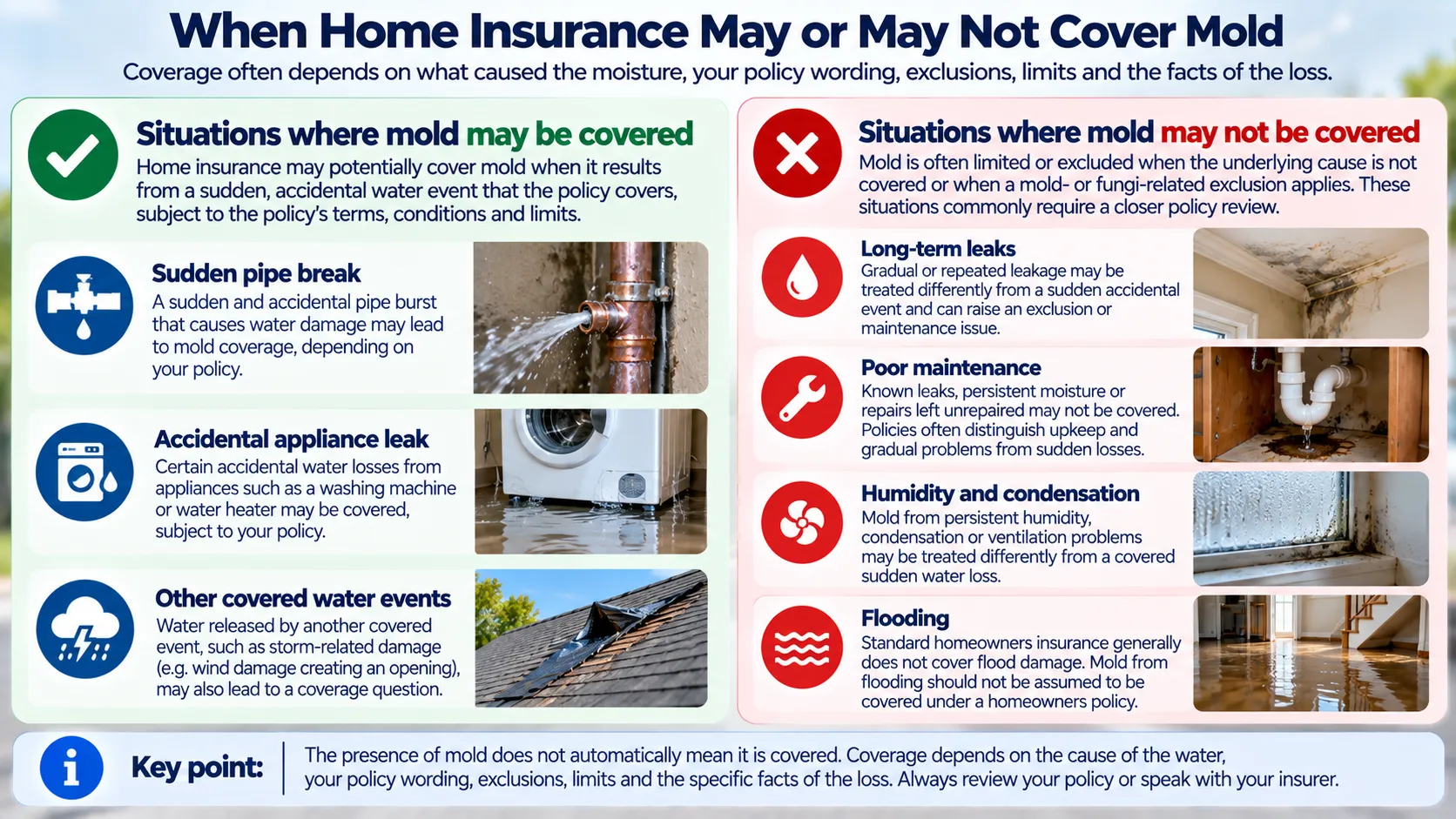
The important question is often not simply whether mold exists, but what caused the moisture or damage that led to it and what the policy says about that cause and resulting loss. Homeowners insurance may potentially respond when mold follows a sudden, accidental water loss that the policy covers, subject to the policy’s conditions and limits.
For example, a sudden accidental pipe break, certain accidental appliance-related water losses, or water released by another covered event could lead to a coverage question. These examples are not universally covered. The cause of the water, the policy form, exclusions, the timing of discovery, and steps taken to limit further damage can all affect the result. Remediation and resulting damage may also be subject to specific limits.
When might mold not be covered?
Mold can be unavailable or limited when the underlying cause is not covered or when a mold- or fungi-related exclusion applies. The wording in a particular contract matters, but the following situations commonly require a closer policy review.
Long-term leaks
Gradual or repeated leakage can be treated differently from a sudden accidental water event. A stain, damp cabinet, or slow plumbing problem that develops over time may raise an exclusion or maintenance issue even if mold is discovered later. There is no single time period that makes a leak “long-term” for every policy; the policy language and facts matter.
The source of water may not be obvious when mold is found. A policyholder may need to distinguish between a one-time accidental discharge and moisture that was entering repeatedly through a pipe, appliance connection, roof, wall, or foundation area. An insurer’s inspection can consider the observed condition, repair history, and other information alongside the policy language.
Poor maintenance or neglected moisture problems
Homeowners insurance generally should not be treated as a maintenance contract. Known leaking plumbing left unrepaired, persistent moisture, or deterioration that continues can be evaluated differently from unexpected damage. This is not a judgment about the homeowner; it is a reminder that policies often distinguish upkeep and gradual problems from covered accidental losses.
Regular maintenance does not decide every claim, and a maintenance issue does not answer every coverage question by itself. It does, however, make it especially important to read the relevant exclusions and report the actual condition of the home accurately. If a policy uses terms such as neglect, deterioration, seepage, or repeated leakage, ask what the term means in that policy rather than relying on a general description.
Humidity and condensation
Mold arising gradually from persistent humidity, condensation, or ventilation problems may be treated differently from mold that follows a covered sudden loss. The source of the moisture, how long it existed, and the policy’s exclusions can be important. Do not assume that indoor moisture is handled the same way as a burst pipe or storm-related water intrusion.
Flooding
Standard homeowners insurance generally does not cover flood damage. Mold resulting from flooding therefore should not be assumed to be covered under the homeowners policy. Flood insurance is separate; FEMA explains that most homeowners and renters policies do not cover flood damage. The coverage and exclusions in a separate flood policy are also a distinct question.
Does homeowners insurance cover mold from a burst pipe?
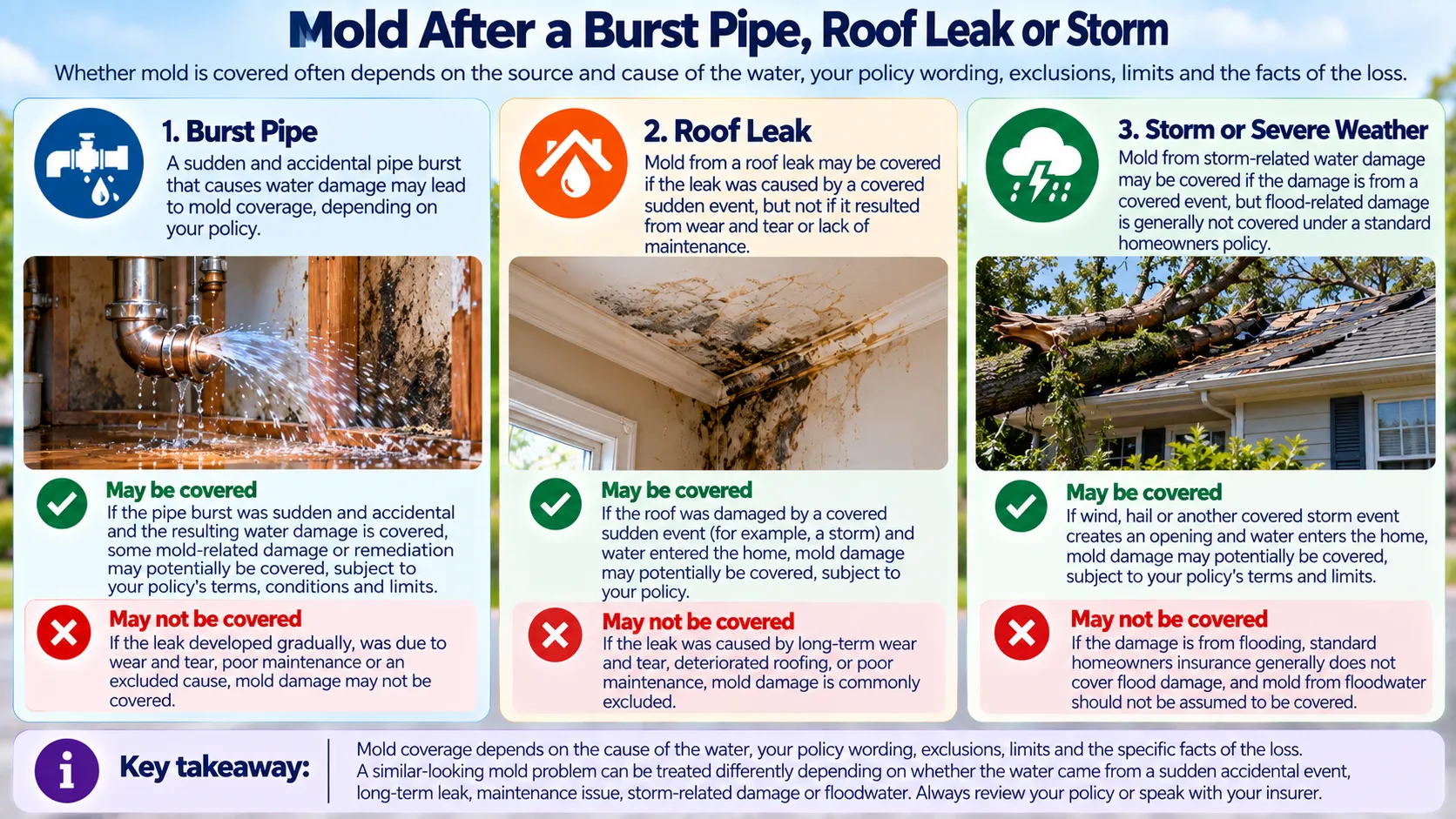
If a pipe suddenly and accidentally bursts and the resulting water damage is covered, some mold-related damage or remediation may potentially be covered, subject to the policy. California’s Department of Insurance notes that mold damage caused by a covered peril may be covered, but directs consumers to check with the insurer about what their policy covers.
That is not a promise of payment. Coverage can depend on the policy wording, why the pipe failed, timing, reasonable efforts to prevent further damage where safe, exclusions, mold or fungi limitations, and applicable limits. Prompt reporting and the policy’s duties after a loss can also matter.
For instance, a policy may treat the resulting water damage differently from the failed pipe or appliance component itself. A covered consequence of an event and the cost to repair the underlying item are not always handled in the same way. The insurer’s claim decision and estimate should identify the basis for each part of the loss.
Does home insurance cover mold from a leaking roof?
This depends on both why the roof leaked and how the policy treats the resulting damage. A sudden covered roof event followed by water intrusion may be evaluated differently from long-term deterioration or an unrepaired recurring leak. Wind or another event being involved does not alone answer the coverage question.
Review the cause of the roof damage, the water-damage provisions, maintenance-related exclusions, and any mold limitation. Keep records of the event and communication with the insurer, but do not assume a roof leak or mold finding establishes coverage on its own.
Does home insurance cover mold after a storm?
If a covered storm event damages the home and water enters, the treatment of resulting mold depends on the policy terms and the facts. The policy may distinguish between wind-driven rain through a covered opening, floodwater, pre-existing conditions, and other sources of moisture.
Not every storm or water damage event is covered. Contact the insurer promptly after a potentially covered loss, follow its inspection and documentation instructions, and review the applicable deductible and exclusions.
If water came from outside the home, identify as clearly as possible whether it was floodwater, rain entering after damage, surface water, a backed-up drain, or another source. Those descriptions can have different meanings under a homeowners policy and any separate flood or water-backup coverage. Do not change or discard relevant evidence before the insurer has had a reasonable opportunity to inspect, unless safety requires immediate action.
Does home insurance cover mold removal?
Mold remediation should not automatically be treated as unlimited coverage. Remediation generally means identifying, containing, and removing mold and addressing affected materials. A policy may limit fungi- or mold-related coverage, exclude certain situations, provide additional coverage through an endorsement, or impose separate limits and conditions.
The scope of covered work, if any, comes from the policy and the covered cause of loss. This guide cannot determine whether a particular assessment, removal method, contractor charge, or repair will be paid. When health or safety concerns exist, use qualified professional help where appropriate and avoid entering an unsafe area.
Are there limits on mold coverage?
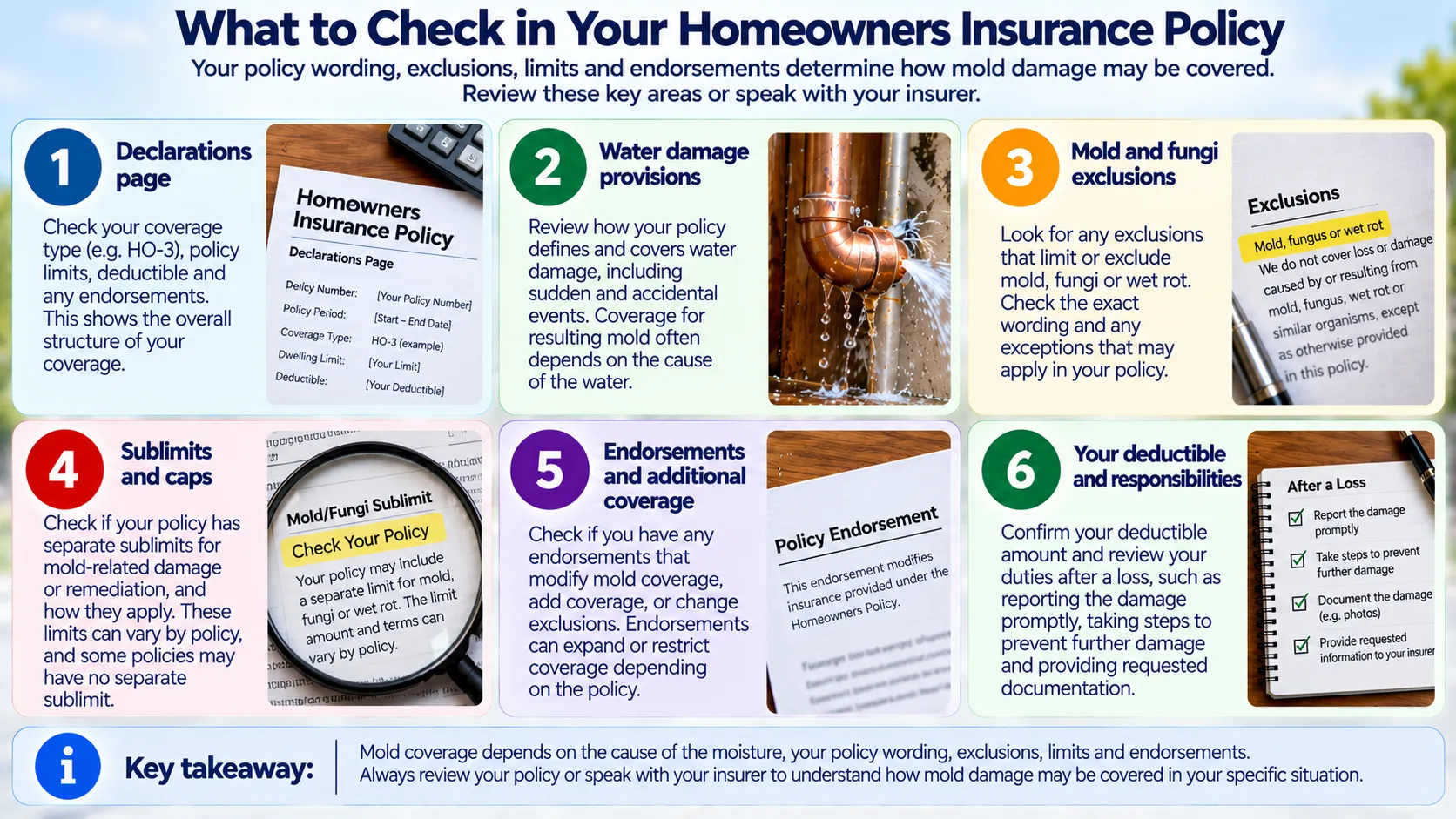
Even where a mold-related loss is covered, the amount payable may be limited. The policy can contain overall coverage limits, mold or fungi sublimits, deductibles, exclusions, remediation provisions, and endorsements that change the result. A limit for the dwelling is not necessarily the only relevant figure.
An additional-coverage provision may have its own conditions, while an endorsement can broaden, limit, replace, or clarify the base policy wording. The deductible may apply to the underlying covered water loss, and a separate provision may describe how mold-related expenses fit into the claim. These details are policy-specific, so avoid assuming that a sublimit found in one quote appears in another.
Inspect the declarations page, the base policy, and all endorsements. Look for defined terms such as “fungi,” “wet rot,” or “microbes,” along with any additional-coverage or exclusion section. If the wording is unclear, ask the insurer or a licensed professional to explain how the relevant provisions work together.
What should you check in your homeowners policy?
Use this plain-English review process:
- Find the covered causes of loss or perils.
- Read the water-damage provisions.
- Check for repeated or continuous leakage exclusions.
- Find mold or fungi definitions.
- Read mold or fungi exclusions.
- Check additional-coverage provisions.
- Identify mold or fungi sublimits.
- Review endorsements.
- Confirm the deductible.
- Read the duties after a loss.
The declarations page helps identify limits and endorsements, but it does not replace the full contract. Save the policy, photos, receipts, and written communications in a place you can access if a loss occurs.
What should you do if you discover mold after water damage?
First address urgent safety issues and do not enter an area that appears unsafe. Where it is safe to do so, take reasonable steps to prevent additional damage, document visible damage, and preserve relevant records and receipts. Review the policy and contact the insurer promptly when a potentially covered loss occurred.
Follow the insurer’s instructions about inspection and documentation. A qualified professional assessment or remediation may be appropriate depending on the situation, but do not assume those costs will be reimbursed. The California Department of Insurance advises consumers to protect property after a loss without risking their safety and to report the damage to the insurer.
Keep a simple timeline of when the water event or mold was first noticed, the steps taken, who was contacted, and any instructions received. Photos, repair invoices, receipts for reasonable protective measures, and correspondence can help document the condition, but they do not determine coverage by themselves. Avoid making permanent repairs beyond what is necessary for safety or to prevent further damage until the insurer has advised you or inspected the loss.
Can a mold claim affect future insurance?
Claims history can be one factor insurers may consider in underwriting or rating where permitted. The effect of any particular claim varies by insurer, state, claim circumstances, and applicable law. A claim involving water or mold does not produce one universal premium or eligibility result.
Do not avoid reporting a legitimate potentially covered loss solely because of a general assumption about future insurance. Review the policy, consider the facts, and ask the insurer what information it needs to evaluate a claim.
How mold coverage fits into homeowners insurance
Mold is one example of why homeowners insurance cannot be understood simply as “damage to the house equals covered.” The cause of loss, exclusions, policy conditions, limits, and endorsements matter. For the broader structure of a policy, see our homeowners coverage guide.
An endorsement or additional mold-related protection, when available, can affect the policy’s price and terms. Our guide to home insurance cost factors explains why equivalent coverage is important when comparing premiums.
Mold insurance coverage checklist
- What caused the moisture?
- Was the event sudden or gradual?
- Is the underlying cause covered?
- Does the policy contain a mold or fungi exclusion?
- Is there limited mold coverage?
- Is there an endorsement?
- What limit applies?
- What deductible applies?
- What documentation is available?
- What duties after loss apply?
The bottom line
Home insurance can cover some mold-related losses, particularly when mold results from a covered sudden event, but coverage is highly dependent on the cause and policy wording. Long-term moisture, maintenance-related problems, and flood-related mold should not automatically be expected to fall under standard homeowners coverage. The policy and circumstances determine the actual result.