
Does renters insurance cover fire?
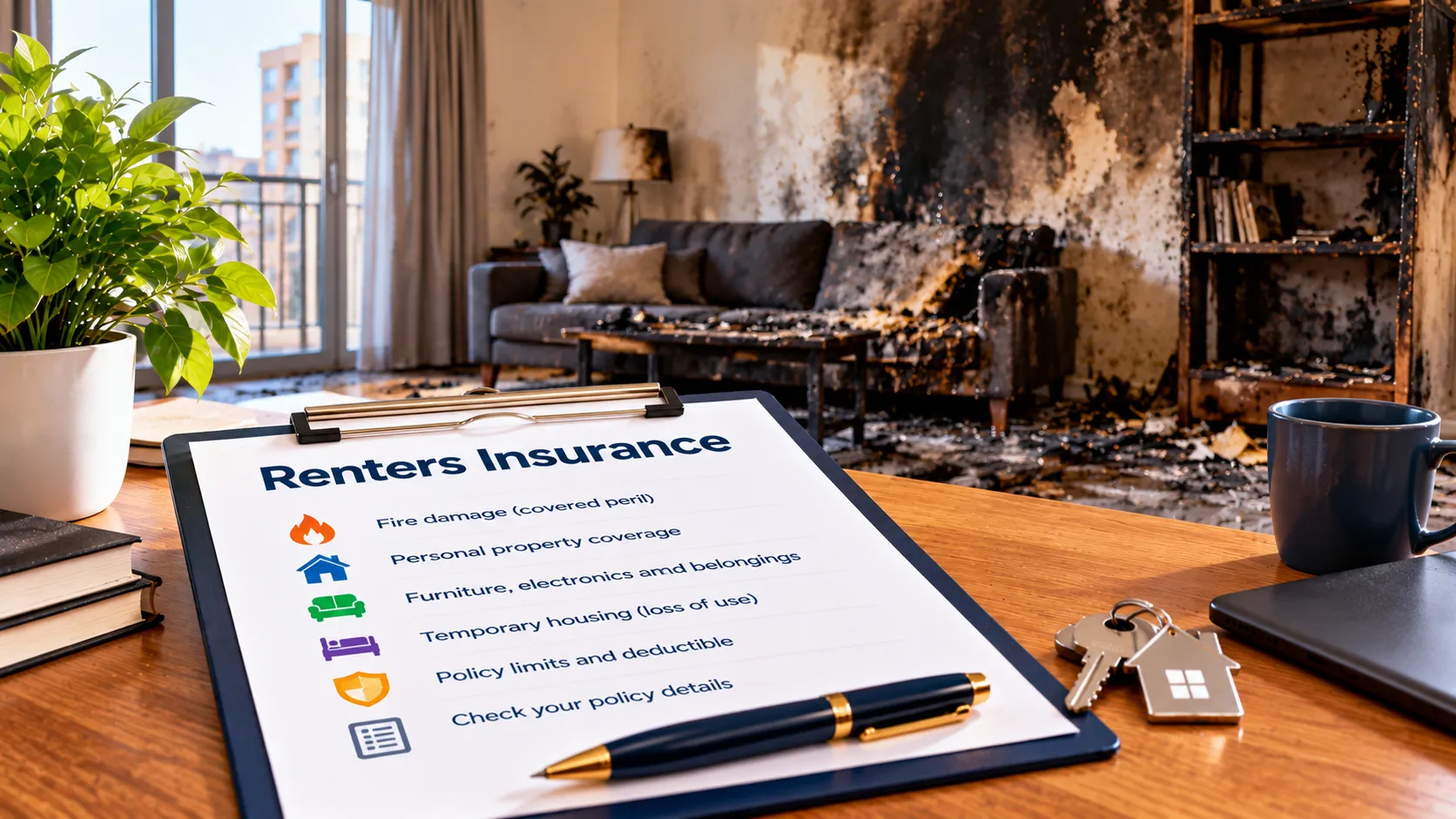
Renters insurance generally covers insured personal belongings damaged or destroyed by fire when fire is a covered peril under the policy. NAIC consumer guidance identifies fire among typical covered events under a broad-form renters policy, and California’s residential guide lists fire among generally covered perils. Those sources provide general context; the actual policy controls a particular claim.
Coverage can depend on the policy form, exclusions, limits, deductible, valuation method and proof of loss. A fire claim is not just about the event: it also requires identifying what was damaged and which part of the renters policy may apply.
What does renters insurance cover after a fire?
Several coverage components can be relevant. Personal-property coverage may help repair or replace covered belongings damaged by fire. Loss of use may help with qualifying additional living expenses if a covered fire makes the rental uninhabitable. Personal liability may become relevant if the insured is legally responsible for injury or damage to someone else’s property, subject to policy terms and exclusions.
Liability does not automatically apply merely because a fire occurred. For a broader explanation of these policy components, see what renters insurance can cover.
What belongings can renters insurance cover after a fire?
Covered personal property can include clothing, furniture, electronics, kitchen items, books, household goods and other personal possessions. The policy limit, exclusions, special limits for certain categories and proof of ownership all matter. A policy does not promise coverage for every item simply because it was in a rental during a fire.
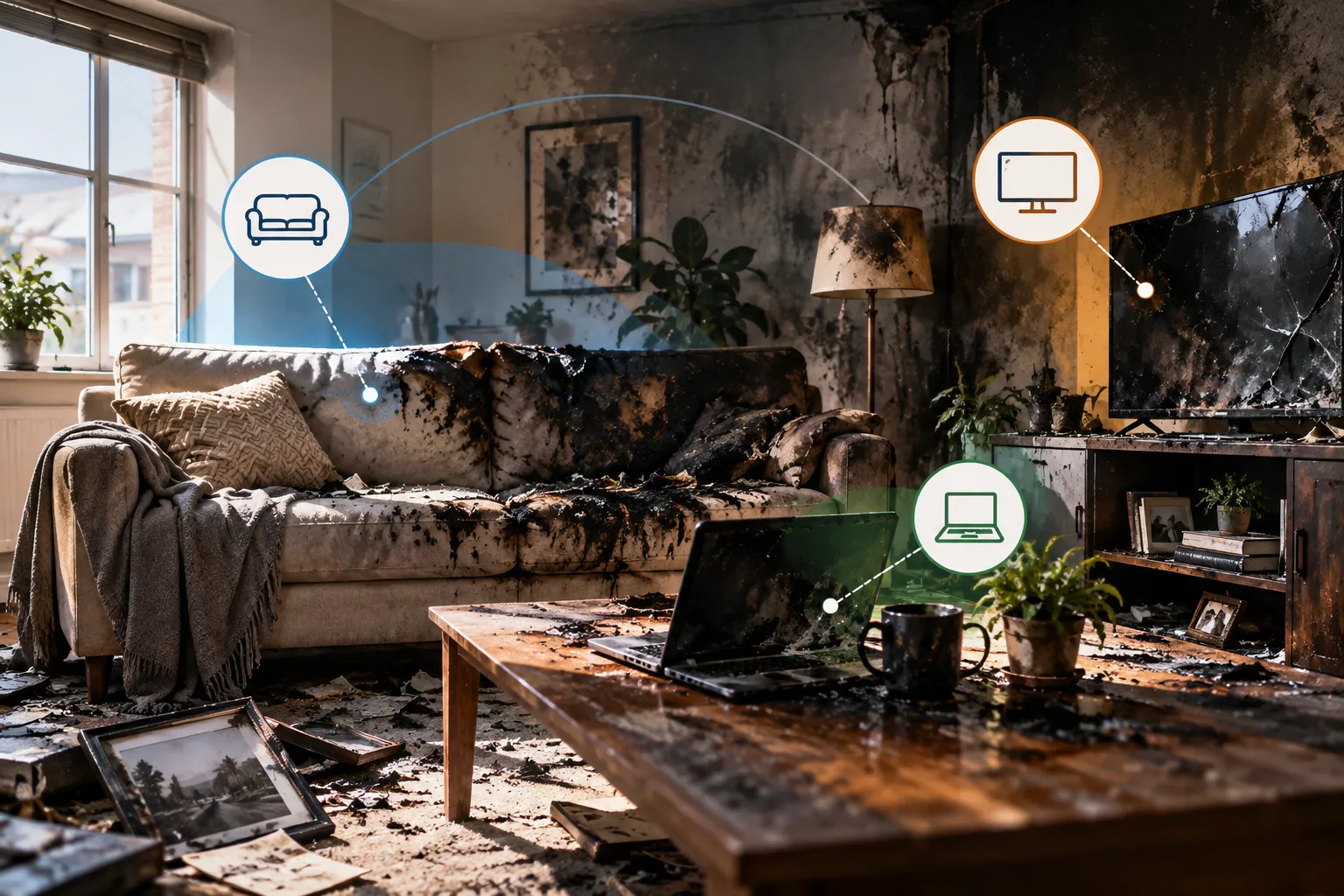
High-value categories can have separate limits, and an item may need additional coverage or scheduling. Make a room-by-room list after a loss and distinguish belongings you own from property that belongs to the landlord or another person.
Does renters insurance cover smoke and soot damage?
It may. NAIC consumer guidance describes a typical policy as addressing property damaged by flames, smoke, soot and ash. Belongings can be affected even when flames never directly touch them: smoke contamination, soot deposits, ash and heat-related damage may still need review.
That does not promise cleaning, repair or replacement for every item. The nature of damage, property involved, policy terms and claim assessment influence the outcome. Avoid discarding damaged property until the insurer advises whether it needs inspection, unless safety requires it.
Does renters insurance cover the apartment building after a fire?
Generally, no. Renters insurance protects the renter’s insured interests rather than the landlord’s building structure. The landlord or property owner’s insurance generally addresses the building itself, but that does not mean it necessarily pays every structural fire claim.
A single apartment fire can involve separate questions: the renter’s belongings may be considered under the renter’s policy; building damage may involve the owner’s policy; and liability can depend on responsibility and applicable coverage. Keeping those interests separate helps avoid assuming one policy replaces another.
What if the fire started in another apartment?
Damage to the renter’s insured belongings may still be considered under the renter’s own policy even when the fire started elsewhere. The renter should not assume they must first prove another tenant was negligent before reporting their own covered-property loss.
Any recovery or subrogation discussion between insurers is separate from the basic question of whether the renter’s policy responds. Report the loss promptly and let the insurer review the relevant facts and policy terms.
What if you accidentally start the fire?
Personal-property coverage and liability are separate questions. The policy’s property coverage and exclusions determine whether the renter’s belongings are covered. Personal liability may become relevant if the renter is legally responsible for damage to someone else’s property or injuries.
The circumstances, exclusions and policy language matter. Intentional losses can be treated differently from accidental losses, and this guide does not decide negligence, criminal conduct, landlord recovery rights or a particular claim outcome.
Does renters insurance cover a kitchen fire?
The room where the fire starts is generally not the core coverage question. A kitchen fire can damage furniture, electronics, clothing, kitchen belongings and other covered personal property. Coverage depends on the policy terms, circumstances, damaged property, limits and deductible.
Does renters insurance cover electrical fires?
The same principle applies to an electrical fire. Fire is commonly a covered peril, but not every loss is automatic. The cause, circumstances, exclusions, property damaged and policy provisions must be considered. This guide does not provide electrical-safety advice or determine the source of a particular fire.
Does renters insurance cover wildfire damage?
Fire damage from a wildfire may fall within fire coverage, subject to the policy. If evacuation occurs without physical damage, civil-authority or evacuation coverage can depend heavily on policy wording and state rules. Do not assume California wildfire protections or another state’s rules apply nationwide.
Does renters insurance pay for a hotel after a fire?
If a covered fire makes the insured rental uninhabitable, loss-of-use or additional-living-expense coverage may help with qualifying temporary housing and additional living expenses. For the covered-loss, approval, limits and receipts questions, read whether renters insurance can cover hotel stays.

How much will renters insurance pay for fire-damaged belongings?
There is no generic payment amount. It depends on the personal-property limit, special limits or sublimits, deductible, covered amount of loss, valuation method, proof and other policy conditions. The declarations page shows selected limits, while the policy explains how those limits apply.
Actual cash value vs replacement cost after a fire
Actual cash value generally reflects depreciation or current value according to policy terms. Replacement-cost coverage generally bases covered reimbursement on replacing property with comparable new property, subject to policy procedures and limits. NAIC renters guidance uses this distinction when explaining claim settlement choices.
Replacement-cost coverage does not mean unlimited reimbursement, and some policies require particular claim steps before the full replacement amount is paid. Check the declarations page and policy wording rather than assuming the valuation basis.
Does the deductible apply to a fire claim?
Property claims can be subject to the policy deductible. The deductible is the portion of a covered property loss the insured is responsible for before applicable insurance payment, subject to the policy terms. There is no standard renters deductible, so check the declarations page and ask how it applies to the reported loss.
What if expensive belongings are damaged in the fire?
Special limits can apply to jewelry, art, collectibles, certain electronics and other high-value property depending on the policy. Scheduled property, riders, floaters or endorsements may provide additional coverage where available. The category, proof of value and policy language matter; sublimits are not identical across all insurers.
How do you prove what you owned after a fire?
Insurers can request documentation of damaged or lost property. A home inventory, photographs or videos, receipts, purchase records, serial numbers, bank or card records, manuals and other reasonable ownership evidence can help. The NAIC recommends maintaining an inventory and preserving images, descriptions and serial numbers.

The absence of one receipt does not by itself determine a claim. Gather the evidence reasonably available, make a detailed inventory and ask the insurer what documentation is needed before disposing of property where safe to retain it.
Organize the inventory by room and describe each item as specifically as possible. A photograph can show condition or ownership, while a serial number, statement or retailer record can help identify an item and its age. Keep copies of every document sent to the insurer and note when damage was first observed. This information helps the insurer evaluate the claim, but does not replace the policy requirements or guarantee payment.
If belongings were already documented before the fire, provide that inventory with any post-loss photographs when requested. If records were lost in the fire, explain that fact and reconstruct a list from available records, accounts and memory. Avoid guessing at values; identify estimates clearly and ask how the insurer wants uncertain items documented.
What should you do after a fire in your rental?
- Follow emergency and fire-authority instructions.
- Do not re-enter an unsafe building.
- Notify the landlord or property manager.
- Contact the renters insurer promptly.
- Ask about personal-property and loss-of-use coverage.
- Photograph or video damage only when authorities say it is safe.
- Create an inventory of damaged belongings.
- Preserve receipts and ownership records.
- Keep receipts for qualifying additional living expenses.
- Follow insurer instructions for protecting property from further loss where safe and reasonable.
- Keep a record of claim communications.
Questions to ask your insurer after a fire
- Is fire a covered peril under my policy?
- What personal-property limit applies?
- What deductible applies?
- Do I have actual cash value or replacement-cost coverage?
- Are any damaged items subject to special limits?
- What documentation do you need?
- Should damaged property be retained for inspection?
- Does loss-of-use coverage apply?
- What temporary-housing expenses can qualify?
- Are there deadlines or claim procedures I should know about?
Fire coverage examples
These illustrations are not claim decisions:
- Apartment fire damages furniture and clothing: Personal-property coverage may apply subject to policy terms, limits and deductible.
- A neighboring-unit fire creates smoke damage: The renter’s policy may still be relevant to covered smoke or fire damage.
- A covered fire makes the apartment uninhabitable: Loss-of-use coverage may help with qualifying additional living expenses.
- Fire damages the building itself: Renters insurance generally does not insure the landlord’s structure.
- A renter is alleged to have accidentally caused damage to another person’s property: Liability coverage may become relevant depending on the circumstances and policy terms.
The bottom line
Renters insurance generally covers insured personal belongings damaged or destroyed by fire when fire is a covered peril under the policy. It may also address smoke or soot damage and qualifying additional living expenses when the rental becomes uninhabitable. Renters insurance generally does not insure the landlord’s building. Payment depends on policy wording, limits, deductible, valuation method, exclusions, documentation and the circumstances of the loss.
After a fire, reporting promptly and preserving claim information can help establish what happened and what property was affected. Those steps are not a coverage decision: the insurer applies the actual policy to the facts of the loss.