
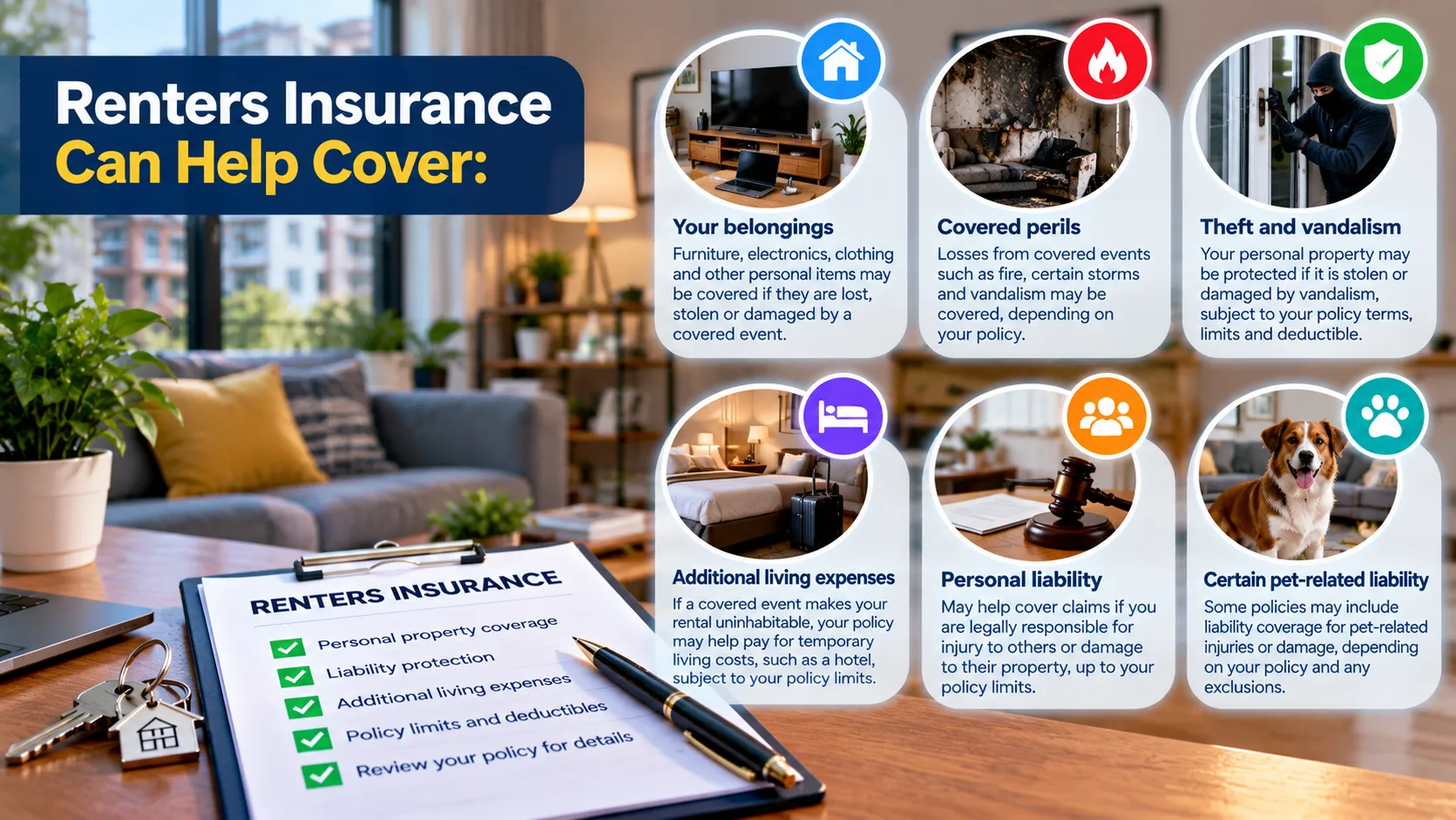
Renters insurance is designed for people who rent an apartment, house, condo or room. It can help with losses involving your belongings and with certain liability expenses, but its protection is defined by the policy you buy. This guide explains the common building blocks, the limits that can apply and the questions to ask before relying on coverage.
What is renters insurance?
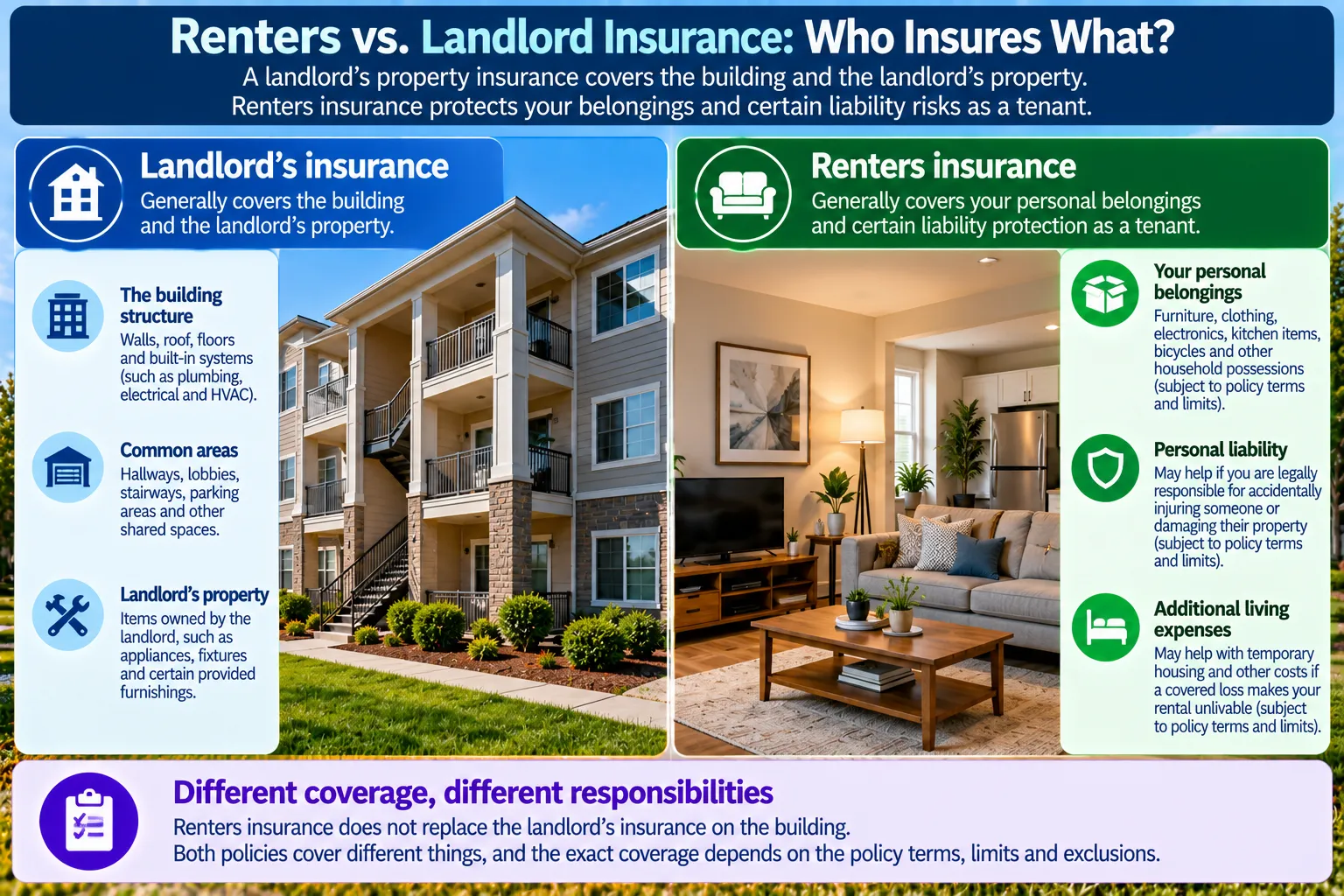
Renters insurance is a policy for a tenant’s financial interests. A landlord’s property insurance generally insures the building and the landlord’s property, not a tenant’s furniture, clothing, electronics or personal liability. Your lease may require you to carry liability coverage, but the policy can also be useful when a lease does not require it.
Most renters policies package several coverages together. They commonly address personal property, liability, medical payments to others and additional living expenses after a covered loss makes the rented home uninhabitable. The exact names, eligibility rules and amounts vary by insurer and state.
What does renters insurance cover?
The declarations page and policy forms control what is covered. In broad terms, a renters policy may include the following coverages.
Personal property
Personal property coverage can help repair or replace belongings such as clothing, furniture, kitchen items, laptops and bicycles when they are damaged, destroyed or stolen by a covered event. Coverage may apply at home and, subject to the policy, away from home too. A loss still has to fit the policy’s covered causes of loss and other conditions.
Personal liability
Personal liability coverage may help if you are legally responsible for accidentally injuring another person or damaging someone else’s property. It can include a legal defense where the policy provides one, up to applicable limits and subject to exclusions. For example, an accidental kitchen fire that damages a neighbor’s belongings could raise a liability claim; intentional harm is not the same thing as an accident.
Medical payments to others
Medical payments coverage can provide a smaller amount for certain medical expenses when a guest is injured, regardless of whether you are found legally liable. Its purpose, limit and exclusions are different from personal liability coverage. It is not a substitute for health insurance or a guarantee that every injury on the premises will be paid.
Additional living expenses or loss of use
If a covered loss makes the rental unlivable, additional living expense or loss-of-use coverage may help with the reasonable increase in living costs while repairs are made or until you relocate as the policy allows. Hotel charges, additional meal costs and temporary housing may be examples. For the covered-loss, limits and documentation questions behind temporary lodging, read whether renters insurance can cover hotel stays.
Renters insurance coverage at a glance
| Coverage | What it may help pay for | Important limits to check |
|---|---|---|
| Personal property | Covered damage, destruction or theft of your belongings | Property limit, category sublimits, covered causes of loss and settlement method |
| Personal liability | Certain claims alleging you accidentally injured someone or damaged their property | Liability limit, exclusions and whether legal defense is provided |
| Medical payments to others | Certain smaller medical expenses for an injured guest | Coverage limit, eligibility and exclusions |
| Additional living expenses or loss of use | Qualifying increased living costs after a covered loss makes the rental uninhabitable | Covered cause, time period, dollar limit, receipts and insurer requirements |
These are common coverage parts, not a promise that every renters policy includes identical terms. The declarations page, policy form and endorsements determine the protection in force. A landlord’s building coverage is separate from the tenant’s personal-property and liability protection.
What kinds of events can renters insurance cover?
Many policies cover named hazards or causes of loss such as fire, smoke, theft, vandalism, certain types of water damage, wind or hail. Whether a particular event is covered depends on the form, the cause, the location, exclusions and endorsements. For the personal-property, smoke and temporary-housing questions that follow a fire, see whether renters insurance can cover fire. A burst pipe and water that enters during a flood can lead to very different coverage results, even though both involve water.
Read the policy’s list of covered causes of loss rather than relying on a label such as “water damage” or “storm damage.” State rules and available policy forms also differ, so an insurer or licensed insurance professional can explain the policy offered in your location.
Does renters insurance cover theft?
Theft of personal property is commonly covered, subject to the deductible, policy limits and special limits for certain categories. That can include a break-in at your rental or, in some policies, theft of belongings while you are traveling. A police report, receipts, photographs or a home inventory can make it easier to document what was lost.
Theft coverage does not mean every missing item is automatically covered. The circumstances, proof of ownership, policy terms and any applicable exclusions matter. It is wise to ask how off-premises theft is handled and whether it has a lower limit.
Does renters insurance cover damage to the building?
Usually, the landlord’s property policy is intended to insure the building itself. Your renters policy is not building coverage for the owner. However, your personal liability coverage may respond if you are legally responsible for accidental damage to the rental, subject to the policy’s terms and limits.
That distinction matters after a loss. Damage from normal wear, a maintenance problem or an event for which you are not legally liable may not become your renters claim. Notify the landlord promptly and document the condition, but do not assume either policy will pay before the insurers review the facts.
Does renters insurance cover your roommate’s belongings?
Not automatically. A renters policy commonly covers the named insured and may cover certain resident relatives, but an unrelated roommate often needs their own policy. Listing a roommate or sharing a policy can have consequences for limits, claims history and who receives payment, so confirm the insurer’s rules before assuming a shared household has shared coverage.
Does renters insurance cover pets?
Pets themselves are usually not personal property for purposes of veterinary costs, and routine pet damage is generally not what a renters policy is for. Liability coverage can sometimes be relevant if a pet injures someone or damages another person’s property, but animal-related exclusions, breed or species restrictions, prior incidents and local rules can affect the result. Ask the insurer specifically about a pet before buying or renewing.
What doesn’t renters insurance usually cover?
Common exclusions and gaps can include flood, earthquake or earth movement, wear and tear, maintenance problems, pests, intentional acts and losses above policy or special-category limits. Flood and earthquake coverage may require separate insurance or an endorsement where available. A policy can also limit business property, cash, collectibles, jewelry, firearms or electronics.
This is not a complete list. The important question is not only whether an item is listed in a brochure, but whether the actual cause of loss is covered and whether a limit or exclusion applies. Review the exclusions and endorsements before a claim happens.
Does renters insurance cover mold?
Mold coverage is often limited and depends heavily on the cause. Some policies may address mold resulting directly from a covered sudden loss, while mold connected to long-term moisture, maintenance or seepage may be excluded or capped. For a focused explanation of the cause, exclusions and damaged-property questions, read whether renters insurance can cover mold.
Actual cash value vs replacement cost
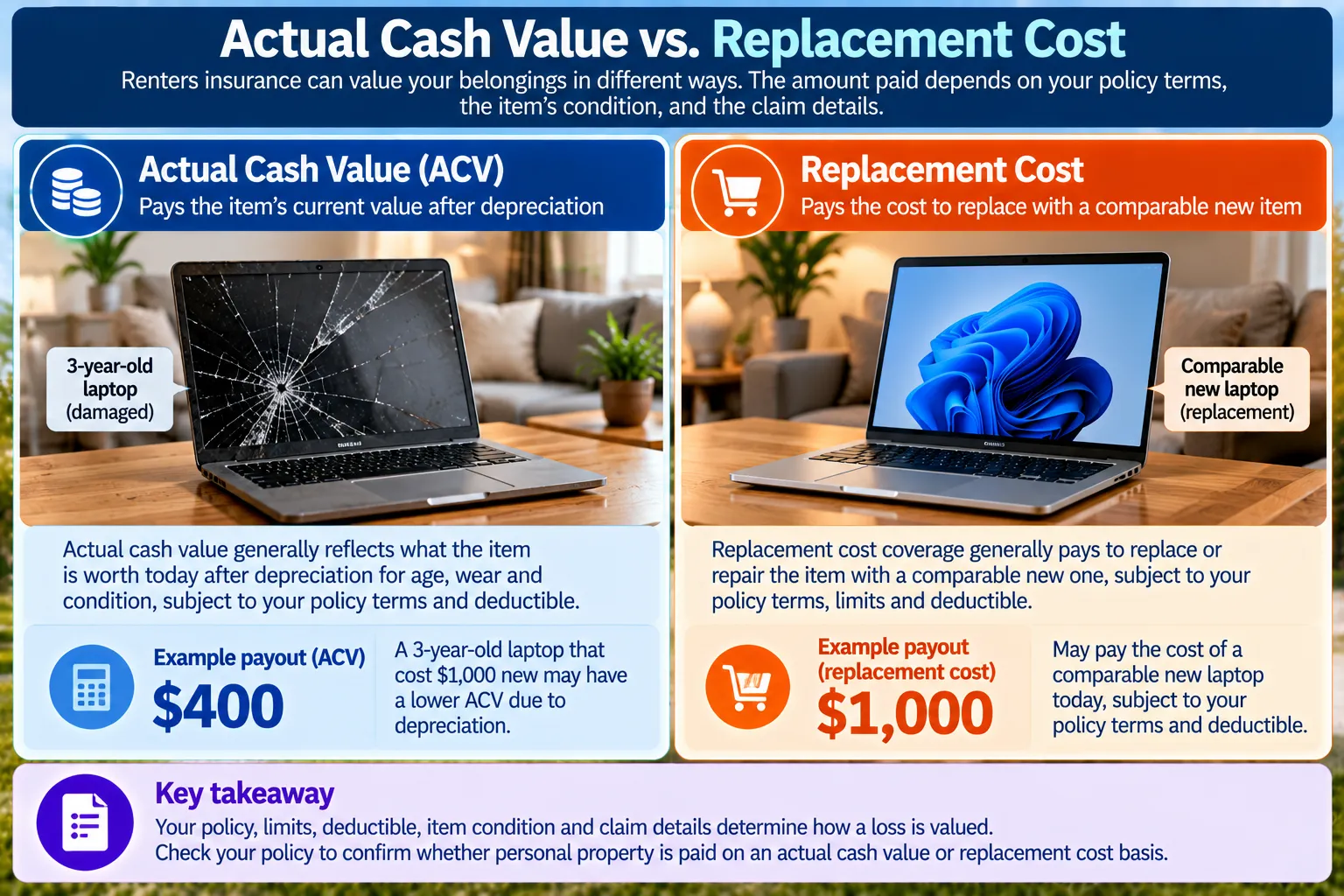
Personal property may be settled on an actual cash value or replacement cost basis. Actual cash value generally reflects depreciation, so an older item may receive less than the cost of a new replacement. Replacement cost coverage may pay more for a comparable replacement, but many policies require you to replace the item and follow claim procedures before the full amount is paid.
Compare the premium, deductible and settlement terms instead of assuming one approach is universally better. For belongings you could not readily replace with a depreciated payment, replacement cost may be worth considering.
How renters insurance limits work
A policy has an overall personal property limit and may also have separate limits for liability, medical payments and loss of use. Within personal property coverage, special limits can apply to categories such as jewelry, cash, watches, firearms, collectibles or property used for business. A scheduled endorsement may offer broader or higher protection for eligible valuable items.
Limits are not promises that every claim will reach that amount. The covered loss, valuation method, deductible and sublimits all affect payment. Ask for the applicable limit in writing when an item is unusually valuable.
What is a renters insurance deductible?
A deductible is the amount you generally pay before the insurer contributes to a covered property claim. If a covered loss is worth $2,000 and the deductible is $500, the claim payment may be reduced by $500, subject to the policy. Liability coverage often works differently, so check the declarations page rather than applying the property deductible to every coverage.
A higher deductible can lower the premium, but it means you must be able to absorb more of a loss. Choose an amount that fits your emergency savings, not just the lowest advertised price.
A simple example can help explain the calculation. If a covered personal-property loss is valued at $2,000 and the applicable deductible is $500, the insurer may calculate a payment of $1,500 before considering any special limit, depreciation, coinsurance provision if applicable, or other policy terms. The actual settlement can therefore be different from this simplified illustration. Check whether the deductible applies per occurrence and whether a separate deductible applies to a particular peril.
What is a good renters insurance deductible?
There is no single deductible that is right for every renter. Compare the premium savings, if any, with the amount you would need to pay after a covered loss. A deductible that looks attractive on a quote may be difficult to manage if you do not have enough savings available. Ask the insurer to show the premium at more than one deductible level and confirm the deductible shown on the declarations page.
Does renters insurance cover expensive belongings?
It can, but standard coverage may be insufficient for expensive belongings. A policy’s personal property limit and special category limits can leave a gap for a high-value engagement ring, camera equipment, art collection or musical instrument. An appraisal, receipt, serial number and photographs can support a request for scheduled coverage or a higher limit.
Ask whether the item is covered for theft only or for a wider range of accidental loss, whether a deductible applies and whether coverage follows the item away from home. Do this before a loss rather than after discovering a sublimit.
How to figure out how much personal property coverage you need
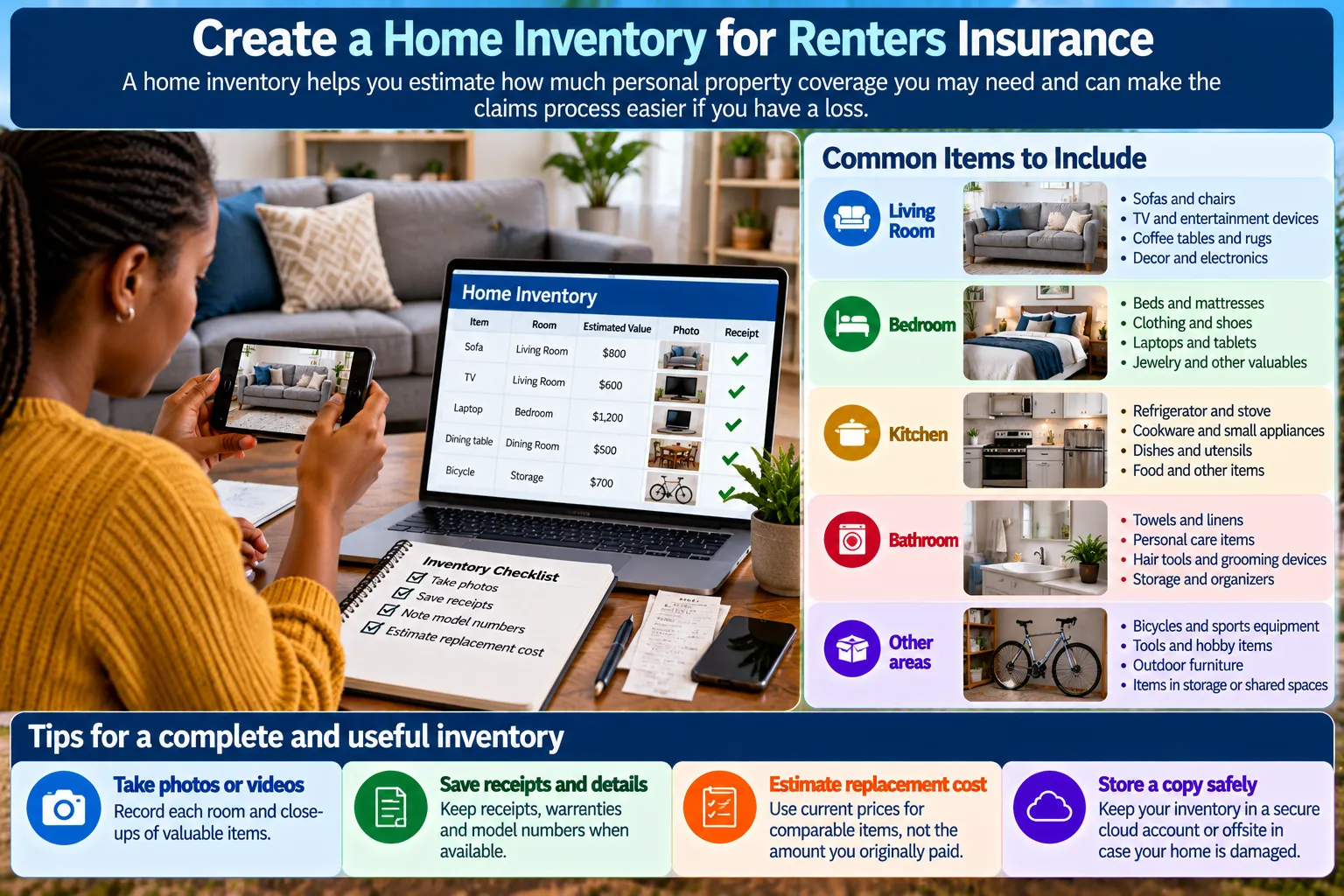
Start a room-by-room inventory. List furniture, clothing, appliances you own, electronics, kitchen items, sporting goods, tools and valuables. Add replacement estimates, save receipts and take photos or video. Then total the likely cost to replace the items, not merely their original purchase price.
Review the inventory each year and after major purchases or a move. Compare the total with the policy’s personal property limit, then separately check special limits for valuables. Your needs can change faster than a policy’s default limits.
Common renters insurance coverage questions
Does renters insurance cover fire?
Fire is commonly a covered cause of loss for insured personal belongings, subject to the policy’s terms, limits and deductible. Smoke or soot damage and additional living expenses may also be relevant after a covered fire. The renters policy generally does not insure the landlord’s building. See the dedicated guide to renters insurance and fire damage for claim documentation and temporary-housing considerations.
Does renters insurance cover every kind of water damage?
No. The source and circumstances of the water matter. A sudden pipe-related loss, gradual seepage, water backup and surface flooding can be treated differently under a policy. Review the covered causes of loss, water exclusions and available endorsements rather than assuming that all water damage is treated alike.
How to check what your renters policy actually covers
Use this short review before relying on a policy:
- Find the declarations page and confirm the named insured, address and policy period.
- Identify the personal property, liability, medical payments and loss-of-use limits.
- Check whether personal property is actual cash value or replacement cost.
- Read the deductible and note which property coverages it applies to.
- Review covered causes of loss and the exclusions section.
- Look for special limits on valuables, cash, electronics and business property.
- Confirm how theft away from home is treated.
- Check flood, earthquake, water backup and mold provisions or available endorsements.
- Ask how a roommate, resident relative or pet affects coverage.
- Make or update a home inventory and store a copy away from the rental.
- Ask the insurer how temporary housing expenses are calculated after a covered loss.
- Get answers and any coverage changes in writing before you need to claim.
Renters insurance coverage checklist
Before you buy, renew or file a claim, make sure you can answer these questions: What belongings do I need to protect? What would it cost to replace them? Which risks are excluded? Is my liability limit appropriate? Could I afford the deductible? Do I need a separate policy for flood, earthquake or valuable property?
Use the answers to compare quotes on more than price. For broader orientation, visit the renters insurance hub or return to the United States insurance guides. A policy is most useful when its limits and exclusions match the risks you actually face.