

When can a new driver be added to a parent’s car insurance?
A new driver may be added to a parent’s policy when the insurer is willing to write the household and vehicle arrangement that way. A driver who lives in the home and regularly drives a household vehicle is a common example, but the insurer needs the actual facts before deciding how the policy should be written.
Residence, who owns each vehicle, where each vehicle is primarily garaged, who regularly drives it, and the insurer’s underwriting rules can all matter. State rules can also affect available coverage and policy requirements. The National Association of Insurance Commissioners advises consumers to provide the same accurate vehicle, driver, and household information when shopping for quotes.

Adding a driver can change the household premium, coverage choices, and listed-driver information. It is better to ask the insurer how it treats the specific arrangement than to assume that a family relationship alone determines eligibility.
Does the new driver have to live with their parents?
Living at home may support a household-policy arrangement, but residence is not a single nationwide test. Insurers can distinguish between a driver who lives in the home, a person temporarily away, and someone who has established a separate household. The policy terms and the insurer’s rules are important.
A driver who lives elsewhere but regularly uses a household vehicle may still need to be disclosed. Conversely, a driver who has moved out permanently and keeps a vehicle at a new primary address may need a different arrangement. Do not use a parent’s address as a garaging address if that is not where the vehicle is primarily kept.
What happens if the new driver goes away to college?
Temporary attendance at school can be treated differently from permanently establishing another household, but practices vary. Tell the insurer whether the student takes a vehicle to school, where it will be garaged, how often the student drives household vehicles, and whether the address is temporary or has become a primary residence.
College can change the facts used for the policy even if the student returns home during breaks. A car kept near campus, a new out-of-state address, a change in vehicle ownership, or reduced access to a household vehicle may all prompt questions for the insurer. Confirm the answer in the policy documents rather than relying on an informal assumption about student status.

What if the new driver owns their own car?
Vehicle title and ownership can affect how insurance needs to be arranged. Owning a vehicle does not automatically require a separate policy in every situation, but an insurer may have rules about named insureds, vehicle ownership, garaging, and the principal driver.
Ask the insurer how it handles the title holder, regular driver, and policyholder for the particular vehicle. If the car is financed or leased, the lender or lessor may have separate requirements for physical-damage coverage or how it is listed. The policy and finance or lease agreement, not a general rule, provide the answer for the specific arrangement.
Parents’ policy vs. a separate policy
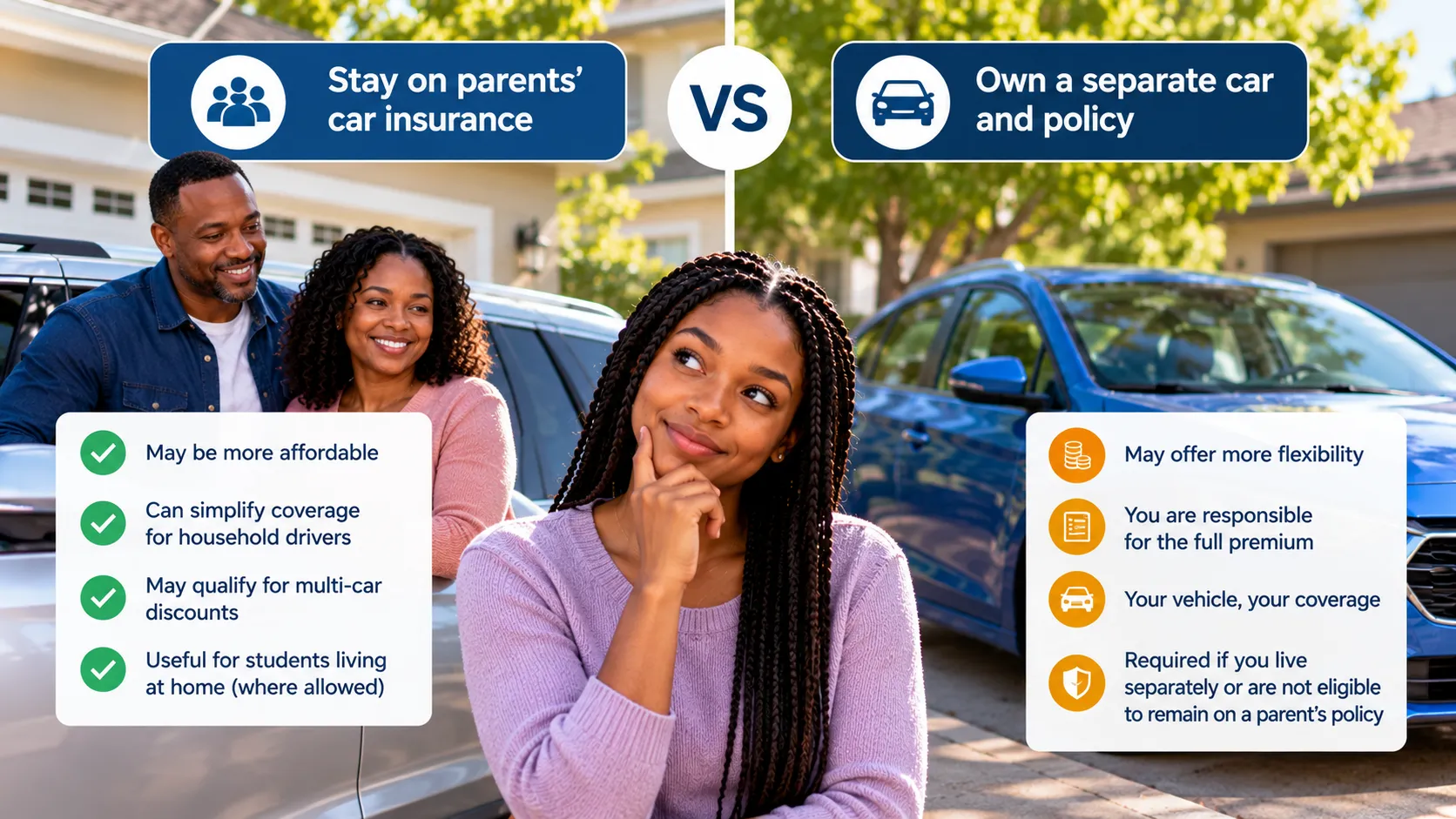
A parent’s policy may already have a household structure, multiple vehicles, and an existing billing arrangement. It may also make a multi-car discount available if the insurer offers one and the household qualifies. Adding a new driver can still increase the household premium, especially when the driver has limited experience.
A separate policy can give the driver direct control over coverage choices and billing and can begin an independent policy history. It may also cost more for an inexperienced driver, and it may be necessary when residence, ownership, vehicle use, or insurer rules do not support a household-policy arrangement.
Neither option is universally cheaper or better. Compare equivalent coverage, deductibles, limits, policy terms, and fees after the insurer has the correct household and vehicle information.
Does age determine when you must leave your parents’ car insurance?
No single birthday creates a universal auto-insurance cutoff. Auto insurance is not governed by the familiar health-insurance age-26 rule. A driver’s residence, vehicle ownership, regular use, policy terms, and insurer eligibility rules can matter more than age alone.
Ask the insurer to explain how it treats the driver’s current circumstances and whether an update is needed when circumstances change. That approach is more reliable than assuming a rule based only on turning 18, 21, 25, 26, or any other age.
Can a financially independent adult stay on a parent’s car insurance?
Financial independence alone is not a universal deciding factor. A driver’s residence, ownership of a vehicle, regular use of insured vehicles, and the insurer’s eligibility rules may be more relevant to how the policy is written.
An adult who lives with parents and drives a household vehicle may present a different policy question from an adult who owns a car, lives at another address, and garages that car there. Give the insurer the current facts and ask whether the driver and vehicle can remain on the policy.
What should happen when a new driver moves out permanently?
Notify the insurer when the driver establishes a new primary residence, takes a vehicle to a different address, changes a vehicle’s garaging location, begins regular use of another vehicle, or changes vehicle ownership. Those facts can affect underwriting, coverage, policy eligibility, and price.
The insurer can explain whether the driver should remain listed, whether the vehicle can stay on the household policy, or whether a separate policy is needed. Do not wait for a renewal or a claim to correct outdated address, driver, or vehicle-use information.
Why household-driver disclosure matters
Insurers generally need accurate information about people who regularly drive insured vehicles and where those vehicles are kept. The declarations page and policy application should reflect the drivers, vehicles, garaging address, and coverage choices the insurer has agreed to insure.
Incomplete or inaccurate information can lead to underwriting questions, a corrected premium, or problems when a claim is evaluated. This is not a reason to assume a particular outcome in advance; it is a reason to give the insurer complete, current information and retain the written response or updated documents.
Is staying on a parent’s policy always cheaper?
No. Premiums can depend on the driver’s experience and record, the vehicle, location, garaging, coverage, deductible, claims history, available programs, and the insurer’s rating methods. Adding a driver can change a household premium even when the arrangement is eligible.
Compare equivalent quotes to see whether a household policy or separate policy is a better fit for the actual arrangement. How to Compare Car Insurance Quotes explains how to line up coverage, drivers, vehicles, limits, deductibles, and payment terms before treating one price as lower.
How adding a new driver can affect the parents’ premium
Adding an inexperienced driver can change the household premium. The result can depend on driving experience, driving record, vehicle assignment, location, coverage selections, deductibles, mileage, and the insurer’s rating method. It is not possible to predict a household’s price from one factor alone.
Ask for a quote or policy change using the actual driver and vehicle information. Review whether the quote identifies the listed drivers, assigned vehicles where applicable, coverage limits, deductibles, and any discount assumptions. How Much Is Car Insurance? provides more context about why comparable policies can be priced differently.
Ways a new driver may be able to lower insurance costs
Useful starting points can include comparing insurers, asking about legitimate discounts, checking whether driver education is recognized by the insurer, maintaining safe driving habits, considering the insurance cost of a vehicle, and reviewing telematics carefully where it is available. None of these steps guarantees a lower premium, and availability can vary.
For a fuller framework, see How to Lower Car Insurance. The important part is to compare equivalent coverage and understand the financial trade-offs before reducing limits, removing coverage, or raising a deductible.
Questions to ask the insurer
- Does this new driver need to be listed on the policy?
- Can the driver remain on this policy at the current residence?
- Does vehicle ownership or title affect eligibility?
- How would a temporary college address or permanent move change the policy?
- Which address should be used as the vehicle’s primary garaging address?
- How should the primary driver and regular drivers be listed?
- Are any discounts or programs available, and what are their terms?
- Would a separate policy change coverage, eligibility, or cost?
Frequently asked questions
Can I stay on my parents’ car insurance after I turn 18?
Possibly. Turning 18 is not a universal auto-insurance cutoff. The insurer will generally need current information about residence, vehicle ownership, regular use, and the household arrangement.
Can I stay on my parents’ car insurance after I turn 26?
Possibly, depending on the policy and circumstances. Auto insurance does not use a universal age-26 rule. Ask the insurer how residence, vehicle ownership, garaging, and regular vehicle use affect eligibility.
Can I stay on my parents’ insurance if I move out?
It depends on whether the move is temporary or permanent, where any vehicle is kept, who owns it, and the insurer’s rules. Notify the insurer promptly rather than assuming an old address or arrangement still applies.
Can a college student stay on their parents’ car insurance?
Some students may be able to remain on a household policy, but treatment can differ by insurer and situation. The insurer should know whether the student takes a vehicle to school, where it is garaged, and whether the school address is temporary or primary.
Can I be on my parents’ insurance if the car is in my name?
Possibly, but vehicle ownership can affect how a policy is arranged. Ask the insurer how it handles the title holder, named insured, primary driver, and garaging address for that particular vehicle.
Is it cheaper to stay on my parents’ car insurance?
Not always. A household policy may have available discounts or existing structure, but adding an inexperienced driver can increase its premium. Compare equivalent quotes after giving each insurer the correct facts.
Do my parents have to add me when I get my driver’s license?
Insurers often need to know about licensed household members and regular drivers, but the policy’s requirements and the insurer’s rules control. Ask the insurer whether the new driver must be listed and keep the answer with the policy documents.
The bottom line
There is no universal age at which a new driver automatically has to leave a parent’s auto policy. The appropriate arrangement depends on residence, vehicle ownership, regular use, insurer rules, and state requirements. Give the insurer accurate information and compare equivalent coverage before choosing between a household policy and a separate policy.