

How to compare car insurance quotes at a glance
Place every quote beside the same reference point—usually your declarations page or a written list of desired coverage. Compare the items below before treating one price as lower for the same protection.
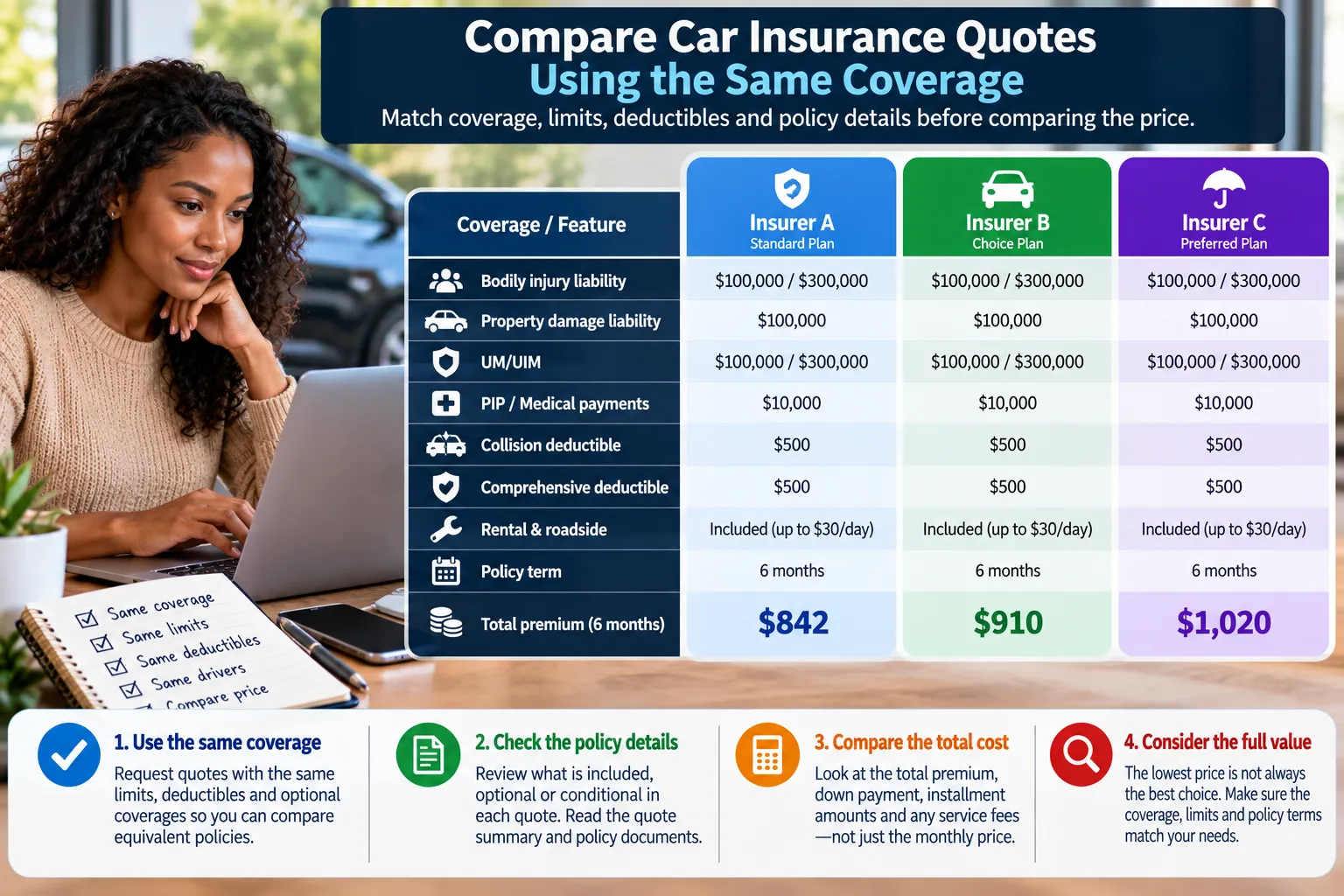
| Compare | What to match or ask about |
|---|---|
| Bodily injury liability | Per-person and per-accident limits |
| Property damage liability | Limit for damage you cause to others’ property |
| UM/UIM | Whether applicable, the limits, and any selection or waiver |
| PIP/medical payments | Whether applicable in the state and the limit shown |
| Collision and comprehensive | Whether included and the deductible for each |
| Rental and roadside/towing | Whether included, limits, and conditions |
| Policy term | Effective dates and whether it covers six months, a year, or another term |
| Total premium and fees | Total premium, down payment, installments, and service fees |
This is an apples-to-apples exercise. Do not treat optional or state-dependent coverage as universally required, and do not assume the lowest headline premium is automatically the best choice.
What is a car insurance quote?
A quote is a price estimate or offer based on the information supplied and the coverage requested. It helps compare companies, agents, or buying channels, but it is not the policy contract and does not guarantee the final premium. During underwriting, an insurer may verify driving, vehicle, address, prior-insurance, or other application information. Corrected or additional information can change the offered price or terms.
Keep each quote and its coverage summary. The issued declarations page, endorsements, and policy wording are the documents to check once coverage is bound or issued.
Gather the same information before requesting quotes
Use the same facts for every request: drivers, vehicles, garaging address, usual vehicle use, estimated annual mileage, requested driving and claims information, and current insurance details. Include finance or lease information when it applies. A quote based on a different use, omitted household driver, or different garaging location is not a clean comparison.
Start with the declarations page if you already have insurance. It identifies listed vehicles, drivers, policy term, limits, and deductibles. For a start-to-finish process, see how to get car insurance.
Start with the same liability limits
Liability coverage generally addresses covered injury or property-damage claims you cause to others, subject to its limits. Match both bodily injury and property damage limits across quotes. A policy with lower limits may cost less, but that is a coverage difference—not proof that an insurer prices the same policy lower.
State minimum requirements vary, and a legal minimum is not a universal recommendation. Identify the limit shown on every quote and read what it represents. Our liability insurance guide explains the basic roles of bodily injury and property damage liability.
Compare collision and comprehensive deductibles
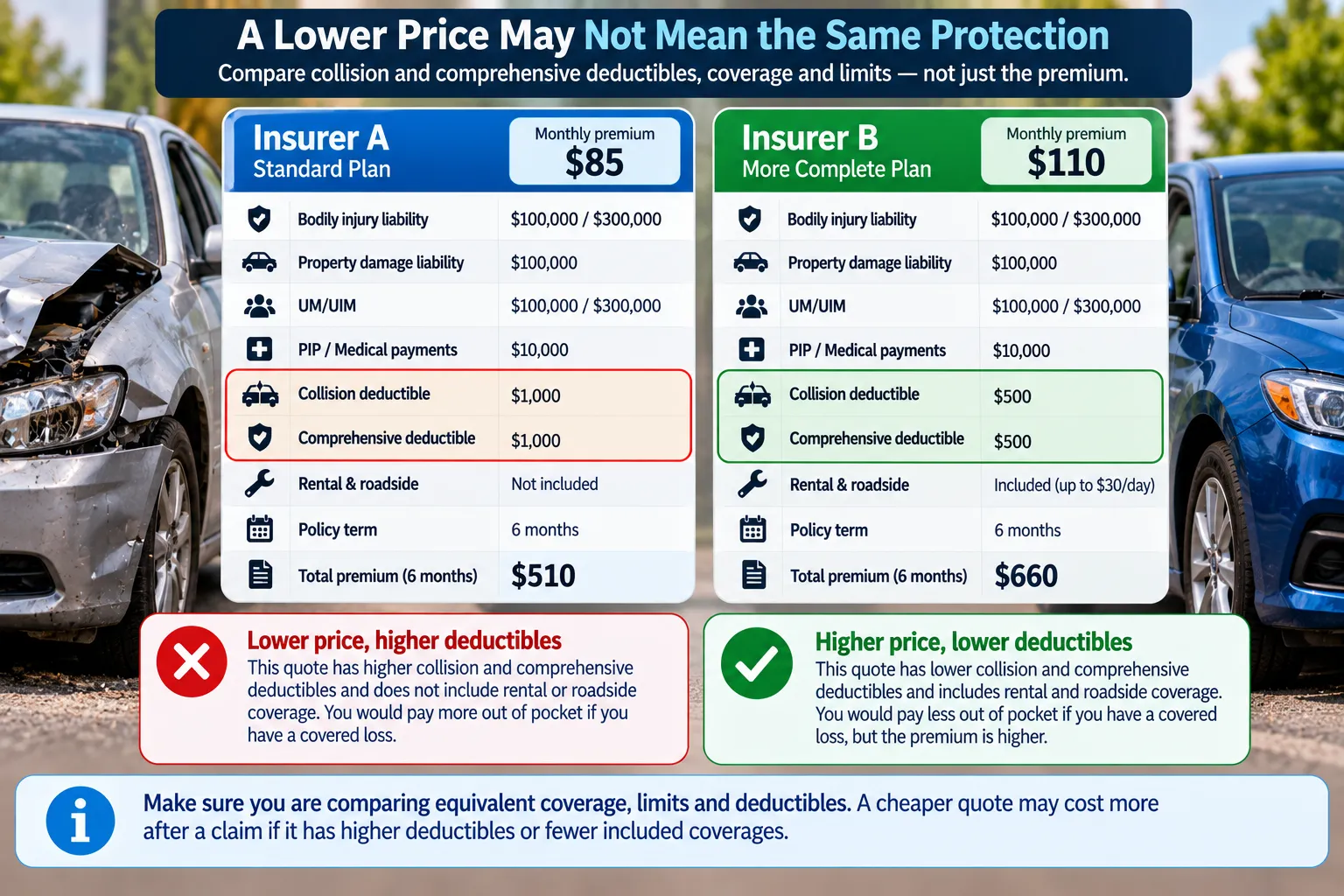
Collision generally addresses covered damage from an impact, while comprehensive generally addresses certain non-collision losses such as theft, fire, weather, or vandalism. Compare whether each is included and record the deductible for each separately. A higher deductible can reduce premium while increasing what you may pay after a covered loss.
“Full coverage” is informal terminology, not a standardized policy. It is not a substitute for reading actual coverages, limits, deductibles, and exclusions. A lender or lessor may require collision and comprehensive under a loan or lease agreement; that contractual requirement is separate from state law. See comprehensive versus collision insurance for the distinction.
Compare UM/UIM, PIP, medical payments and state-required coverage
Uninsured and underinsured motorist coverage, personal injury protection (PIP), and medical payments coverage do not operate identically nationwide. A state may require a coverage, require it to be offered, permit a waiver, or make it unavailable in a particular form. Match the type and limit shown, and ask what state-specific endorsement or selection applies.
PIP and medical payments can address injuries under different policy and state rules. Likewise, UM/UIM can involve bodily injury, property damage, limits, offsets, or other conditions that vary. Read the UM/UIM guide, then confirm current rules with the relevant state insurance department.
Compare optional coverages separately
Rental reimbursement, roadside assistance or towing, glass options, and endorsements can be included, excluded, or offered with different limits and conditions. Put each feature in its own row rather than assuming a familiar label means the same benefit on every quote. Rental reimbursement, for example, may have daily and total limits; roadside coverage can have service limits or conditions.
Also check what the quote does not answer. A short summary may not identify every exclusion, condition, waiting period, or endorsement. Read the available coverage summary and ask where the feature appears in the issued policy. If one quote includes an option that another leaves blank, ask whether it is unavailable, declined, included elsewhere, or simply not shown. That prevents a missing line item from being mistaken for identical protection.
Compare policy documents and service assumptions
Price comparisons work best when the documents are compared too. Look for the named insured, each listed driver and vehicle, the stated vehicle use, effective dates, coverage limits, deductibles, endorsements, and exclusions. If you have a current declarations page, use it as a checklist rather than assuming a new quote copied every selection correctly.
Claims handling, repair options, communication channels, and rental arrangements can be meaningful practical questions, but a general reputation or a marketing promise does not make policies comparable. Ask each insurer or agent to identify the applicable policy provision, available service option, or claims process for the quote you received. Keep the answer with the quote. This is not a prediction of a particular claim outcome; coverage decisions depend on policy language, facts, and applicable law.
When a quote is materially lower, ask a direct question: “Which coverage, deductible, discount, payment assumption, or underwriting information explains the difference?” A clear answer can reveal that the policies are equivalent, or it can identify a trade-off you may wish to consider. If the answer depends on a state rule, confirm it with the insurer and the state insurance department rather than relying on another state’s consumer guide.
Check discounts carefully
Ask each insurer or agent which discounts are reflected in the quote and what must remain true to keep them. Availability, eligibility, and state rules vary. A multi-policy, safety-device, low-mileage, student, driver-training, or payment-related discount is an assumption to compare, not a promise. Give accurate information rather than changing facts to qualify for a discount.
Compare annual, six-month and monthly costs correctly
First match the policy term. A six-month total, annual total, and monthly installment are not automatically comparable. A monthly figure can reflect a deposit, down payment, installment schedule, or payment-plan fee rather than one-twelfth of the total premium.
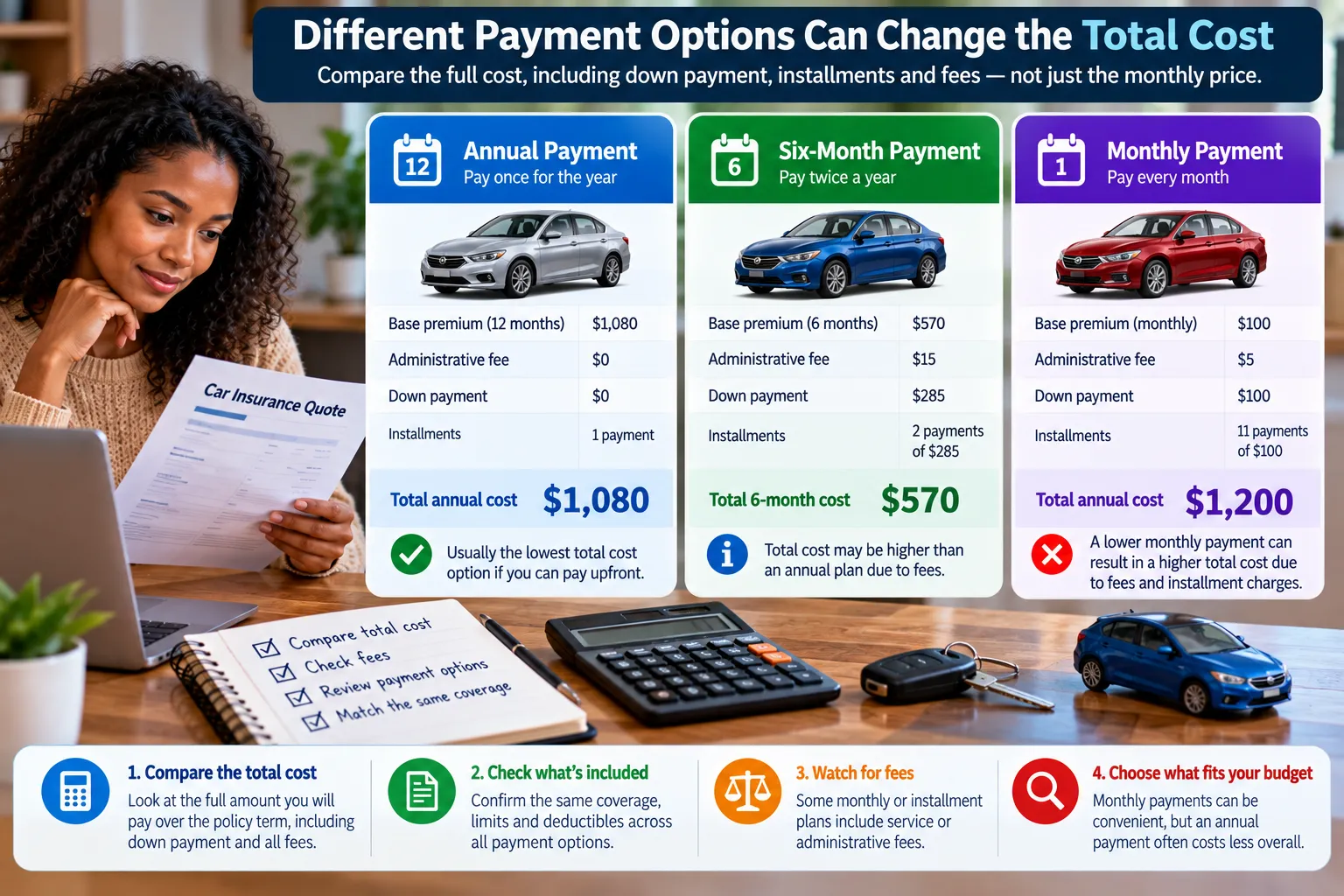
Ask for the full premium for stated effective dates, then compare only equivalent terms and coverages. How much car insurance costs explains further factors that can affect a premium.
Check installment charges and other payment-related fees
Record the amount due at purchase, every installment, payment dates, and any installment, service, late-payment, or other disclosed charge. Ask whether a payment method or automatic payment changes the total. Compare the total amount owed for equivalent coverage and term, not only the lowest initial or monthly payment.
Why two insurers can quote very different prices
Insurers can use different underwriting and rating practices within applicable law. They may evaluate permitted factors, coverage choices, deductibles, policy terms, discounts, and payment plans differently. In some states, credit-based insurance information may be used under restrictions; other states restrict or prohibit particular uses. It is not the same as a lending credit score, and state law matters.
Price differences are a reason to compare policy terms and quote assumptions, not evidence that either insurer will use the same price for every driver.
Quote price vs. final premium
A quote can change when an insurer verifies or corrects application information, completes underwriting, or identifies a different coverage choice or eligibility condition. Do not assume a quote guarantees the final premium or that a short online summary contains every policy condition.
Before buying, check issued documents for the named insured, drivers, vehicles, limits, deductibles, optional coverage, effective date, and total premium. Ask the insurer or agent to explain material differences between the quote and policy.
Verify the insurer or agent is licensed
Before buying, use your state insurance department to verify that the insurer and, where applicable, agent are authorized to do business in your state. This is a consumer-protection check, not a recommendation of one insurer over another. State departments can also provide jurisdiction-specific information and explain local requirements.
Common mistakes when comparing car insurance quotes
- Choosing the lowest displayed premium without matching limits, deductibles, and coverage types.
- Comparing a monthly installment with another insurer’s six-month or annual total.
- Assuming “full coverage” is a uniform package.
- Treating lender or lessor conditions as state insurance requirements.
- Assuming optional rental, roadside, UM/UIM, PIP, or medical coverage is included.
- Relying on incomplete facts or assuming a quote cannot change after underwriting.
- Skipping the insurer or agent licensing check.
Practical car-insurance quote comparison checklist
- Give every insurer the same accurate driver, vehicle, use, mileage, address, and prior-insurance information.
- Match bodily injury and property-damage liability limits.
- Record UM/UIM and PIP or medical payments only as they apply to the state and quote.
- Match collision and comprehensive selections and deductibles.
- List optional coverage, limits, exclusions, and conditions separately.
- Compare the same policy term, total premium, payment schedule, and disclosed fees.
- Confirm discounts and their eligibility assumptions.
- Verify the insurer or agent through the relevant state insurance department.
- Read the quote and issued policy documents before deciding.
Bottom line
To compare car insurance quotes well, make the coverage and facts equivalent before comparing price. Check limits, deductibles, state-dependent protection, optional features, policy term, and payment charges alongside total premium. Confirm issued documents and state-specific requirements rather than relying on a headline quote alone.