
What is liability car insurance?
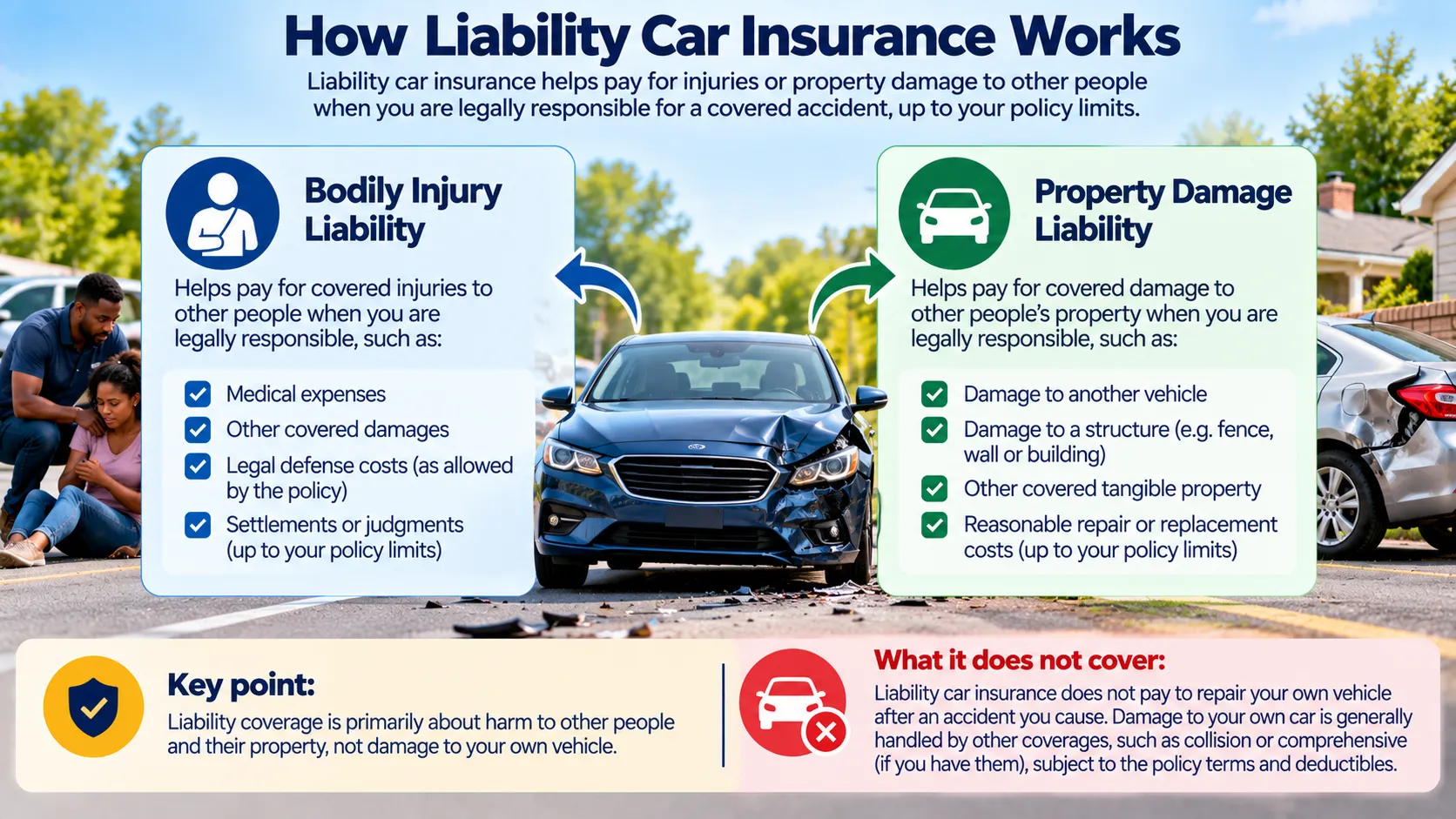
Liability car insurance addresses covered legal responsibility for harm a driver causes to other people. If an insured driver is legally responsible for a covered accident, the policy may help pay certain injury or property-damage claims made by others, up to the applicable limits. It is not general protection for every loss involving the insured vehicle.
That distinction is important when reading a quote or declarations page. Liability is mainly about harm to others. A driver who causes a collision may have liability coverage for a covered claim involving another person or their property, while damage to the driver’s own car is a separate question. Whether a particular claim is covered depends on the policy, the accident facts, exclusions, conditions, and applicable law.
What does liability car insurance cover?
Personal auto liability is commonly described through two principal components. They may be required, offered, or structured differently depending on state rules and the policy, but the basic categories help explain what a quote is showing.
Bodily injury liability
Bodily injury liability generally responds to covered injuries an insured driver causes to other people when the driver is legally responsible. Depending on the claim and policy terms, that can include medical expenses and other covered damages. A claim may also involve legal-defense costs or a settlement, but those details are governed by the insurance contract and the circumstances.
It should not be read as a promise that every injury, treatment, claimed loss, lawsuit, or legal award will be paid. Questions about fault, coverage, exclusions, reporting, evidence, and the limits of insurance can all affect the outcome. An insurer investigates the claim under the policy rather than simply paying every amount someone requests.
Property damage liability
Property damage liability generally responds to covered damage an insured driver causes to someone else’s property. Another vehicle is the most familiar example, but a loss can also involve a structure or other tangible property. The property and damage must fit the policy and the covered circumstances.
As with bodily injury liability, the policy amount is not an open-ended promise. The applicable limit, the facts of the accident, and the policy’s terms guide what may be available. A repair estimate alone does not establish what the policy will pay.
What doesn’t liability car insurance cover?
Liability is not first-party physical-damage coverage for the policyholder’s own car. If the policyholder causes an accident, liability coverage generally does not pay to repair that car simply because the accident happened. Other coverages can address different risks:
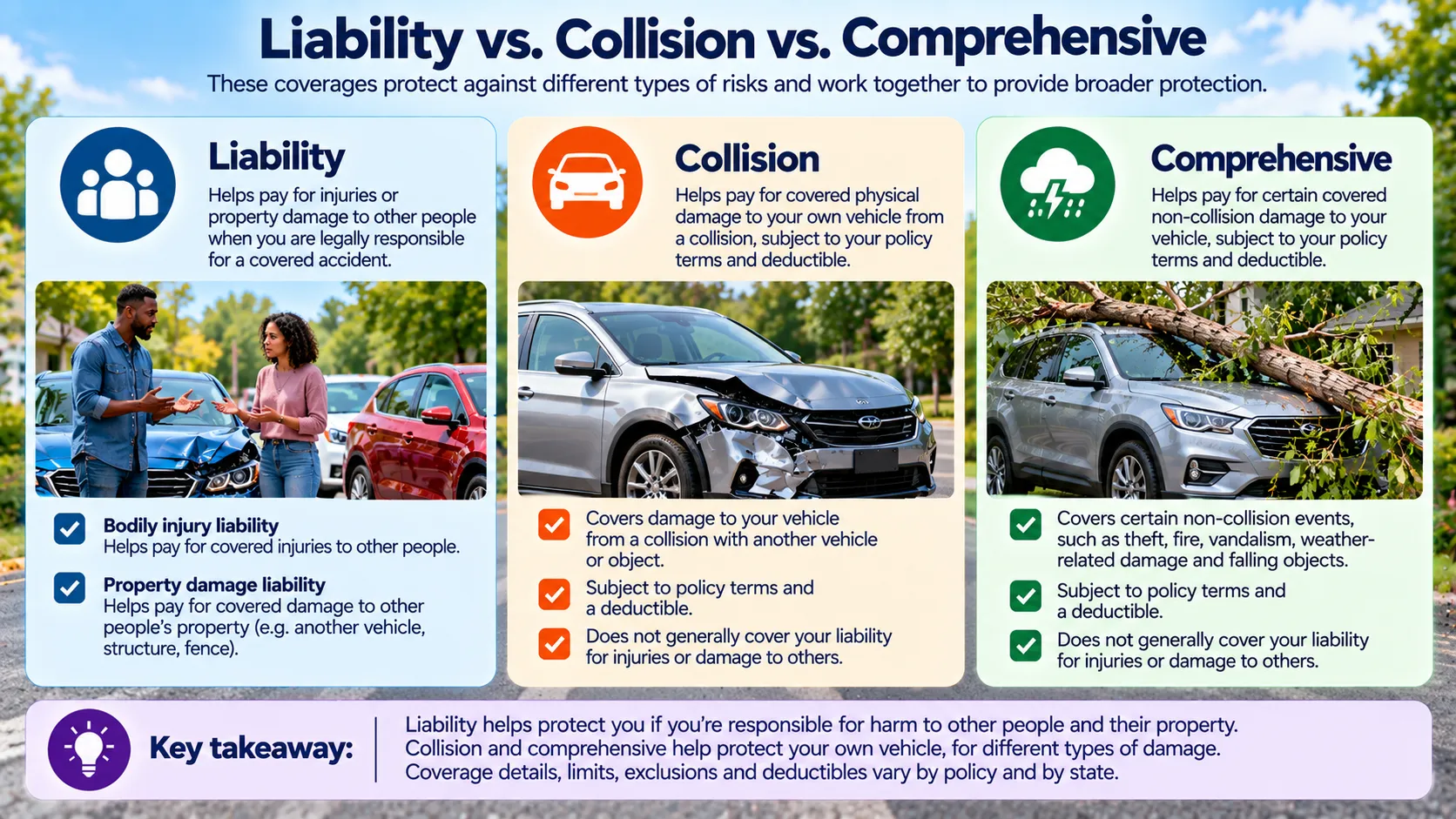
- Collision generally addresses covered physical damage to the insured vehicle from a collision, subject to policy terms and a deductible.
- Comprehensive generally addresses certain covered non-collision damage, such as theft, fire, or weather-related events, also subject to policy terms and a deductible.
- Medical payments or personal injury protection (PIP) may help with certain medical-related costs where available or required, but their rules vary by state and policy.
- Uninsured/underinsured motorist coverage may apply when another driver has no insurance or not enough insurance in circumstances the policy covers.
These labels are a starting point, not a substitute for the policy. An insurer, agent, or licensed professional can explain which options appear on a particular quote.
Is liability car insurance required?
Auto-insurance and financial-responsibility requirements vary by state. Most states require drivers to meet some form of financial-responsibility requirement, commonly through liability insurance, but the required coverages and limits are state-specific. Some states also have requirements that go beyond basic bodily injury and property damage liability.
There is no universal minimum limit to publish for the United States. For the state-specific meaning of minimum coverage and financial responsibility, see What Is State-Minimum Car Insurance?. Check your state insurance regulator, DMV, or other appropriate state authority for current requirements, and compare that information with your policy documents. The NAIC’s directory of state insurance departments is a useful starting point for finding the right regulator.
How do liability insurance limits work?
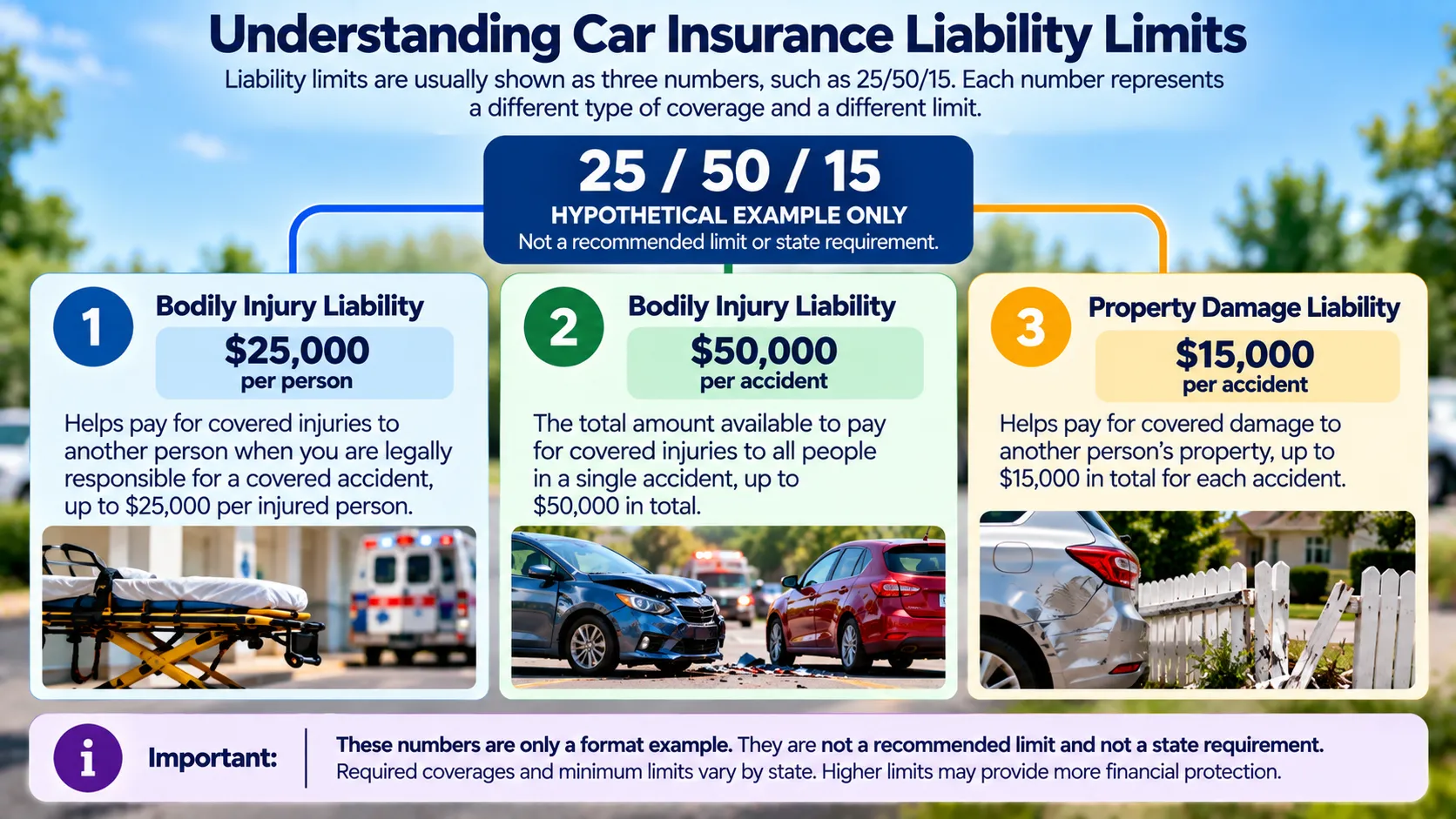
Many policies use split limits. This format separates bodily injury and property damage into three maximum amounts: bodily injury per person, bodily injury per accident, and property damage per accident. A notation such as 25/50/15 is only a hypothetical way to show the format: it could mean a $25,000 bodily-injury maximum for one person, a $50,000 bodily-injury maximum for one accident, and a $15,000 property-damage maximum for one accident. It is not a recommended amount or a statement of any state’s current requirement.
The per-person number does not override the per-accident maximum. When more than one person has a covered bodily-injury claim, the total available for that accident is still subject to the per-accident limit. Some policies use a combined single limit instead, which is one amount shared across covered bodily injury and property damage for an accident. Read the declarations page to see which structure applies.
What happens if damages exceed your liability limits?
Insurance generally pays covered claims only up to the applicable policy limits. If covered damages are greater than the available liability coverage, the difference may create personal financial exposure depending on the circumstances and applicable law. Liability, assets, court procedures, and collection rules are legal matters that can vary considerably.
This is a reason to understand what the figures on a quote mean before buying, not a basis for individualized legal advice. If a claim or lawsuit raises questions about your own situation, review the policy and consider speaking with an appropriately qualified professional.
Liability insurance vs. collision coverage
Liability and collision answer different questions. Liability primarily addresses covered injury or property-damage responsibility to others. Collision generally addresses covered physical damage to the insured vehicle from an impact with another vehicle or object, subject to the policy’s terms and deductible.
A single accident can involve both categories. For example, a driver might have a liability claim involving another person’s vehicle and a collision claim involving their own vehicle. The presence of one coverage does not automatically create the other.
Liability insurance vs. comprehensive coverage
Comprehensive generally concerns covered non-collision damage to the insured vehicle, such as theft, fire, or weather-related events, subject to the policy terms and deductible. Liability instead focuses on covered harm the insured driver causes to others.
People sometimes call a package of coverages “full coverage.” That is informal terminology, not a standardized policy type, and it does not define a particular set of protections. For the common liability, collision, and comprehensive shorthand, see What Is Full Coverage Car Insurance?. A quote should be compared by the specific coverages, limits, deductibles, exclusions, and conditions it contains.
For a direct comparison of liability with the full-coverage shorthand, see Liability vs. Full Coverage Car Insurance: What’s the Difference?.
What does “liability-only car insurance” mean?
Consumers often use “liability-only car insurance” to describe a policy without collision and comprehensive physical-damage coverage. The phrase can be imprecise, though. Actual policy contents matter, and state-required or selected first-party coverages may still exist even if a customer uses that label.
Do not assume every policy described as liability-only has the same protections. Review the declarations page for all listed coverages, including medical-related and uninsured/underinsured motorist protection where applicable, rather than relying on a shorthand description.
How much liability coverage do you need?
Legal minimum requirements, selected policy limits, and an individual’s risk and financial circumstances are different things. A state minimum is a legal threshold; it is not a MyCoverScope recommendation about the protection any particular person should choose. The right questions for a quote include what limits are offered, how they interact with the other coverages, and what financial risk the policyholder is considering.
For a personal decision, read the policy materials and ask an appropriately licensed insurance professional to explain choices that depend on your circumstances. Avoid choosing a limit simply because it is the lowest one shown or because another driver’s situation sounds similar.
Does liability coverage have a deductible?
Policies do not all work identically, so the policy documents are the answer for a specific quote. Deductibles are commonly associated with collision and comprehensive coverage. Check your own declarations page and policy terms to see whether and how a deductible applies to any liability coverage or related claim.
How does liability coverage affect car insurance cost?
Selected coverages and liability limits are among the factors that can affect a car-insurance premium. The insurer, state rules, vehicles, drivers, deductibles, payment structure, and other permitted rating factors can also matter. A higher or lower premium is not meaningful without knowing what policy is being compared.
For more on why quoted prices differ, see our guide to car insurance cost factors. Compare total premium and coverage on equivalent terms instead of treating a monthly payment alone as the whole cost.
How to compare liability car insurance
When comparing quotes, keep the underlying facts consistent and review more than price. A practical checklist includes:
- bodily injury limits and property damage limits;
- policy exclusions and conditions;
- other included coverages;
- the drivers and vehicles being quoted;
- the policy term;
- insurer or agent licensing; and
- total premium and payment structure.
If you are beginning the shopping process, our guide to getting car insurance explains the information to gather and how to compare issued documents with quotes.
Can you lower the cost of car insurance without misunderstanding coverage?
It is sensible to compare policies, but compare equivalent protection rather than price alone. A lower price can reflect lower limits, fewer coverages, a different deductible, different payment terms, or different information about the driver or vehicle. Our guide to lowering car insurance costs covers practical ways to investigate pricing while keeping those trade-offs visible.
Liability car insurance checklist
Before buying or renewing, review these basics:
- Confirm the bodily injury and property damage limits shown on the policy.
- Check your state’s current financial-responsibility requirements with an official source.
- Identify whether collision, comprehensive, medical-related, or uninsured/underinsured motorist coverage is included.
- Read exclusions, conditions, deductibles, and payment terms.
- Verify the named insured, drivers, vehicles, and vehicle use are accurate.
- Confirm the insurer or agent is properly licensed for your state.
- Save the quote, declarations page, and proof of insurance.
The bottom line
Liability car insurance primarily protects against covered financial responsibility for injuries or property damage caused to others. Bodily injury and property damage liability are the core pieces, while policy terms, limits, and state requirements determine how they apply. It is not the same as coverage for damage to the policyholder’s own vehicle, and it does not guarantee payment for every accident or claim. Read the policy and compare its specific protections before relying on a label or price.