
What does state-minimum car insurance mean?
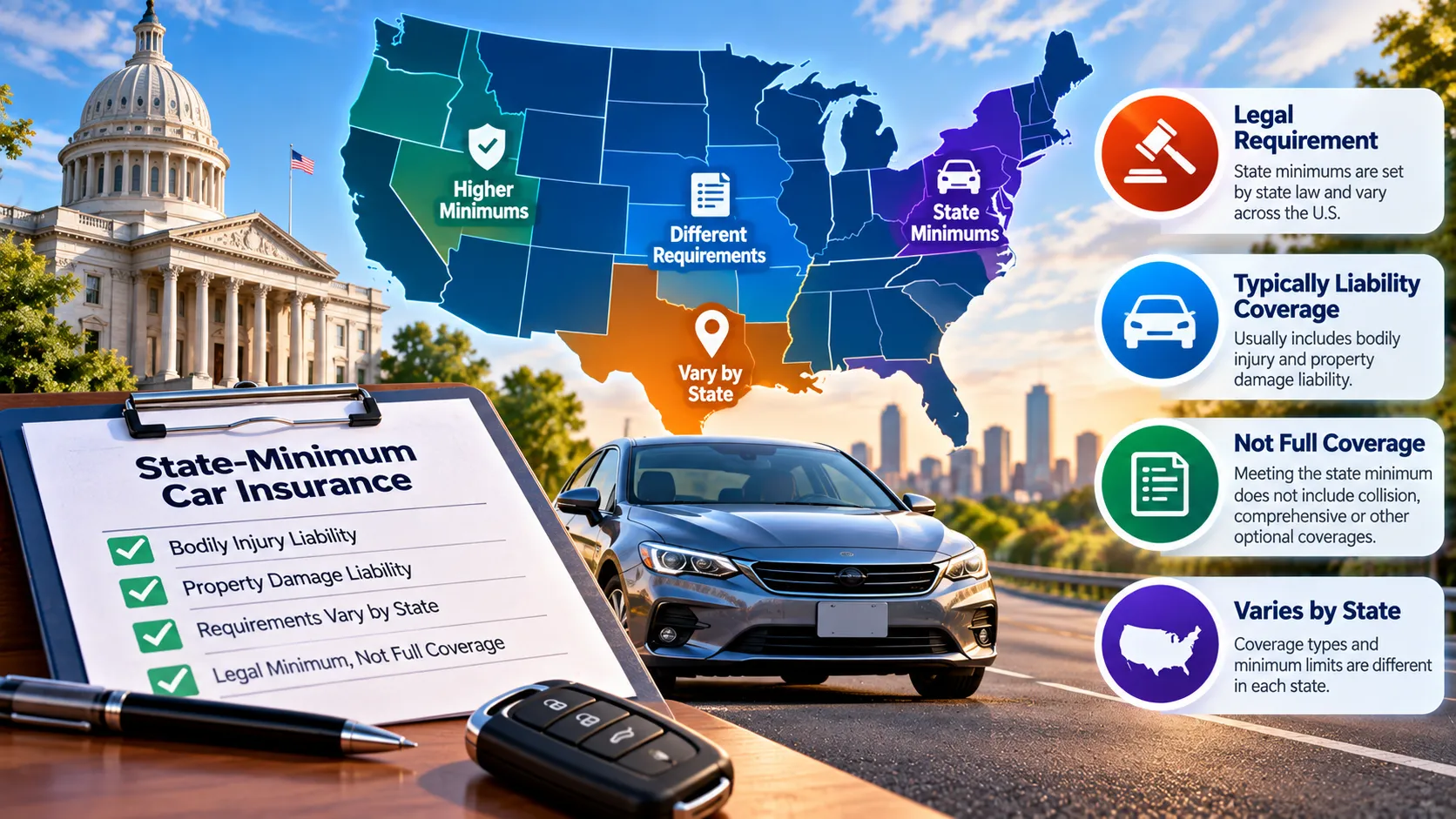
State-minimum car insurance is descriptive shorthand for the minimum protection needed to satisfy the applicable state’s auto-insurance or financial-responsibility rules. It is not one standardized national insurance product. A state can specify required coverage types, minimum limits, proof requirements, and conditions differently from another state.
The National Association of Insurance Commissioners (NAIC) explains that each state has its own auto-insurance rules and that most require at least a basic level of coverage. That legal threshold is different from the full list of protections a policy could offer. “State minimum” tells a reader to identify the relevant state and current rule; it does not identify every coverage in a particular policy.
What coverage is usually part of state-minimum insurance?
Bodily injury liability and property damage liability are central to minimum requirements in most states. Bodily injury liability generally addresses covered injuries an insured driver causes to others, while property damage liability generally addresses covered damage to another person’s vehicle or property. For a closer explanation, read What Is Liability Car Insurance and What Does It Cover?.
Additional required coverage can vary. Depending on the jurisdiction, a required package can include uninsured or underinsured motorist coverage, personal injury protection (PIP), medical payments, or another state-specific protection. The image’s “typically liability coverage” label is a conceptual starting point, not evidence that every minimum package is liability-only. For more about UM/UIM, see What Is Uninsured Motorist Coverage and What Does It Cover?.
Why minimum requirements vary by state
States regulate auto insurance and financial responsibility individually. As a result, both the coverage types a state requires and the minimum limits it sets can differ. A national chart can become outdated when a state changes a limit or a requirement, so it is not a reliable substitute for the state insurance department, DMV, or other official source.
The variation also means that “minimum coverage” is not automatically a judgment about the protection a particular driver needs. It is a legal or financial-responsibility threshold. Policy terms, exclusions, limits, deductibles, vehicle ownership, and personal circumstances remain separate questions.
How liability limits are written
Many policies use split limits, often written as three numbers. For example, 30/60/15 can describe a $30,000 bodily-injury limit for one person, a $60,000 bodily-injury limit for one accident involving multiple injured people, and a $15,000 property-damage limit per accident. This is an explanation of the notation, not a recommendation or U.S. standard.
California provides a current example of how one state writes its minimum liability limits. Its Department of Insurance lists standard minimum liability limits of 30/60/15, effective January 1, 2025. California is not representative of every state: the purpose of the example is to show how split-limit notation works and why readers must check their own state’s current rules.
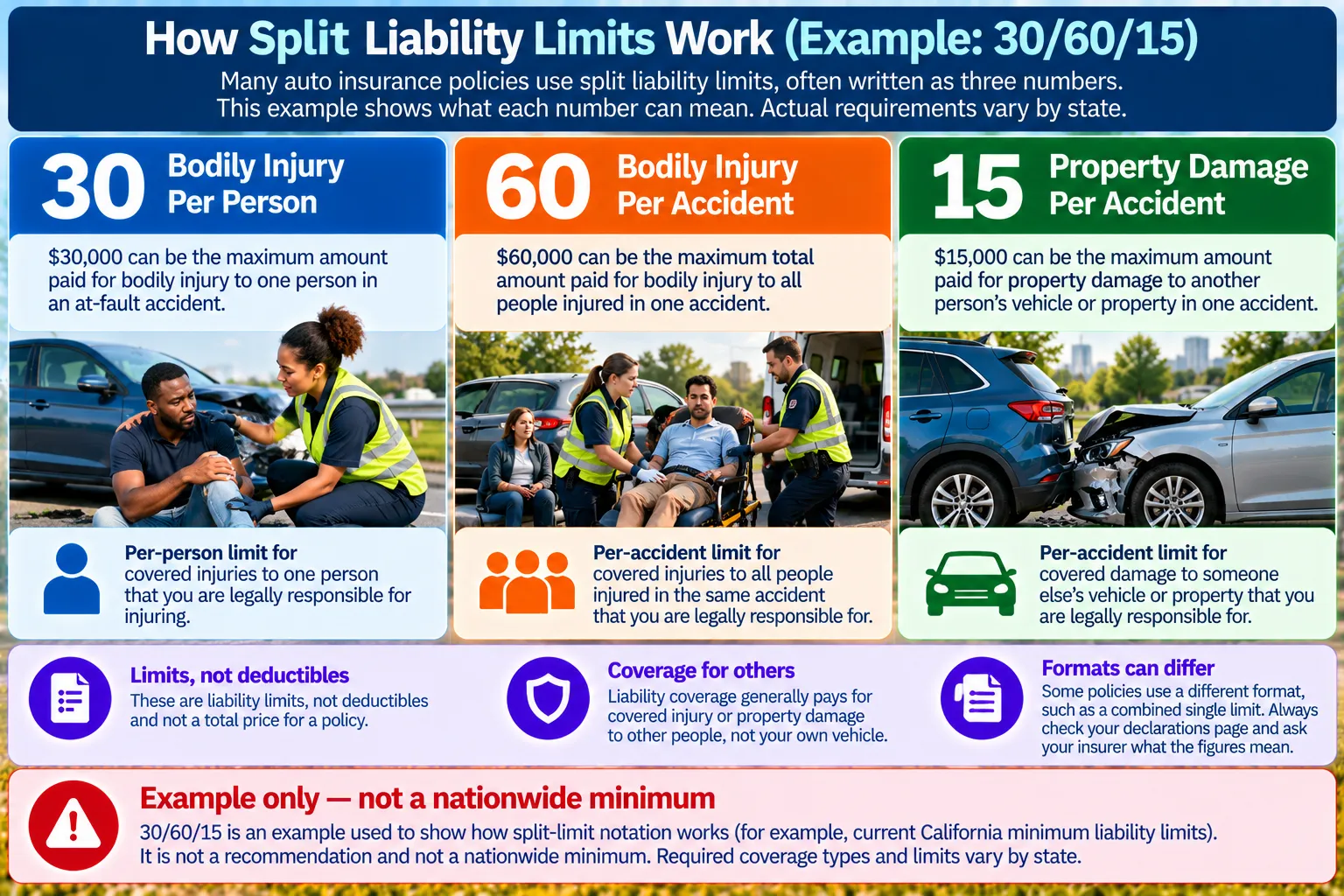
The three figures are limits, not deductibles and not a total price for a policy. A per-person bodily-injury limit operates within the per-accident bodily-injury limit, while the property-damage limit is a separate maximum for covered damage to others’ property. A declarations page may use another format, such as a combined single limit, so readers should ask the insurer what the figures on their own document mean rather than mapping one state’s notation onto another policy.
Is state-minimum insurance the same as liability-only insurance?
Not necessarily. Liability coverage is central to most states’ minimum requirements, but some jurisdictions require additional coverage. A policy that meets one state’s legal minimum may therefore include more than bodily injury and property damage liability, while another policy may be structured differently.
The terms can also obscure details. A person might call a policy “liability-only” even though it includes state-required medical-related or uninsured-motorist protection. Review the declarations page and relevant state rule rather than treating either shorthand label as a complete description.
Is state-minimum insurance the same as full coverage?
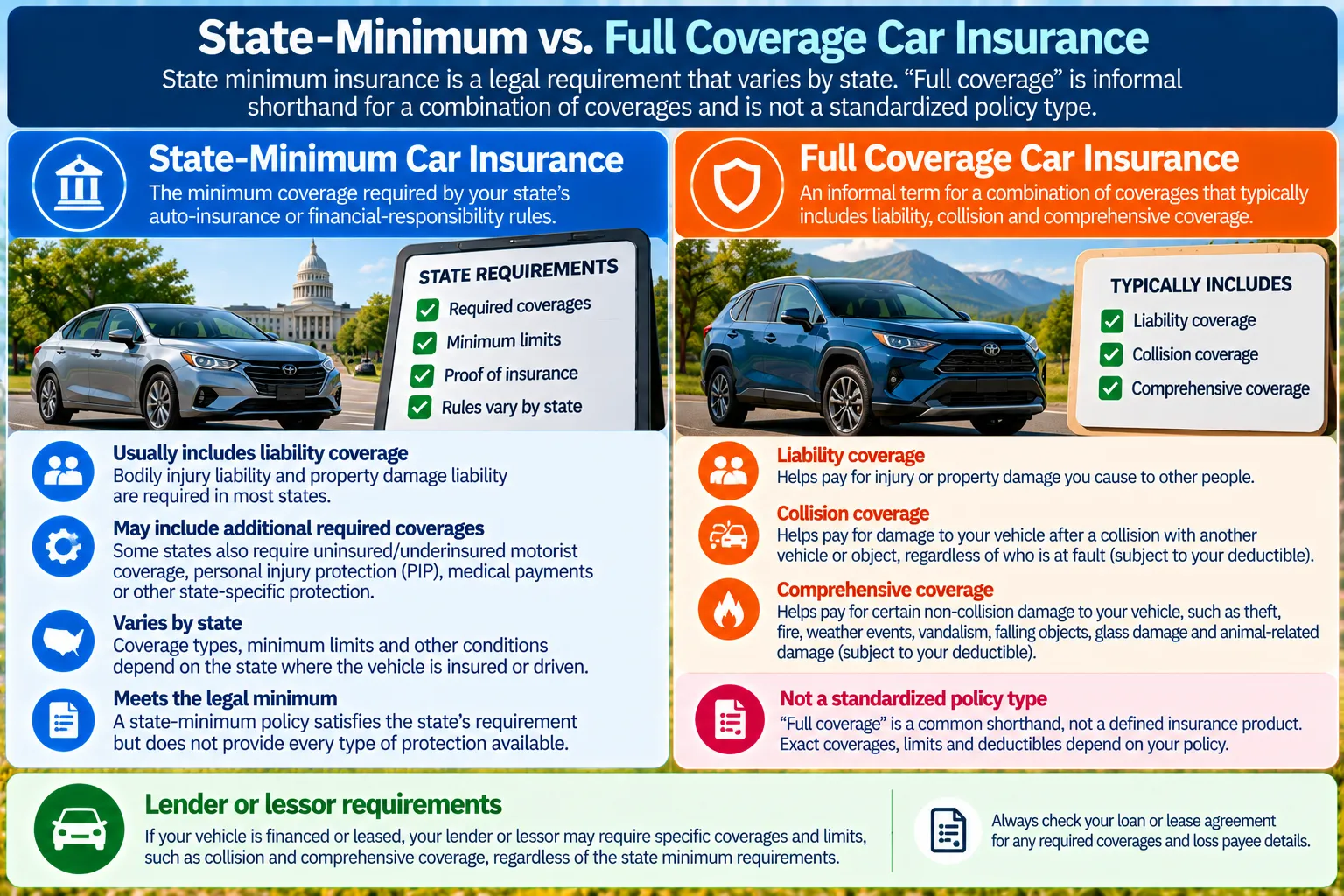
No. State minimum refers to a legal or financial-responsibility threshold. “Full coverage” is an informal phrase commonly used for liability together with collision and comprehensive coverage, but it is not a standardized package or a guarantee of complete protection. Read What Is Full Coverage Car Insurance? for that distinction.
Collision and comprehensive are generally physical-damage coverages, not state-mandated minimum coverage merely because someone owns a vehicle. A lender or lessor may separately require them while it has a financial interest in the vehicle. For the difference between those coverages, see Comprehensive vs. Collision Insurance: What’s the Difference?.
Does state-minimum insurance cover damage to your own car?
Liability coverage generally addresses covered injuries or property damage the insured driver causes to other people. It generally does not operate as collision or comprehensive protection for damage to the insured driver’s own vehicle. Collision and comprehensive can address certain covered physical damage to that vehicle, subject to their own terms and deductibles.
Because minimum packages differ by state, it is better not to say every policy labelled state-minimum contains exactly the same components. Check whether collision, comprehensive, uninsured motorist property damage, or other physical-damage coverage is actually listed for the vehicle, and read the relevant policy provisions.
Does meeting the minimum mean you are fully protected?
No. Legal compliance and protection from every possible financial loss are different ideas. A covered liability loss may exceed the policy’s limit, physical damage to the insured vehicle may require another coverage, and exclusions, deductibles, and claim conditions can still apply.
This does not mean one coverage amount is right for every person. It means a policyholder should understand what the legal minimum does and does not describe. The declarations page can show limits and selected coverages; the policy explains how they apply.
It is also important not to confuse a policy limit with the cost of an accident. A liability limit can cap the insurer’s payment for a covered claim under that coverage, while questions about responsibility, other insurance, exclusions, and applicable law may still affect the result. This is general educational information, not advice about the protection a particular driver should purchase.
Can you buy more than the state minimum?
Policies can generally be issued with liability limits above a state’s minimum and with additional available coverages. The options an insurer offers, any state rules that apply, and the cost can vary. A higher limit or an added coverage is not automatically appropriate for every driver, and this guide does not recommend a particular choice.
When comparing policies, keep the drivers, vehicles, use, limits, deductibles, and optional coverages consistent. That helps distinguish a genuine price difference from a policy that simply provides different protection.
Can a lender require more than the state minimum?
Potentially, yes. State legal requirements and lender or lessor contractual requirements are different. A lender or lessor may require collision and comprehensive coverage while it has a financial interest in the vehicle, even where those coverages are not required by state law.
Review the finance or lease agreement, policy declarations, and lender or lessor notices. Those documents may identify required coverages and conditions. This guide does not interpret a particular contract or advise whether a lender’s requirement applies in a particular situation.
What if a state allows another way to prove financial responsibility?
Insurance requirements and financial-responsibility mechanisms are not identical in every jurisdiction. The NAIC notes that New Hampshire, for example, does not have a compulsory auto-insurance liability law when a driver complies with alternative financial-responsibility requirements, while it has other financial-responsibility rules for certain drivers.
This is not an invitation to drive uninsured or a guide to deposits, bonds, or self-insurance. Alternative mechanisms can have strict legal conditions and may not be available to a particular person. Check the current official state source before relying on any alternative to conventional insurance.
Example: how different states can require different coverage
California and New York illustrate why a nationwide “state minimum” label is incomplete. California’s Department of Insurance lists 30/60/15 as the standard minimum liability limits effective January 1, 2025. Its guide also explains that insurers must offer uninsured and underinsured motorist coverage, subject to its rules.
New York’s Department of Financial Services describes a required auto-insurance package that includes liability, no-fault coverage, and uninsured motorists coverage. The details, definitions, and limits in California and New York should not be transplanted to another state. They simply demonstrate that required packages can differ in both limits and coverage types.
How to find your state’s current minimum requirements
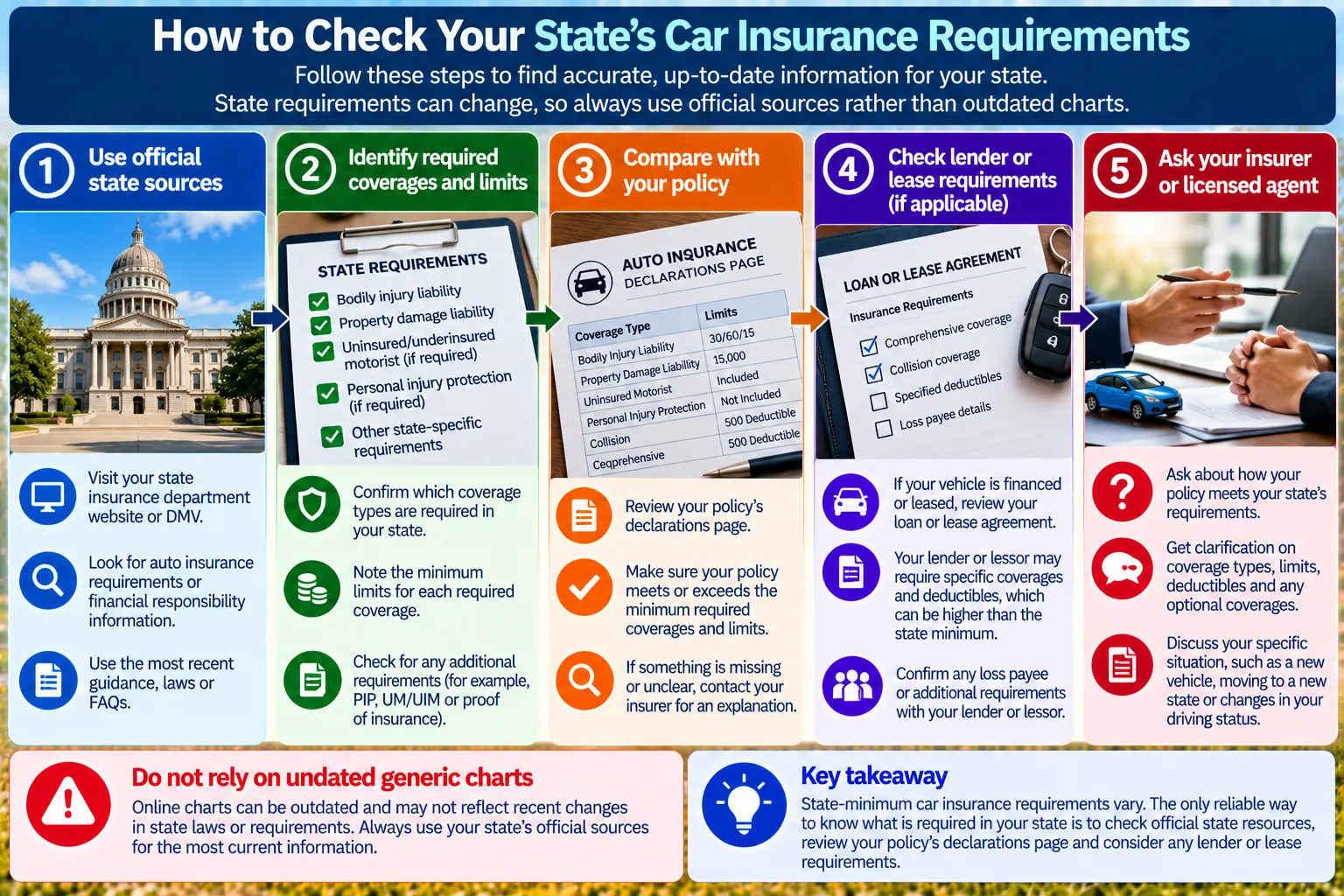
Use an official state insurance department or DMV/motor-vehicle agency as the primary source. Then compare that information with the current declarations page and policy documents. An insurer or licensed agent can answer policy-specific questions, such as how the policy is written for a particular vehicle.
Avoid relying on an undated generic internet chart. Minimum limits and rules can change, and a chart may omit medical-related, UM/UIM, financial-responsibility, or vehicle-specific conditions that matter in the relevant state.
If you recently moved, changed the vehicle’s garaging location, bought or leased a vehicle, or renewed a policy, re-check the rule and the issued documents. A rule from the prior state or an estimate from before the policy was issued may not describe the current requirement. Keep the declarations page and proof-of-insurance information accessible, but use the policy and regulator guidance for questions about what is required.
Questions to ask when reviewing minimum coverage
These questions can make the shorthand more useful:
- Which coverages does my state currently require?
- What minimum limits apply to each required coverage?
- Does my state require, offer, or allow rejection of UM/UIM coverage?
- Does it require PIP or another medical-related coverage?
- What does my policy include beyond the legal minimum?
- Does a lender or lessor require physical-damage coverage?
- What deductibles apply to any collision, comprehensive, or other selected coverage?
The bottom line
There is no single U.S. state-minimum insurance package. Requirements vary by jurisdiction. Liability coverage forms the core requirement in most states, but other required coverages can apply. Meeting a legal minimum is not the same as comprehensive protection or informal “full coverage,” so verify the current state rule and the actual policy documents.