
What does “full coverage” car insurance mean?
“Full coverage” is an informal consumer and industry expression, not a standardized coverage defined the same way by every insurer or state. In ordinary use, it commonly describes a policy with liability coverage plus collision and comprehensive coverage for the insured vehicle. That shorthand can be useful, but it is not a promise that every accident, expense, person, vehicle, or type of damage is covered.
For a direct comparison with liability-focused coverage, see Liability vs. Full Coverage Car Insurance: What’s the Difference?.
The National Association of Insurance Commissioners (NAIC) separates auto insurance into liability and property-damage areas, and describes collision and comprehensive as common forms of property-damage coverage. A particular policy can include more or less than the common shorthand suggests. Its declarations page, endorsements, exclusions, limits, deductibles, and applicable state rules determine the protection that is actually in place.
What is usually included in full coverage?
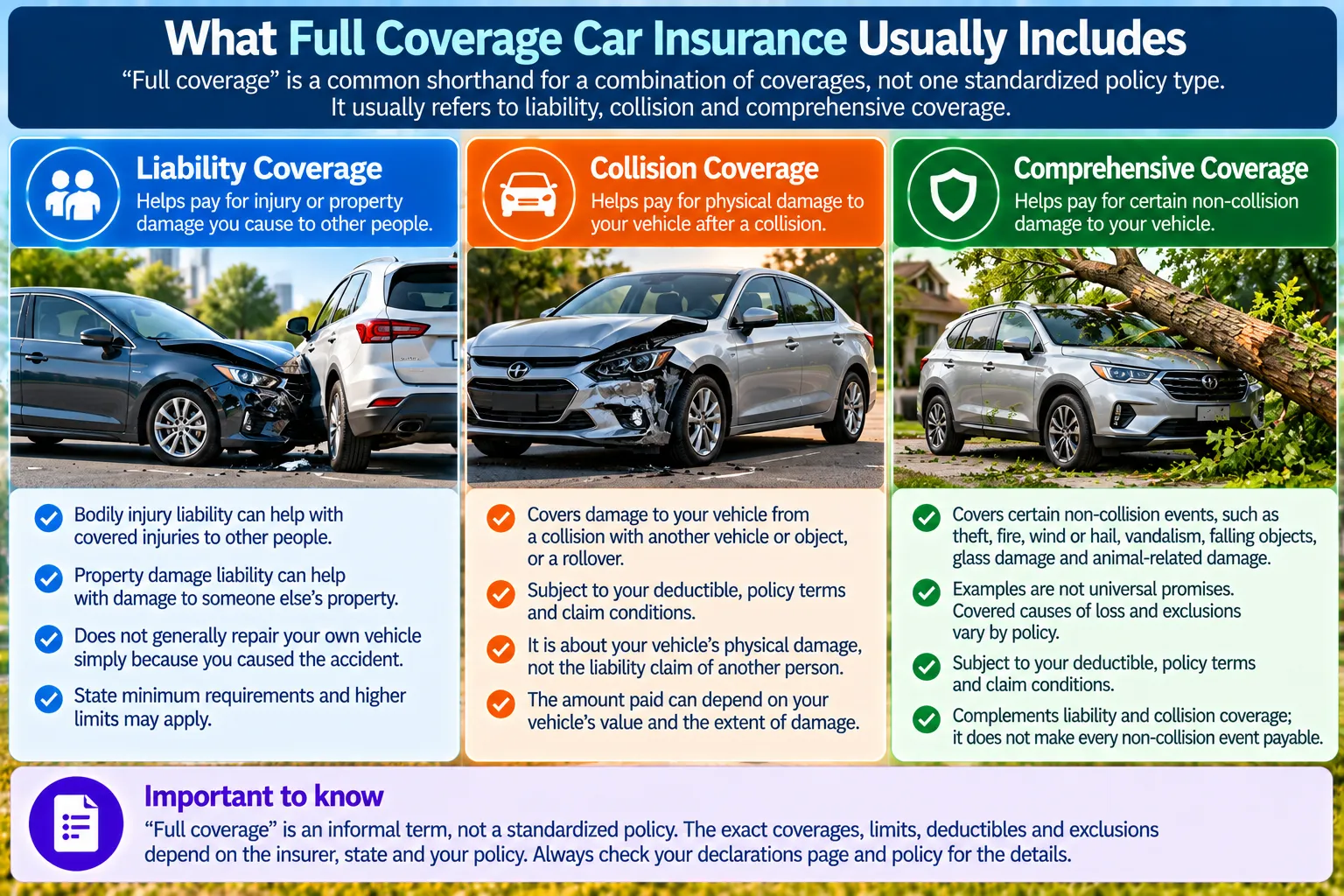
The phrase usually points to three coverage areas. They answer different questions and each remains subject to its own policy wording.
Liability coverage
Liability coverage generally addresses covered injury or property damage an insured driver causes to other people when the driver is legally responsible. Bodily injury liability and property damage liability are commonly listed separately, and state financial-responsibility requirements can differ. It does not generally repair the insured driver’s own vehicle simply because that driver caused an accident.
For a closer explanation of limits and the distinction between harm to others and damage to your own vehicle, read What Is Liability Car Insurance and What Does It Cover?.
Collision coverage
Collision coverage can help with covered physical damage to the insured vehicle after it collides with another vehicle or object, or in a rollover, subject to the policy terms and deductible. It is about the insured vehicle’s physical damage, not the liability claim of another person.
The applicable payment can still depend on the vehicle’s value, the cause and extent of damage, the deductible, exclusions, and claim conditions. Collision is often part of what people mean by full coverage, but the label does not say how that coverage is written in a particular policy.
Comprehensive coverage
Comprehensive coverage generally addresses certain covered non-collision damage to the insured vehicle. Depending on the policy, examples can include theft, fire, particular weather events, vandalism, falling objects, glass damage, or animal-related damage. These examples are not universal promises: covered causes of loss, exclusions, limits, and deductibles differ by policy.
Together, collision and comprehensive are often called physical-damage coverages. They complement liability coverage; they do not turn liability into first-party vehicle coverage or make every non-collision event payable.
For a closer comparison of the two physical-damage coverages and common event examples, see Comprehensive vs. Collision Insurance: What’s the Difference?.
What might not be included?
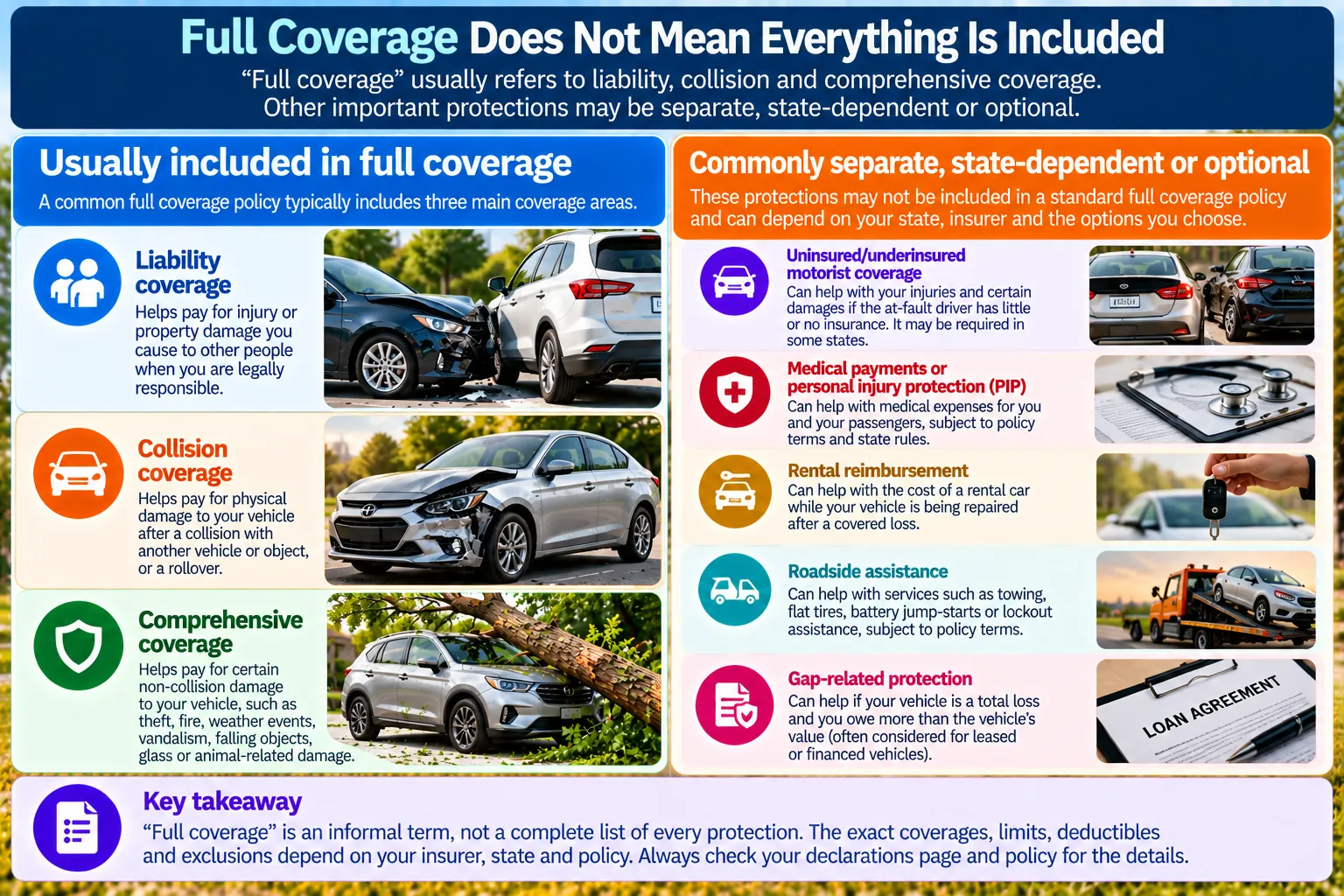
“Full coverage” should not be read as a complete list of every protection a driver might have. Depending on the state and policy, other coverage can be separately required, offered, selected, limited, or excluded. Examples can include uninsured or underinsured motorist coverage, medical payments coverage, personal injury protection, roadside assistance, rental reimbursement, gap-related protection, and coverage for custom equipment or other endorsements.
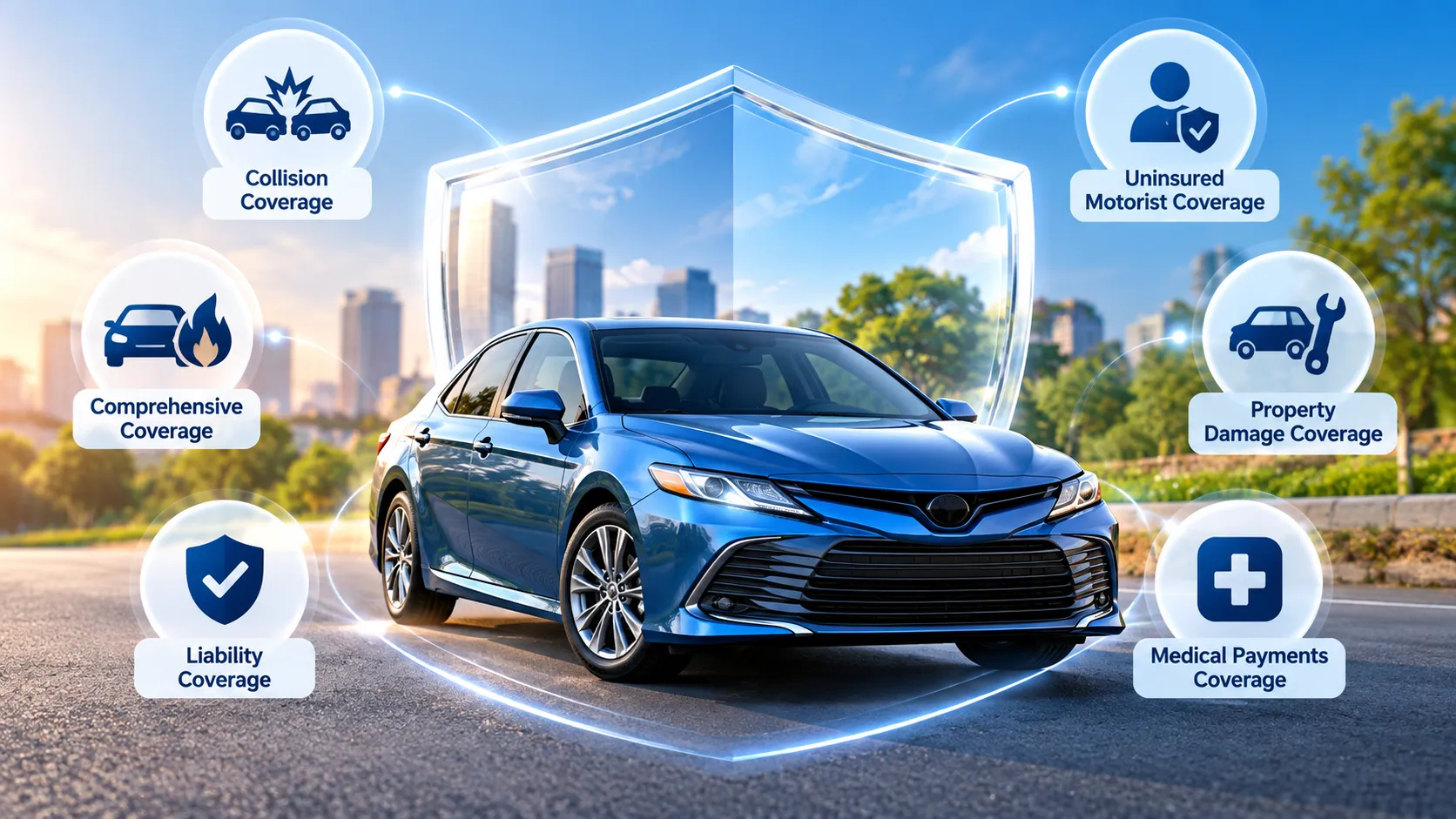
Whether one of those items is available or included is not answered by the phrase “full coverage.” State rules vary, particularly for medical-related and uninsured-motorist protections. For the distinction between uninsured and underinsured motorist coverage, see What Is Uninsured Motorist Coverage and What Does It Cover?. A lender or lessor may also have separate contract requirements. The illustration on this page represents common coverage concepts, not a standardized full-coverage package.
Does full coverage cover everything?
No. A policy described as full coverage can still have exclusions, coverage limits, deductibles, conditions, and defined uses or drivers. Claims can be affected by whether the loss fits the insuring agreement, whether a driver or use is covered, and whether the required claim steps were followed.
For example, intentional damage generally is treated differently from an accidental covered loss. Normal wear and tear, maintenance, and mechanical breakdown are not automatically insured vehicle damage. A policy can also exclude or limit particular uses, people, equipment, locations, or types of loss. Those examples do not decide any particular claim; the actual policy and facts control.
The limits matter as much as the coverage names. Liability is generally subject to the listed liability limits, while physical-damage coverage may be limited by the covered loss, vehicle value, deductible, valuation provisions, and policy conditions. A loss can therefore be covered in principle but still result in a payment that is less than a repair estimate or replacement cost. That is not a reason to assume a claim will or will not be paid; it is a reason to read the applicable policy language and ask how the insurer will evaluate the reported loss.
Full coverage vs. liability-only insurance
Liability-focused insurance primarily addresses covered harm an insured driver causes to others. A person may use “liability-only” as shorthand for a policy without collision and comprehensive, although that label can also be imprecise because other coverages may still apply.
Full coverage commonly adds collision and comprehensive, which can address certain covered damage to the insured vehicle. It is not a better-or-worse verdict on any individual policy, and it is not a guarantee of complete protection. The useful comparison is the specific coverage list, limits, deductibles, exclusions, and policy conditions.
When might full coverage be required?
State law does not generally require a universal package called full coverage. Auto-insurance and financial-responsibility rules vary by state, and a state may require coverages beyond or different from basic liability. Check the current rules with the appropriate state insurance regulator or DMV rather than relying on a national shorthand.
A different issue arises when a vehicle is financed or leased. While it has a financial interest in the vehicle, a lender or lessor may contractually require physical-damage coverage such as collision and comprehensive. The NAIC notes that collision may be required by a lending institution or lessor, even though it is not generally required by law. Review the finance or lease agreement, the policy declarations, and any notice from the lender or lessor to understand its current requirements.
Do you need full coverage on a paid-off car?
There is no universal answer. Paying off a vehicle may end a lender’s or lessor’s contractual physical-damage requirement, but it does not end state-required liability or other legally required coverage. The decision to keep, change, or decline physical-damage coverage can involve the vehicle’s value, the cost of the coverage, deductibles, the ability to absorb a repair or total loss, and personal financial circumstances.
Rather than relying on the label full coverage, identify the coverage currently listed for the vehicle and what financial loss each part addresses. A policy document and a current vehicle valuation can make that conversation more concrete. An insurer, agent, or licensed professional can explain the options available for a particular policy; this guide does not recommend a specific choice.
How much does full coverage cost?
There is no single national price that usefully describes every policy called full coverage. Premium can vary with the insurer, state, vehicle, location, drivers, driving and claims history, coverage limits, deductibles, payment structure, and other factors permitted by law. Different physical-damage coverage choices can change a premium, but a lower price may also reflect less coverage or a different deductible.
For the broader factors behind auto-insurance pricing and a method for comparing equivalent quotes, see How Much Is Car Insurance? What Affects the Cost. Compare total premium and coverage details on the same facts rather than treating a generic average or monthly payment as a complete answer.
What deductibles apply?
Collision and comprehensive commonly have deductibles. A deductible is the amount the policyholder may be responsible for before an insurer pays a covered loss under that coverage, subject to the policy terms. The declarations page should show the deductible that applies to each listed physical-damage coverage.
Liability works differently and should not be treated as though it necessarily has the same deductible structure. Check the policy documents for how any deductible, limit, or other condition applies. This guide does not recommend a deductible amount; the relevant question is what the policy says and what financial risk the policyholder can manage.
How to check what your policy actually covers
Start with the declarations page, then read the policy and any endorsements. The NAIC notes that the declarations page identifies important information such as the policy term, coverage limits, insured, and covered vehicles. A practical review includes:
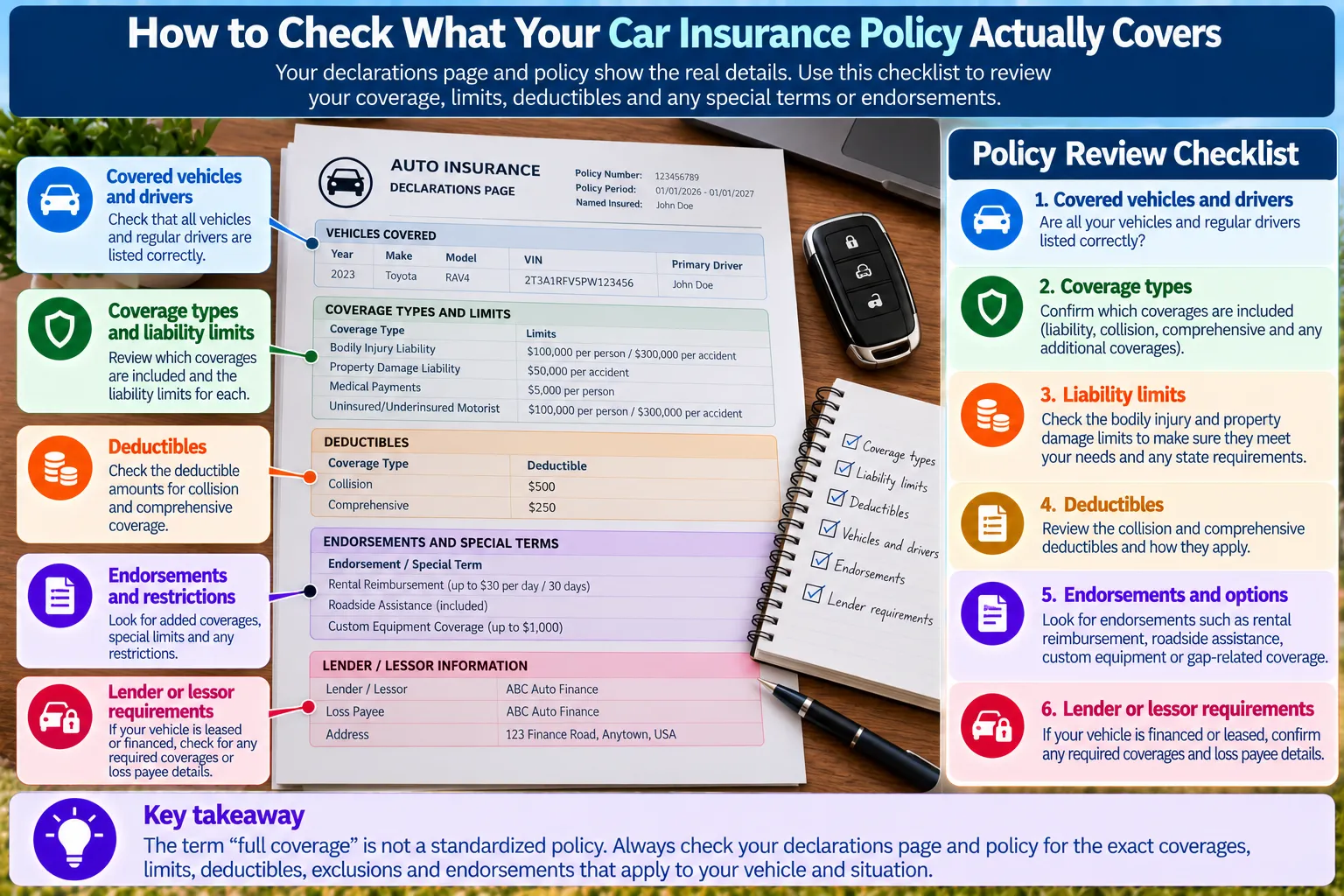
- The named coverage types, including liability, collision, comprehensive, medical-related coverage, and uninsured or underinsured motorist protection where relevant.
- The liability limits and physical-damage deductibles shown for each vehicle.
- Exclusions, conditions, endorsements, and any restrictions on vehicle use or drivers.
- The named or covered vehicles and drivers, as applicable.
- Any lender or lessor requirement while a loan or lease remains in place.
If a label on a quote or renewal is unclear, ask the insurer or agent to identify the exact coverage form and limits. The informal phrase full coverage is less useful than the actual documents.
It can also help to compare the declarations page with the vehicle’s current use. A change in garaging location, ownership, lease or loan status, listed drivers, business use, ridesharing, delivery, or custom equipment can affect what questions to ask about a policy. That review does not alter the policy by itself. Report changes to the insurer as the policy requires and keep written copies of the documents and responses you receive.
Questions to ask before choosing coverage
These questions can help a reader understand a quote without assuming the same answer fits everyone:
- What damage to my own vehicle is covered, and under which coverage?
- What bodily injury and property damage liability limits are shown?
- What deductibles apply to collision and comprehensive?
- Are uninsured or underinsured motorist protections included, required, or available in my state?
- Are medical-related auto coverages required or available where I live?
- Which exclusions, conditions, and endorsements should I understand?
- Does a lender or lease agreement require particular physical-damage coverage?
The bottom line
Full coverage usually means a policy centered on liability, comprehensive, and collision coverage. It is a useful starting description, but it is not a standardized guarantee that every loss is covered. State requirements, lender or lessor requirements, selections, limits, deductibles, exclusions, and policy terms all matter. Before relying on the phrase, review the declarations page and the policy’s actual coverage components.