
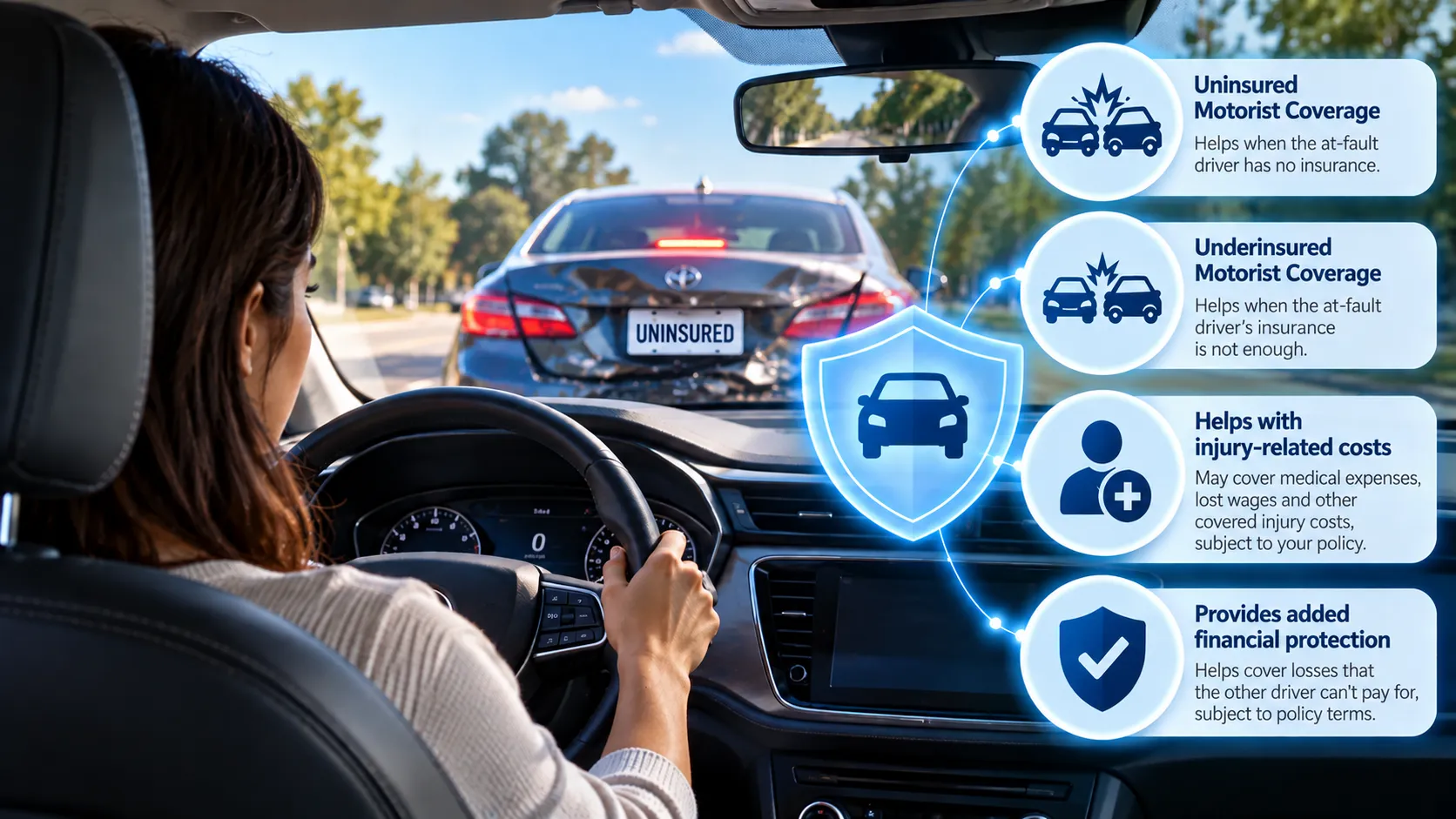
What is uninsured motorist coverage?
Uninsured motorist coverage, often called UM coverage, is protection under the insured person’s own policy when a driver responsible for a covered crash has no applicable liability insurance. It is conceptually different from the other driver’s liability insurance: liability is intended to address covered claims against the at-fault driver, while UM can address a covered loss under the injured person’s own policy when the other driver lacks applicable coverage.
The NAIC describes uninsured motorist coverage as protection for insureds injured by an at-fault motorist with no bodily liability insurance, including certain hit-and-run or denied-coverage situations. The exact definition, who counts as an insured, covered damages, notice requirements, and exclusions depend on state law and the policy. Do not assume the same rule applies across every jurisdiction.
What is underinsured motorist coverage?
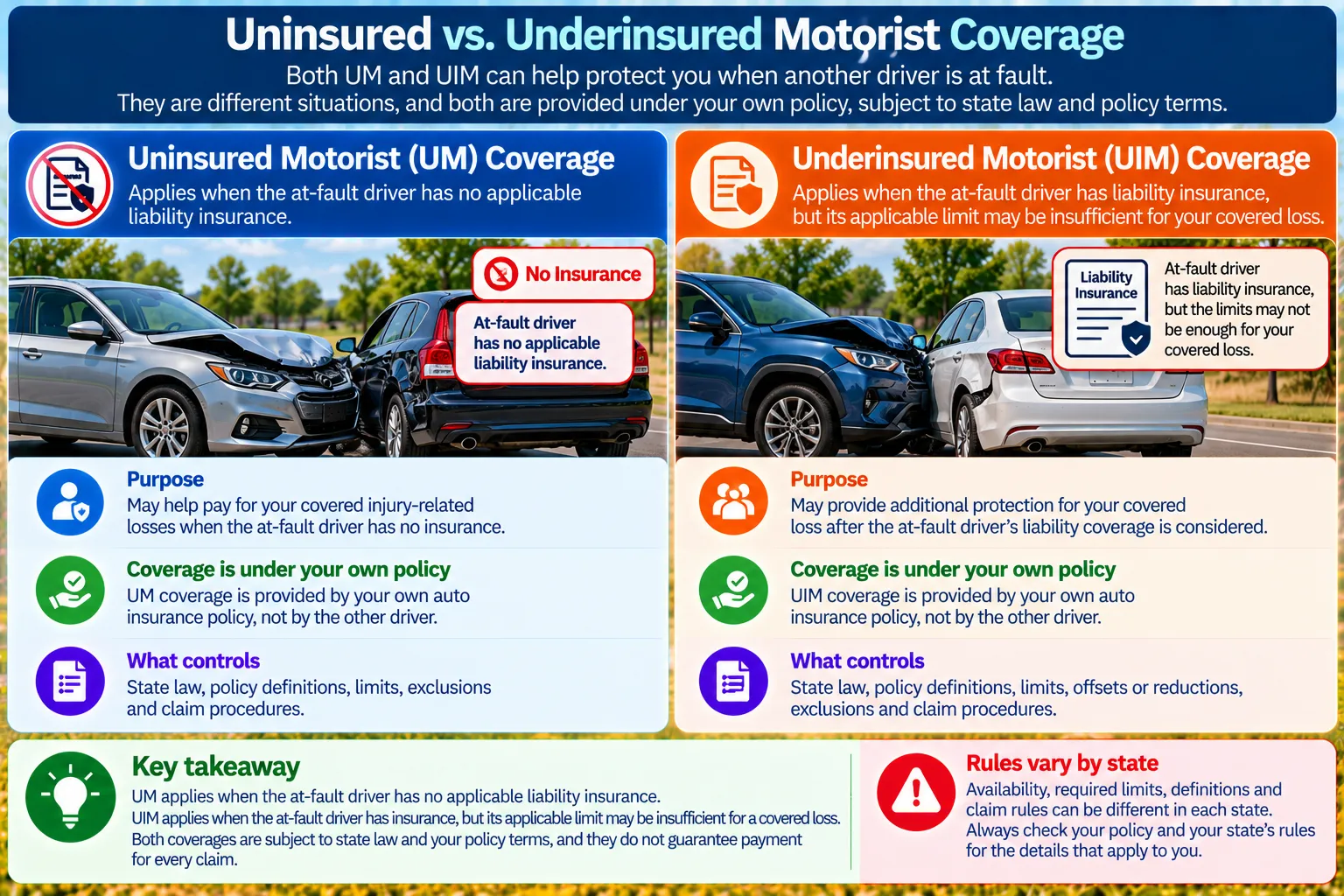
Underinsured motorist coverage, usually called UIM coverage, can apply when the at-fault driver has liability insurance but the applicable limit may not be enough for a covered loss. It is not simply “extra liability coverage” for the other driver; it is protection under the injured person’s own policy, subject to its conditions.
UIM rules can be especially state-specific. Policies and state law may address applicable limits, offsets or reductions for other payments, settlement consent, stacking, and other procedures differently. There is no universal formula for deciding whether a driver is underinsured or how much UIM coverage may be available. The policy and the law that applies to it control.
Uninsured vs. underinsured motorist coverage
The basic distinction is the other driver’s applicable liability insurance situation:
| Situation | Uninsured motorist (UM) | Underinsured motorist (UIM) |
|---|---|---|
| Other driver’s applicable liability insurance | None, or treated as unavailable under applicable law and policy terms | Exists, but may be insufficient for a covered loss |
| Basic purpose | May protect an insured person injured in a covered crash | May provide additional protection after the other driver’s applicable coverage is considered |
| What controls | State law, policy definitions, limits, exclusions, and claim procedures | State law, policy definitions, limits, offsets or reductions, exclusions, and claim procedures |
This table is a conceptual comparison, not a universal claim rule. A state may use different terms, require an offer or waiver process, or distinguish bodily injury from property damage coverage.
What can uninsured motorist bodily injury cover?
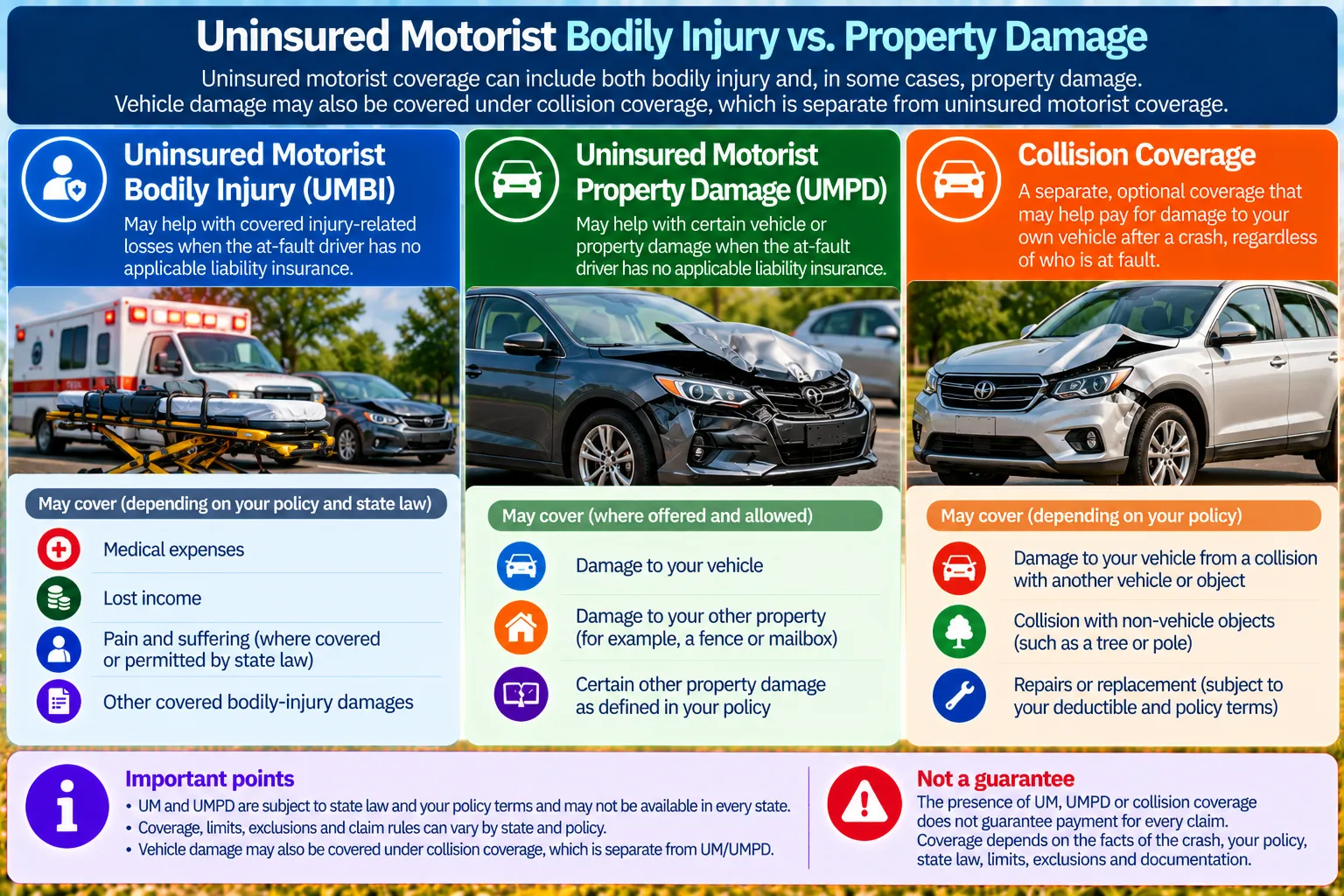
Uninsured motorist bodily injury, sometimes abbreviated UMBI, may help with covered injury-related losses when the policy and state law allow. Depending on the policy, those losses can include medical expenses, lost income, pain and suffering where covered or permitted, and other covered bodily-injury damages.
The category does not promise payment of every medical bill, wage loss, or claimed damage. The facts of the crash, the legal responsibility of the other driver, the insured-person definition, limits, exclusions, documentation, and state requirements can affect a claim. This guide is educational information, not medical or legal advice.
Who can be protected?
UM and UIM coverage can apply to people the policy defines as insureds. That may include a named insured, resident family or household members where the policy defines them that way, and passengers in some circumstances. Pedestrians or occupants of other vehicles can also raise policy-specific questions.
Those categories are not universal. Definitions can differ by state, policy form, vehicle, residence, and the circumstances of the loss. The New York Department of Financial Services, for example, describes protections for particular people and situations under New York rules; that example should not be treated as a nationwide definition. Read the policy’s insured-person language rather than assuming all passengers or household members are always covered.
Does uninsured motorist coverage pay for vehicle damage?
It depends on the type of UM coverage and the state. UM bodily injury coverage should not be treated as vehicle-damage coverage. Some policies or jurisdictions offer uninsured motorist property damage, often called UMPD, which may address certain damage to an insured vehicle caused by an uninsured driver. Its availability, limits, deductible treatment, identification requirements, and relationship to other coverage vary.
Collision coverage may also be relevant to damage to the insured vehicle after a crash. UMPD and collision are not interchangeable: they can have different triggers, limits, deductibles, and state-law rules. For a guide to vehicle physical-damage categories, see Comprehensive vs. Collision Insurance: What’s the Difference?.
What happens in a hit-and-run?
Whether a hit-and-run event qualifies under UM coverage can vary by state and policy. Requirements may differ on physical contact, identification of the other vehicle or driver, proof, timely reporting, and the treatment of bodily injury versus property damage. It is not accurate to say UM always covers every hit-and-run accident nationwide.
After a crash, prioritize safety and emergency assistance. When safe, preserve photographs, witness information, available vehicle details, and report information. Notify the insurer promptly according to the policy, and ask what documentation or claim steps apply. Those steps help document an event; they do not guarantee coverage or payment.
Is uninsured motorist coverage required?
Requirements vary significantly by state. Depending on the jurisdiction, UM or UIM may be required, insurers may be required to offer it, a policyholder may be allowed to reject it, or a rejection may have to follow a particular form or process. Different rules can apply to bodily injury and property damage coverage.
For example, California’s consumer guide states that insurers must offer UM/UIM coverage and describes a waiver process, while New York has its own mandatory and supplementary uninsured-motorist framework. Those are examples of why a reader should not generalize one state’s system nationwide. Check the current information from the state insurance regulator and the policy documents for the state where coverage is issued.
How do UM and UIM limits work?
Policies specify limits for UM and UIM coverage. Some states or policy forms relate those limits to liability limits; others may have rules about selection, stacking, offsets, reductions, combining limits, or the order in which coverages apply. These details can materially affect a claim and are not uniform across the United States.
There is no single limit or stacking rule that MyCoverScope can recommend for every driver. Review the declarations page for the limits shown, then read any applicable endorsements and ask the insurer or agent to explain terms that are unclear. A limit on a declarations page is not a prediction of what an insurer will pay on a particular claim.
If another insurer or policy may also be involved, do not assume the coverages can simply be added together. The policy and applicable state rules can set the order, amount, and conditions of any available protection. Preserve notices and correspondence so the insurer can explain the applicable process.
Does uninsured motorist coverage have a deductible?
Do not assume a universal answer. UM bodily injury and UM property damage can operate differently, and any deductible can depend on the coverage, state, and policy. A declaration or endorsement may show a deductible for a particular property-damage feature while bodily-injury coverage works differently.
Check the declarations page and policy wording rather than relying on a standard deductible amount. The deductible question also should not be confused with collision or comprehensive deductibles, which can be separately selected.
How does UM/UIM relate to liability insurance?
The responsible driver’s liability insurance is intended to respond to covered liability claims against that driver. UM/UIM is coverage under the injured person’s own policy when the responsible driver’s insurance situation meets the applicable UM or UIM conditions. The two coverages can therefore be relevant to the same crash for different reasons.
For more about liability’s bodily-injury and property-damage role, read What Is Liability Car Insurance and What Does It Cover?. Liability limits, UM/UIM limits, state rules, and policy procedures should not be assumed to work the same way.
Is UM/UIM part of “full coverage”?
Not automatically. “Full coverage” is informal shorthand, commonly referring to liability plus collision and comprehensive, rather than a standardized package. UM/UIM can be required, offered, selected, limited, or rejected differently depending on state law and the policy.
For the limits of the full-coverage label, see What Is Full Coverage Car Insurance?. The useful question is whether UM, UIM, UMBI, or UMPD is actually listed on the declarations page and how the policy defines it.
Example: uninsured vs. underinsured driver
Consider two conceptual examples. In the first, a driver causes a covered crash and has no applicable liability insurance. UM coverage under the injured person’s own policy may be relevant if the policy, state law, and facts meet its requirements.
In the second, the responsible driver has liability insurance, but its applicable limit may be insufficient for a covered injury loss. UIM coverage may be relevant after the other driver’s coverage and applicable policy rules are considered. Neither example decides fault, coverage, damages, or payment in an actual claim.
What should you check on your policy?
Start with the declarations page, then the policy and endorsements. A practical review includes:
- Whether the policy uses UM, UIM, UMBI, UMPD, or different terminology.
- The difference between bodily-injury and property-damage protection.
- Limits and any deductible that applies.
- Who is defined as an insured person.
- Exclusions, hit-and-run provisions, and state-specific endorsements.
- Selection, rejection, or waiver documentation where relevant.
If the wording is unclear, ask the insurer or agent to identify the policy provision and explain how it applies to the vehicle and state. Keep copies of the declarations page, endorsements, and any signed selection or rejection records.
What to do after a crash involving an uninsured driver
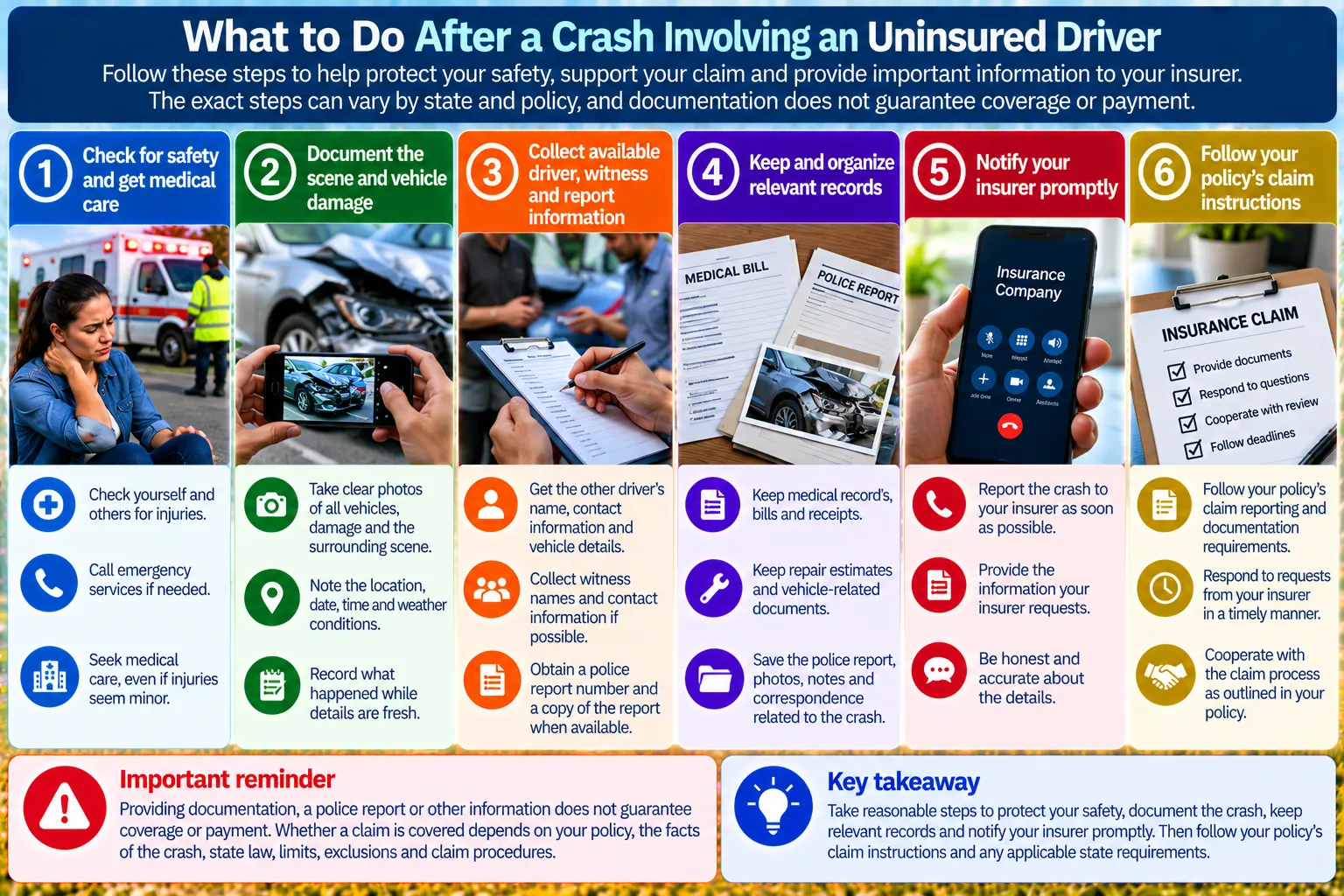
First, prioritize safety and emergency care. Exchange available information if it is safe to do so, document the scene and vehicle damage, and obtain police or report information where appropriate. Preserve photographs, witness information, medical or expense records where relevant, and communications about the event.
Notify the insurer promptly according to the policy’s requirements and follow its claim-documentation instructions. Do not admit or assign fault at the scene. The insurer will evaluate the facts and policy; keeping accurate records can help it investigate without providing a guarantee about coverage.
The bottom line
UM can provide protection when a responsible driver lacks applicable insurance, while UIM can provide protection when that driver’s applicable insurance may be insufficient for a covered loss. Both are shaped heavily by state law and policy language. Check the actual limits, definitions, exclusions, endorsements, and claim procedures before relying on the coverage label.