
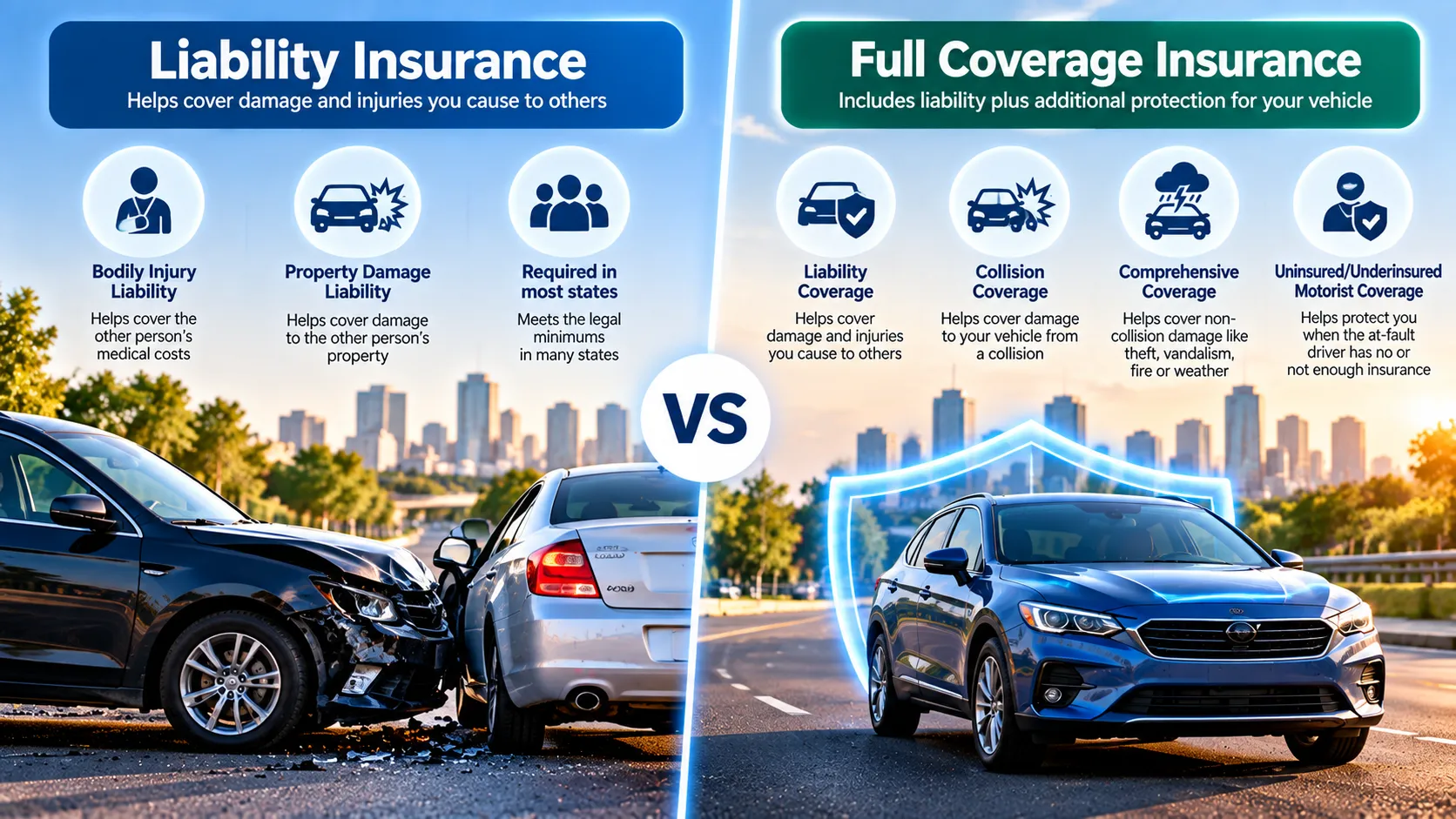
Liability vs. full coverage at a glance
“Full coverage” is an informal label, so the table describes common usage rather than a standardized policy. The declarations page and policy terms determine a particular policy’s coverage.
| Question | Liability coverage | “Full coverage” shorthand |
|---|---|---|
| Main purpose | Covered responsibility for injury or property damage caused to others | Commonly liability plus physical-damage coverage for the insured vehicle |
| Damage to another person’s vehicle | May apply when the insured driver is legally responsible | Liability may apply in the same way |
| Collision damage to the insured vehicle | Generally no | Commonly addressed through collision, subject to terms and deductible |
| Theft, fire, or covered weather damage to the insured vehicle | Generally no | Commonly addressed through comprehensive, subject to terms and deductible |
| State requirements | Most states require minimum liability protection, but rules vary | Not a legal term or universal state-required package |
| Lender or lessor requirements | May be part of required insurance | A lender or lessor may contractually require collision and comprehensive |
| Deductibles and limits | Commonly uses stated liability limits | Collision and comprehensive commonly have deductibles and valuation terms |
| UM/UIM and other coverage | May be required, offered, or selected separately | Not automatically included merely because someone says “full coverage” |
What is liability car insurance?
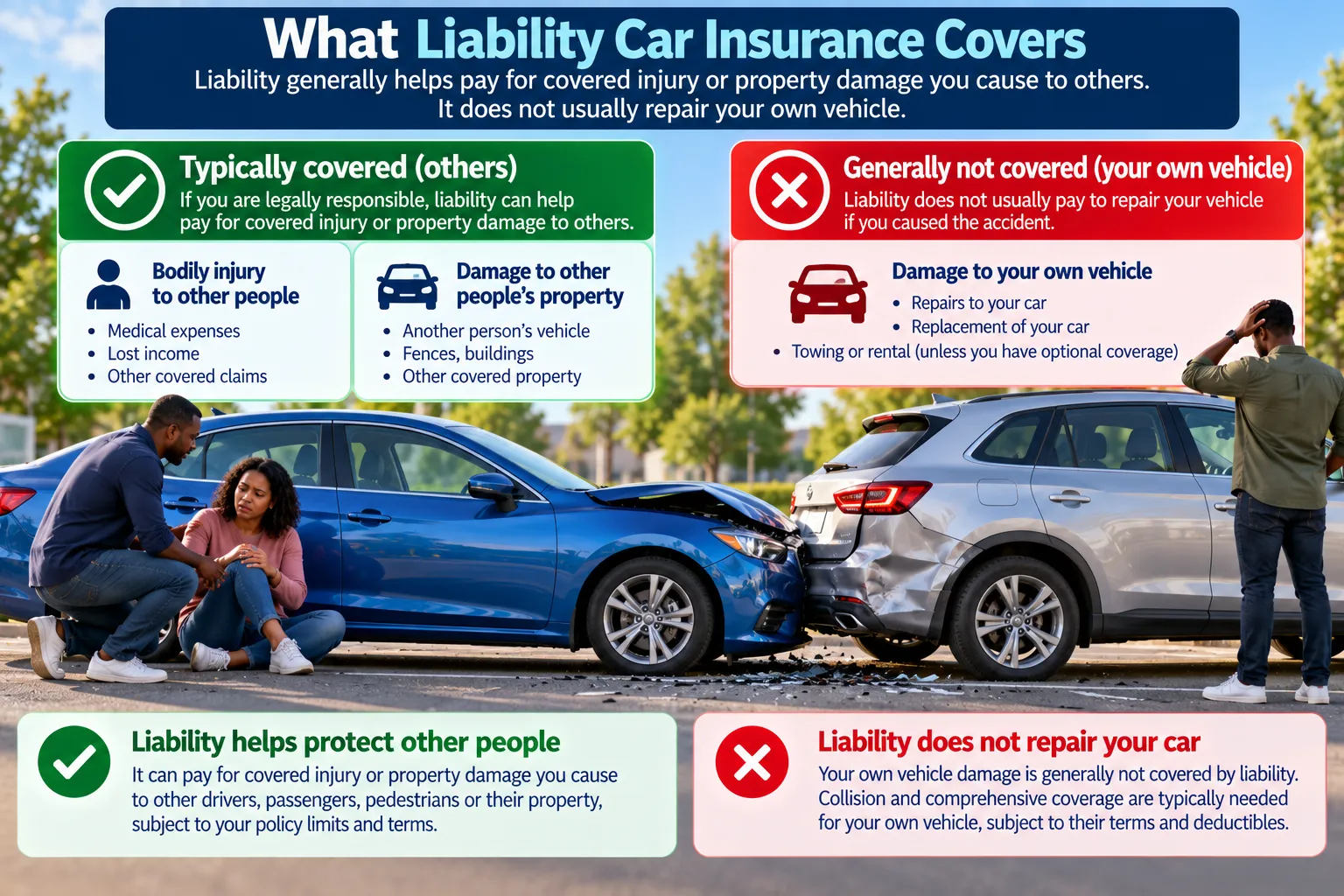
Liability car insurance generally addresses covered harm an insured driver causes to other people when the driver is legally responsible. Its familiar components are bodily injury liability, which can concern covered injuries to others, and property damage liability, which can concern covered damage to another person’s vehicle or property.
Liability limits, policy terms, exclusions, conditions, and the facts of an accident govern how it works. It is primarily about responsibility to others, not repair of the insured driver’s own vehicle. For the detailed guide, see What Is Liability Car Insurance and What Does It Cover?.
What does “full coverage” mean?
Full coverage is informal terminology rather than a standardized insurance product. In common use, it refers to liability coverage together with collision and comprehensive coverage. A policy can have more or fewer additional protections depending on the insurer, state requirements, coverage selections, endorsements, and policy wording.
That means no phrase alone confirms whether a policy includes uninsured or underinsured motorist protection, medical payments, personal injury protection, rental reimbursement, roadside assistance, gap-related protection, or custom-equipment coverage. For the components and limits of the term, read What Is Full Coverage Car Insurance?.
What does liability insurance cover?
Liability coverage can address covered bodily injury or property damage claims made by others after an insured driver causes an accident. For example, a covered claim may involve another person’s injuries or damage to another person’s car, fence, or building. The amount available is generally subject to the liability limits and policy terms.
Liability coverage generally does not repair the insured driver’s own car merely because that driver caused a crash. That distinction matters when comparing a policy described as liability-only with one that includes collision and comprehensive. The presence of liability does not automatically create first-party physical-damage coverage.
What do collision and comprehensive add?
Collision and comprehensive are commonly called physical-damage coverages. Collision can help with covered damage to the insured vehicle after an impact with another vehicle or object, or certain rollover losses. Comprehensive can help with certain covered non-collision damage, such as theft, fire, vandalism, weather, falling objects, or animal-related damage.
These are general examples, not promises that every event is covered. Collision and comprehensive commonly have deductibles, and payment can depend on the policy’s valuation provisions, exclusions, limits, conditions, vehicle, and facts of the loss. For a detailed comparison, see Comprehensive vs. Collision Insurance: What’s the Difference?.
Does full coverage include uninsured motorist coverage?
Not necessarily. The supplied illustration places UM/UIM with full coverage, but that visual organization is not a universal policy definition. Uninsured motorist (UM) and underinsured motorist (UIM) coverage may be required by state law, offered by an insurer, selected by a policyholder, limited, or rejected under a state-specific process.
Some policies called full coverage will include UM/UIM, while others may not include the same feature or may use different terminology. The declarations page and endorsements provide the answer for a particular policy. Read What Is Uninsured Motorist Coverage and What Does It Cover? for the distinction between UM and UIM.
Liability vs. state-minimum insurance
Most states require minimum liability protection, but state-minimum insurance and liability-only insurance are not universal synonyms. A state can require additional coverage, such as personal injury protection, medical-related protection, or UM/UIM. There is no single national minimum package.
State-minimum describes the legal or financial-responsibility threshold in a particular jurisdiction; liability describes a coverage function. A policy can meet a state requirement while containing other required or selected protections. For the state-specific framework, see What Is State-Minimum Car Insurance?.
Does liability insurance cover your own car?
Usually, liability is not the standard coverage used for collision or comprehensive-type physical damage to the insured vehicle. Its primary function is covered responsibility for injury or property damage to others. Collision and comprehensive answer different first-party vehicle-damage questions.
That general distinction does not decide every claim or policy arrangement. Other insurance, endorsements, the accident facts, and policy provisions can matter. The practical step is to identify the vehicle, listed coverage, deductible, and cause of damage on the declarations page and policy.
Does full coverage cover everything?
No. The informal label does not mean every accident, cause of loss, driver, vehicle use, expense, or optional coverage is included. A policy can have exclusions, limits, deductibles, conditions, defined insured persons, use restrictions, and claim procedures.
It also does not mean an entire auto loan is automatically paid if a vehicle is damaged or totaled. Gap-related protection, rental reimbursement, roadside assistance, and other benefits may be separate. A covered loss can still be subject to a deductible, the vehicle’s value, a stated limit, and policy terms. Read the actual documents rather than relying on a quote label or graphic.
The same label can therefore describe policies with materially different protections. One policy might list collision and comprehensive alongside liability but omit rental reimbursement, while another might add endorsements or state-required coverages. A comparison is meaningful only when the vehicles, drivers, liability limits, physical-damage deductibles, included coverages, exclusions, and policy terms are visible.
Liability limits vs. collision/comprehensive deductibles
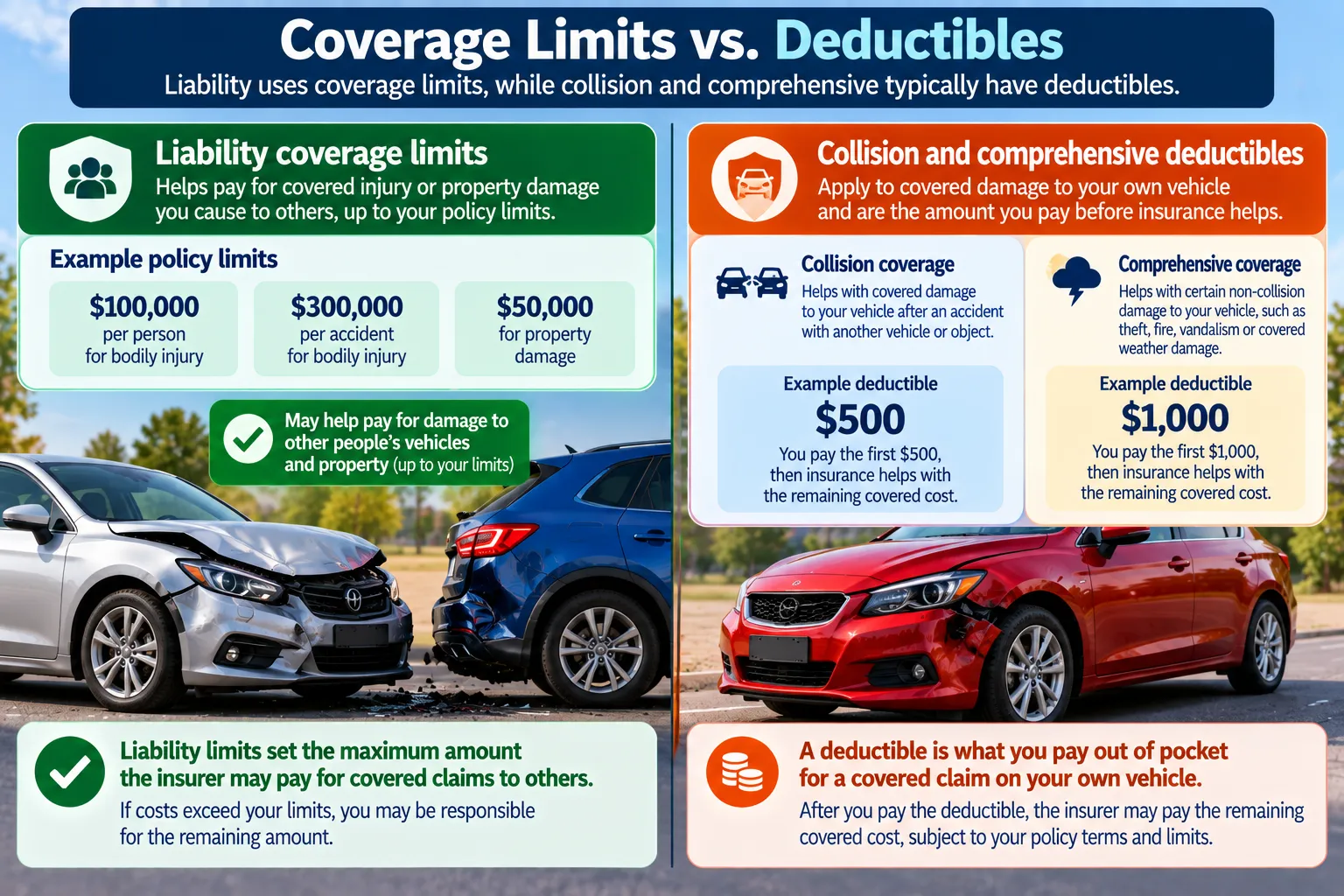
Liability coverage commonly uses stated coverage limits. Those limits describe the maximum amount available for covered liability claims under the applicable coverage, subject to policy terms. They should not be confused with the policyholder’s deductible.
Collision and comprehensive commonly involve deductibles: amounts the policyholder may bear before an insurer pays a covered loss under that coverage. They can also involve valuation provisions and conditions relevant to repair or total-loss payment. Policies are not identical, so review the documents for how limits, deductibles, and any special terms actually apply.
Which usually costs more?
All else equal, adding collision and comprehensive to a policy generally costs more than the same policy without those physical-damage coverages. The actual premium can also vary with the vehicle, location, driving and claims history, coverage limits, deductible choices, insurer practices, and factors allowed by state law.
There is no useful generic national difference to apply to every driver. For a way to compare equivalent policies and understand pricing variables, see How Much Is Car Insurance? What Affects the Cost.
Can a lender require full coverage?
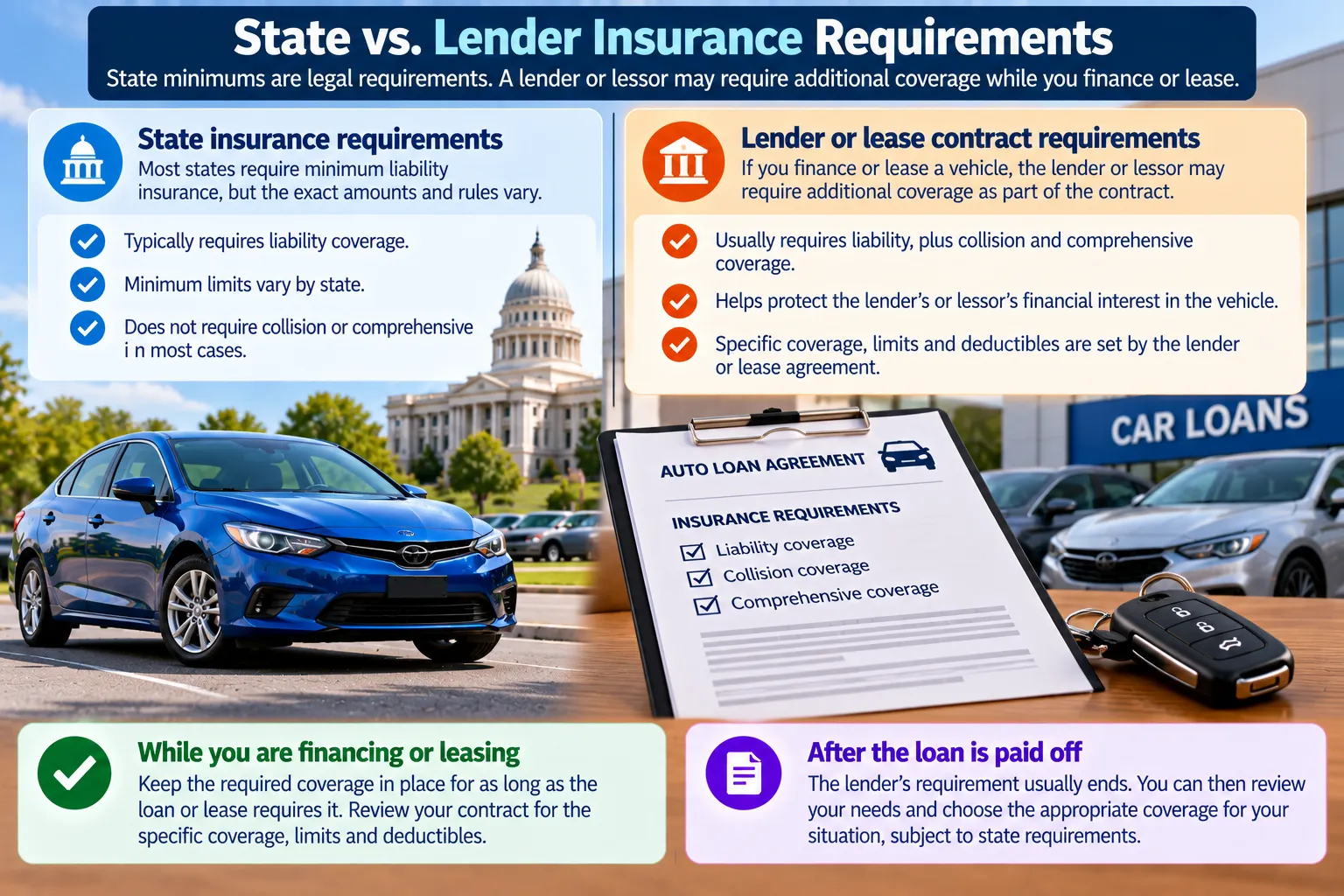
State law generally does not require collision and comprehensive solely because a vehicle is financed. However, a lender or lessor can contractually require physical-damage protection, commonly collision and comprehensive, while it has a financial interest in the vehicle. The NAIC’s consumer guidance describes lender requirements in the context of an auto loan.
Review the finance or lease agreement, policy declarations, and notices from the lender or lessor. A contractual requirement should not be confused with a state insurance requirement, and this guide does not interpret a particular agreement.
What happens after the loan is paid off?
Once a lender no longer has a financial interest, its contractual physical-damage requirement may end. That fact alone does not determine which coverage a vehicle owner should keep, change, or decline. A person may consider vehicle value, potential repair or replacement expense, savings or other resources, premium, deductible, risk tolerance, and policy terms.
Those are individual financial and coverage questions, not a universal recommendation. State-required liability or other legally required coverage can still apply after a loan is paid off. Review the current policy and state requirements before making a coverage change.
If the vehicle’s ownership or financing status changes, update the insurer as the policy requires. The declarations page should identify the covered vehicle and may identify a lender while a loan remains. Keeping current documents together helps distinguish a change in a contract requirement from a change in state law or policy coverage.
Example: liability vs. broader physical-damage coverage
Consider three simple situations. First, an insured driver causes a covered collision that damages another person’s vehicle. Liability coverage may be relevant to the other person’s covered property-damage claim, subject to the policy’s limit and terms.
Second, the insured vehicle is damaged in a covered collision. Collision coverage may be relevant to that vehicle’s damage if it was selected, subject to the deductible and policy terms. Third, the insured vehicle is stolen or damaged in a covered weather event. Comprehensive coverage may be relevant if the cause of loss is covered. These examples do not decide fault, coverage, or payment for an actual claim.
Questions to ask when comparing policies
Compare the documents, not just the labels:
- What bodily injury and property damage liability limits are shown?
- Are collision and comprehensive included for this vehicle?
- What deductibles apply to physical-damage coverage?
- Is UM/UIM included, required, offered, or separately selected?
- Is PIP or other medical-related coverage required or included?
- Which exclusions, conditions, and endorsements apply?
- Does a lender or lease agreement require particular coverage?
- What does the declarations page actually show for each vehicle and driver?
The bottom line
Liability primarily addresses covered responsibility for injury or property damage to others. Full coverage commonly means liability plus collision and comprehensive, but it is not a standardized promise that every loss is covered. The declarations page, endorsements, limits, deductibles, exclusions, and policy terms—not the informal label—determine what a policy actually covers.