
How to get car insurance
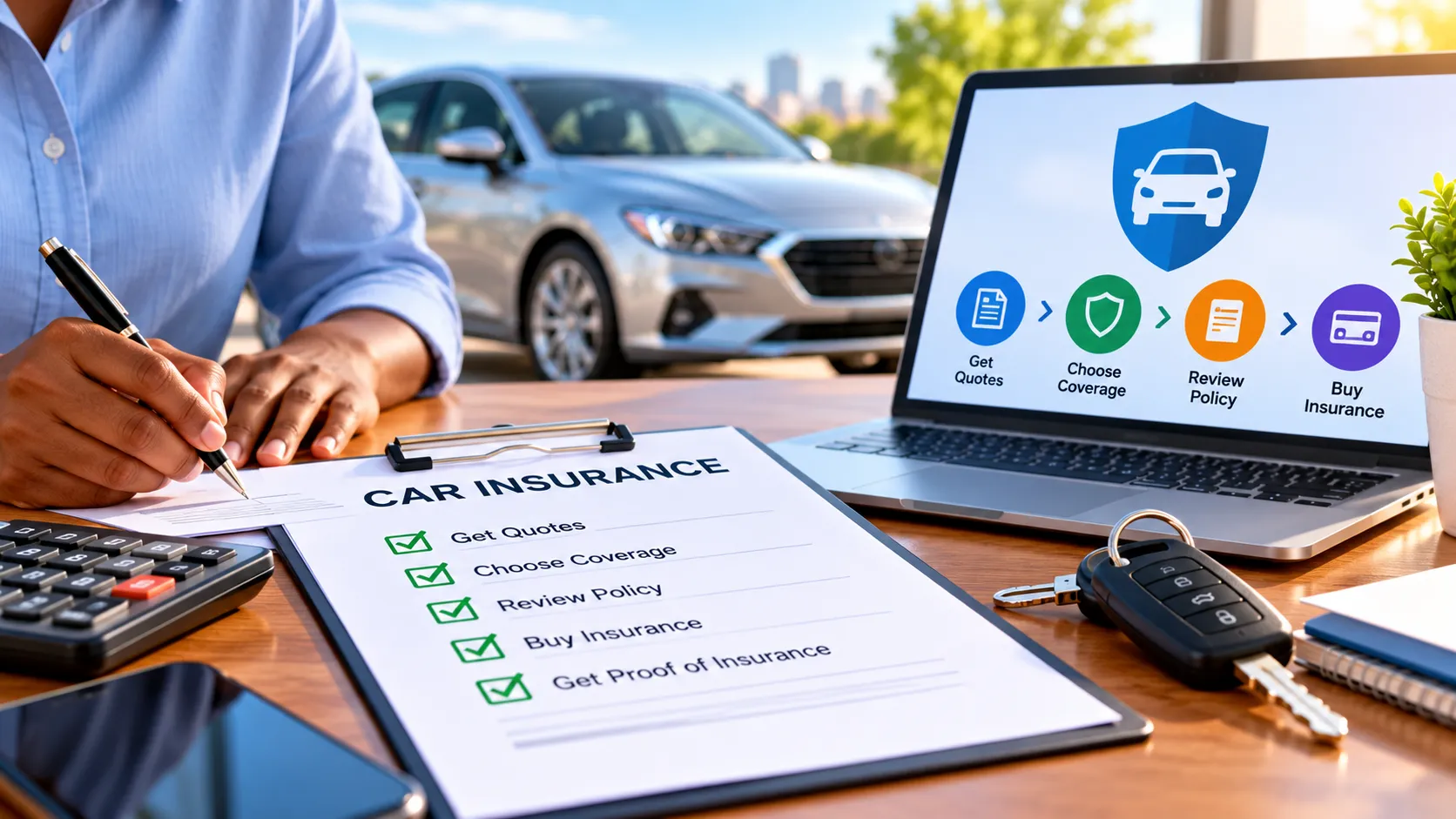
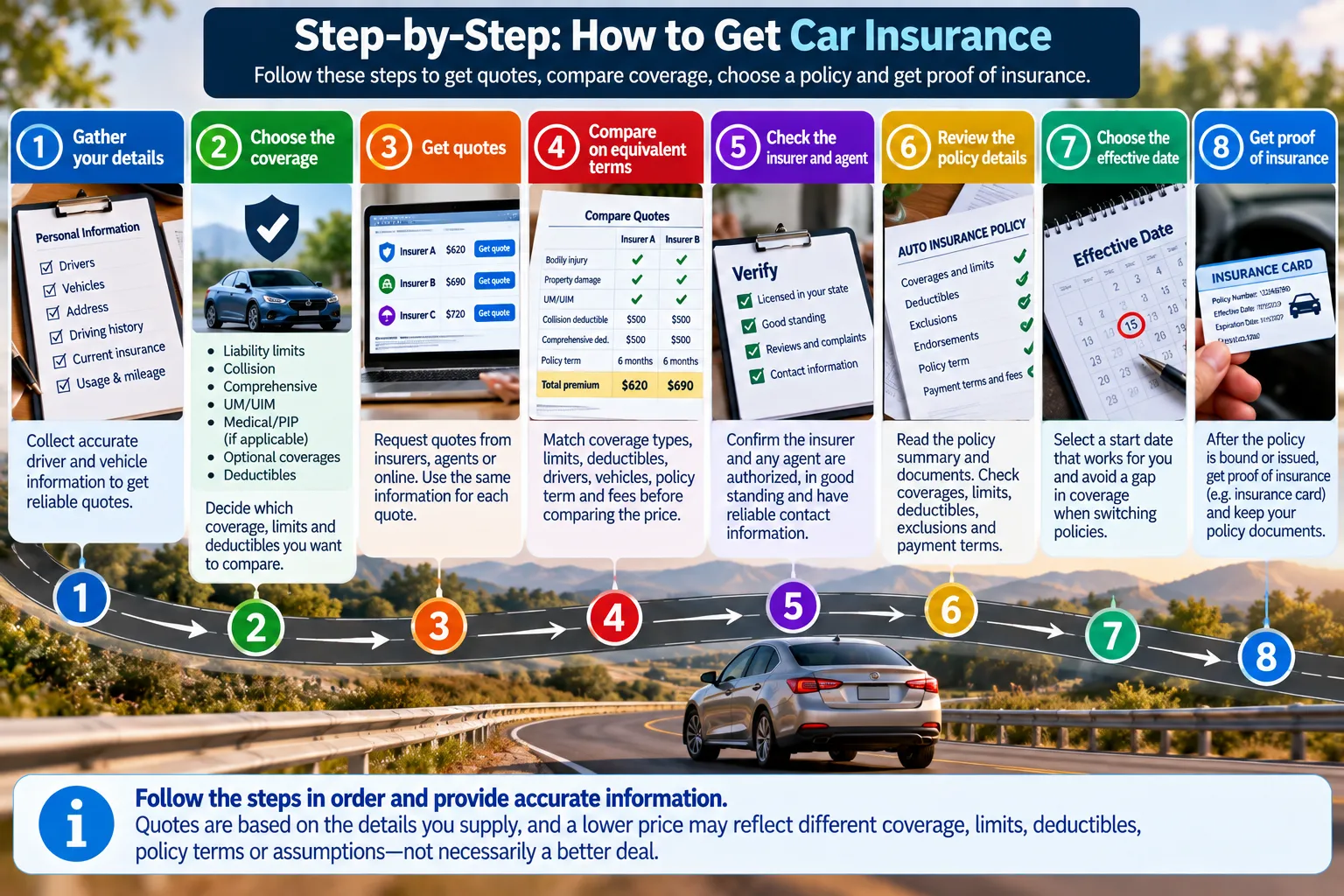
Getting car insurance is a process of matching accurate information with the coverage you want. In broad terms, you gather the details an insurer may need, decide what to compare, obtain quotes, check the provider, and review the policy before choosing an effective date and paying for coverage.
The order helps prevent surprises. A quote can change when information is corrected or underwriting is completed, and a policy may have terms or exclusions that are not visible in a short price summary. Keep a copy of each quote and compare like with like before treating one number as a better offer.
1. Gather the information you may need
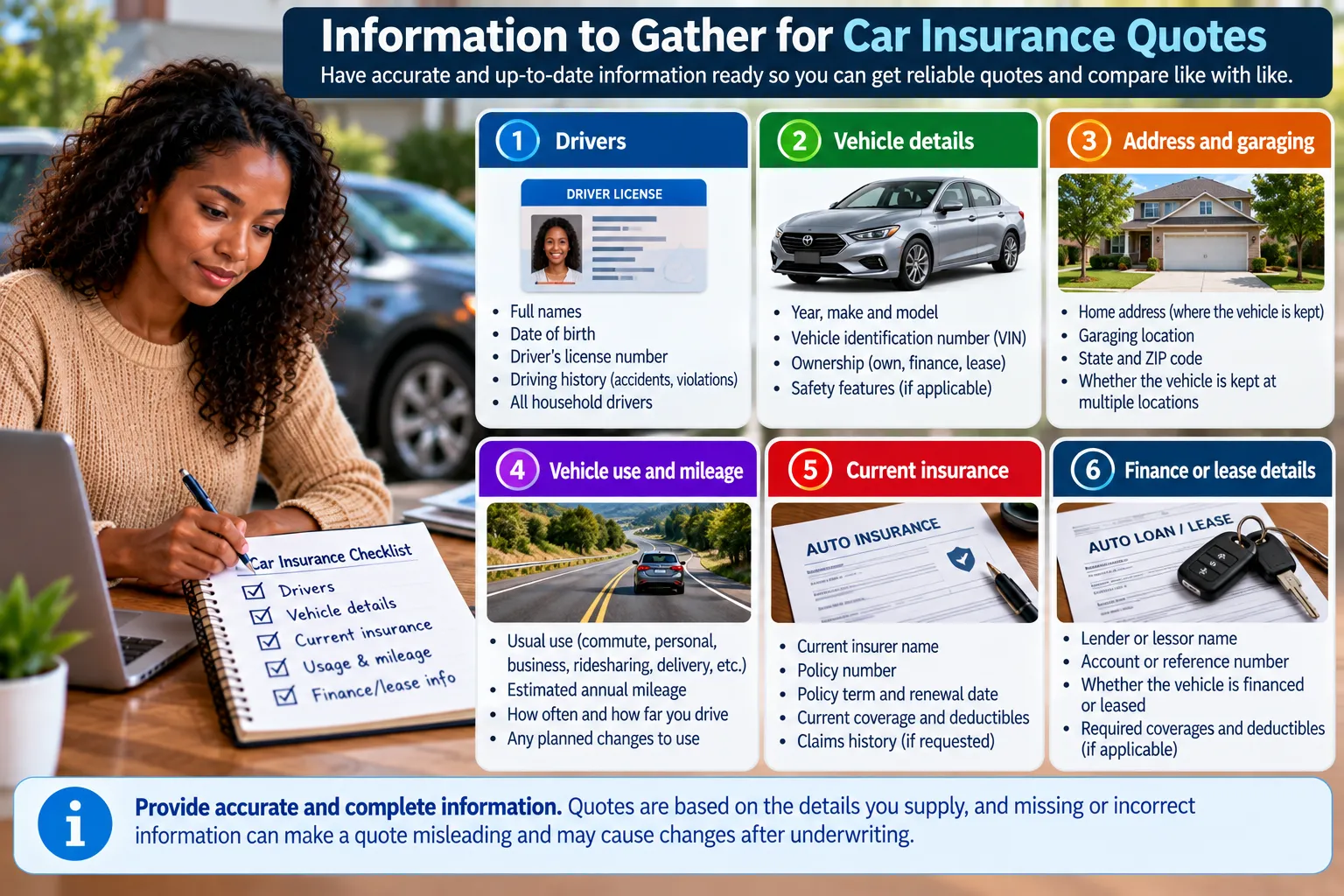
Insurers may ask for information about the people and vehicles to be covered. The exact request varies, but it commonly includes the names of drivers, address, driver’s license information, driving history, and details of any current insurance. For a vehicle, you may need the year, make, model, vehicle identification number when requested, ownership or financing information, estimated annual mileage, and usual use.
Vehicle use deserves particular care. A personal commute, business use, ridesharing, delivery, and occasional use can be treated differently. Provide the facts as they are now, and update the insurer if they change. Incomplete or inaccurate information can make a quote misleading and can create problems after a policy is issued.
2. Understand the coverage you’re comparing
Auto-insurance requirements vary by state. Liability coverage generally helps pay for injury or property damage you cause to others, subject to policy limits. Collision coverage generally addresses damage to your vehicle from an impact, while comprehensive coverage generally addresses certain non-collision losses such as theft, fire, or weather.
Policies may also include uninsured or underinsured motorist coverage and medical-related coverage, depending on the state and the policy. State minimums are a legal baseline, not a universal recommendation for the protection a driver needs. A financed or leased vehicle may also be subject to lender or lessor requirements for collision, comprehensive, or deductibles.
Before requesting quotes, decide which limits, deductibles, optional coverages, and policy term you want to compare. You can then see whether a lower price reflects a genuine difference in insurer pricing or simply less protection.
3. Get car insurance quotes
Quotes may be available through an insurer’s website, an insurer representative, a licensed agent, or an independent agent where that option is available. Different channels can be useful, but the comparison is only as reliable as the information used to create it.
Use the same driver, vehicle, mileage, garaging, coverage, and deductible information for each quote. Ask whether the quoted price assumes a particular payment plan, discount, or policy term. A quote is an estimate or offer based on the information supplied; it is not necessarily the complete insurance contract.
4. Compare quotes on equivalent terms
Meaningful price comparisons match the major policy variables. Put the quotes next to your current declarations page, if you have one, and check:
- Coverage types and liability limits.
- Deductibles for collision, comprehensive, and any other applicable coverage.
- Listed drivers and covered vehicles.
- Optional protection, endorsements, exclusions, and limits on benefits.
- Policy term, total premium, down payment, installment schedule, and applicable fees.
- Discounts and the eligibility assumptions behind them.
For a fuller explanation of why quotes can differ, read How Much Is Car Insurance? A lower premium may be a useful option, but first identify what is different about the coverage or the facts used to calculate it.
5. Check the insurer and agent
Before buying, check that the insurer and any agent are authorized to do business where you live. Your state insurance department is the appropriate place to verify licensing or status and to find consumer information for your jurisdiction. The National Association of Insurance Commissioners maintains a directory of state insurance departments to help consumers find the relevant regulator.
This is a verification step, not a ranking exercise. Licensing does not make every policy identical, so still review the coverage, service arrangements, and policy documents for your own situation.
6. Review the policy before buying
Read the quote, application, coverage summary, and any policy documents available before you complete the purchase. Confirm the named insured and other listed drivers, the covered vehicles, limits, deductibles, optional coverage, exclusions, effective date, and premium or payment schedule.
Ask about anything that is unclear. A quote may summarize important choices, but the issued policy and related documents set out the terms of coverage. This is also the time to check financing or leaseholder information and any proof-of-insurance requirement connected to the vehicle.
Pay attention to the wording around limits, deductibles, and exclusions. A coverage label alone does not always explain every condition, and optional endorsements can change what is included. If you are comparing two policies, note the questions you had to ask about each one and make sure the answers are reflected in the documents you receive. Reviewing these details before the effective date is usually easier than discovering a difference after a loss or a billing issue.
7. Choose when the new policy should start
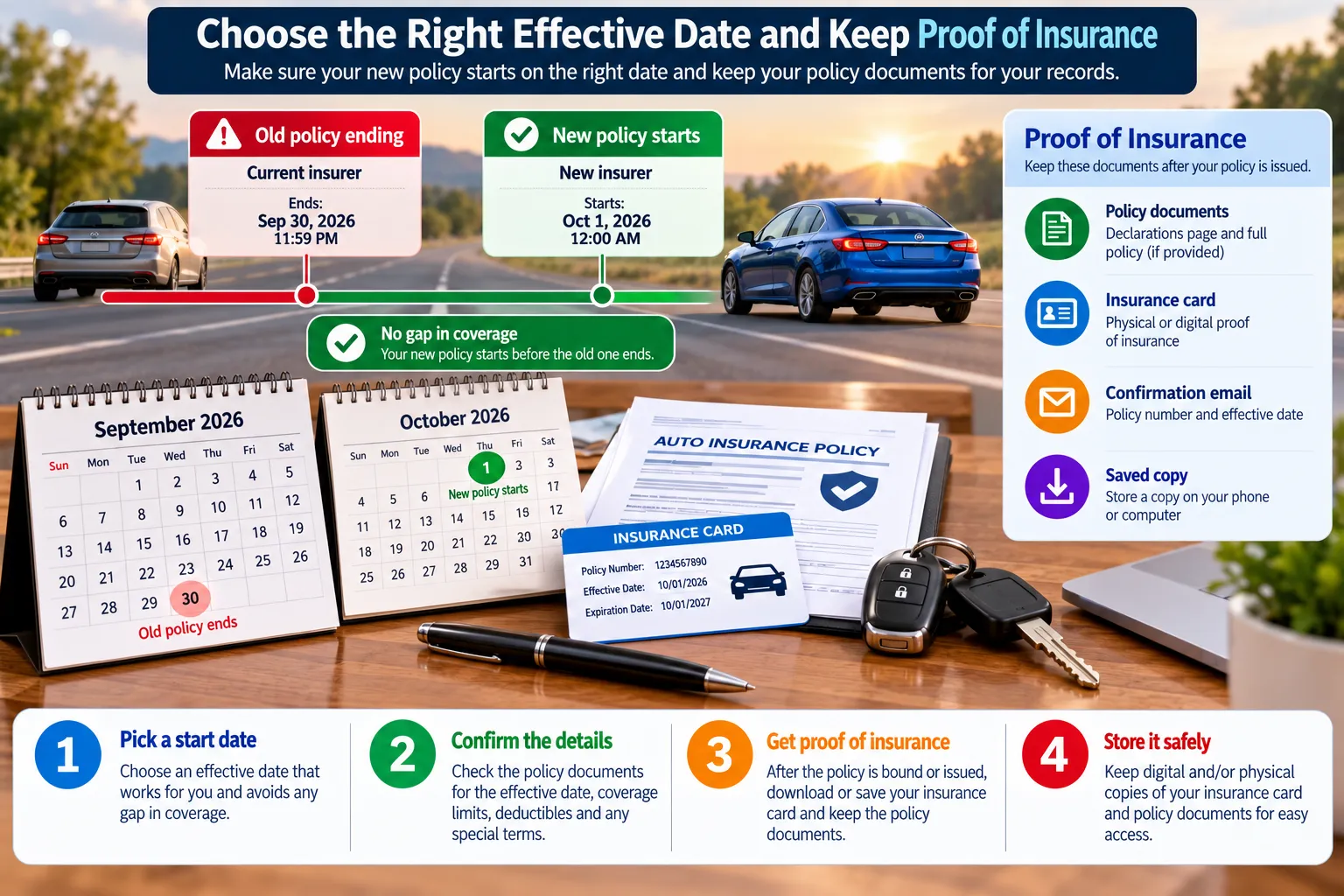
Choose an effective date and time that match your needs. Do not assume coverage begins merely because you received a quote, entered payment information, or submitted an application. Confirm the effective date shown in the policy documents or binder.
If you are replacing existing coverage, make sure the new policy is active before ending the old one. Our guide to switching car insurance explains the steps that can help avoid an unintended coverage gap.
8. Buy the policy and obtain proof of insurance
After coverage is bound or issued, save the declarations page, proof of insurance, payment confirmation, and any binder or correspondence. Check that the information matches what you selected, including drivers, vehicle identification number, limits, deductibles, and effective date.
Requirements for carrying or presenting proof of insurance vary by state and circumstance. Follow the instructions from the insurer and the rules that apply where you drive; do not assume that every form of electronic proof is accepted everywhere.
What if you’re getting car insurance for the first time?
First-time buyers can use the same process, but should allow time to gather accurate information and understand the coverage choices. A lack of prior insurance history or limited driving history may affect the quoting process, depending on the insurer and state rules. It does not remove the need to compare policies carefully.
Ask what information is needed, whether a parent, household member, or vehicle owner needs to be included, and how the vehicle will be used. If you are unfamiliar with the terms, use the quote and coverage summary as a list of questions to ask before buying rather than selecting a policy solely on its initial price.
How to get insurance for a financed or leased car
There are two separate questions: what coverage state law requires, and what the finance or lease contract requires. A lender or lessor may require collision and comprehensive coverage, set deductible conditions, or need to be listed correctly on the policy. Those contractual requirements can differ between lenders and agreements.
Read the contract and ask the lender or leaseholder what evidence of coverage it needs. Give the insurer the correct name and address, then review the issued documents to make sure the information is included. Do not assume that meeting a state minimum alone satisfies a finance or lease agreement.
How long does it take to get car insurance?
Some consumers may be able to obtain coverage quickly after supplying the required information, completing underwriting steps, and arranging payment. Timing can still vary with the insurer, the vehicle, the information that needs verification, state requirements, and the circumstances of the application.
Plan around the effective date rather than an expectation of instant coverage. If you need a policy by a particular time, start gathering information and asking questions early enough to review the terms before the existing coverage ends or the vehicle must be driven.
What if car insurance quotes are too expensive?
Start by checking that the quotes are comparable and that the facts are accurate. Then ask about discounts you may actually qualify for and consider the trade-offs in deductibles, optional coverage, and payment schedules. Do not remove useful coverage or misstate information simply to make a premium appear lower.
For a more detailed framework, see How to Lower Car Insurance. It explains ways to investigate costs while keeping the coverage and out-of-pocket implications in view.
Mistakes to avoid when getting car insurance
- Comparing prices without noticing different limits, deductibles, or optional coverage.
- Providing inaccurate information about drivers, vehicle use, mileage, or garaging.
- Choosing only on the lowest quoted premium without reading the coverage.
- Overlooking deductibles, exclusions, limitations, or payment-plan fees.
- Canceling existing insurance before replacement coverage is confirmed active.
- Failing to verify the insurer or agent through the appropriate state regulator.
Car insurance buying checklist
- Gather driver, vehicle, mileage, use, and current-insurance information.
- Decide the coverage, limits, deductibles, and optional benefits to compare.
- Request quotes using consistent facts and policy terms.
- Verify the insurer and agent through your state insurance department when applicable.
- Review named drivers, vehicles, limits, deductibles, exclusions, effective date, and total payment terms.
- Confirm lender or leaseholder requirements, if relevant.
- Confirm the policy is active and keep proof of insurance and issued documents.
The bottom line
To get car insurance, gather accurate information, compare equivalent coverage, verify the provider, review the policy details, confirm the effective date, and keep proof of coverage. The right sequence is more useful than a one-size-fits-all answer because coverage, state rules, and personal circumstances vary.