
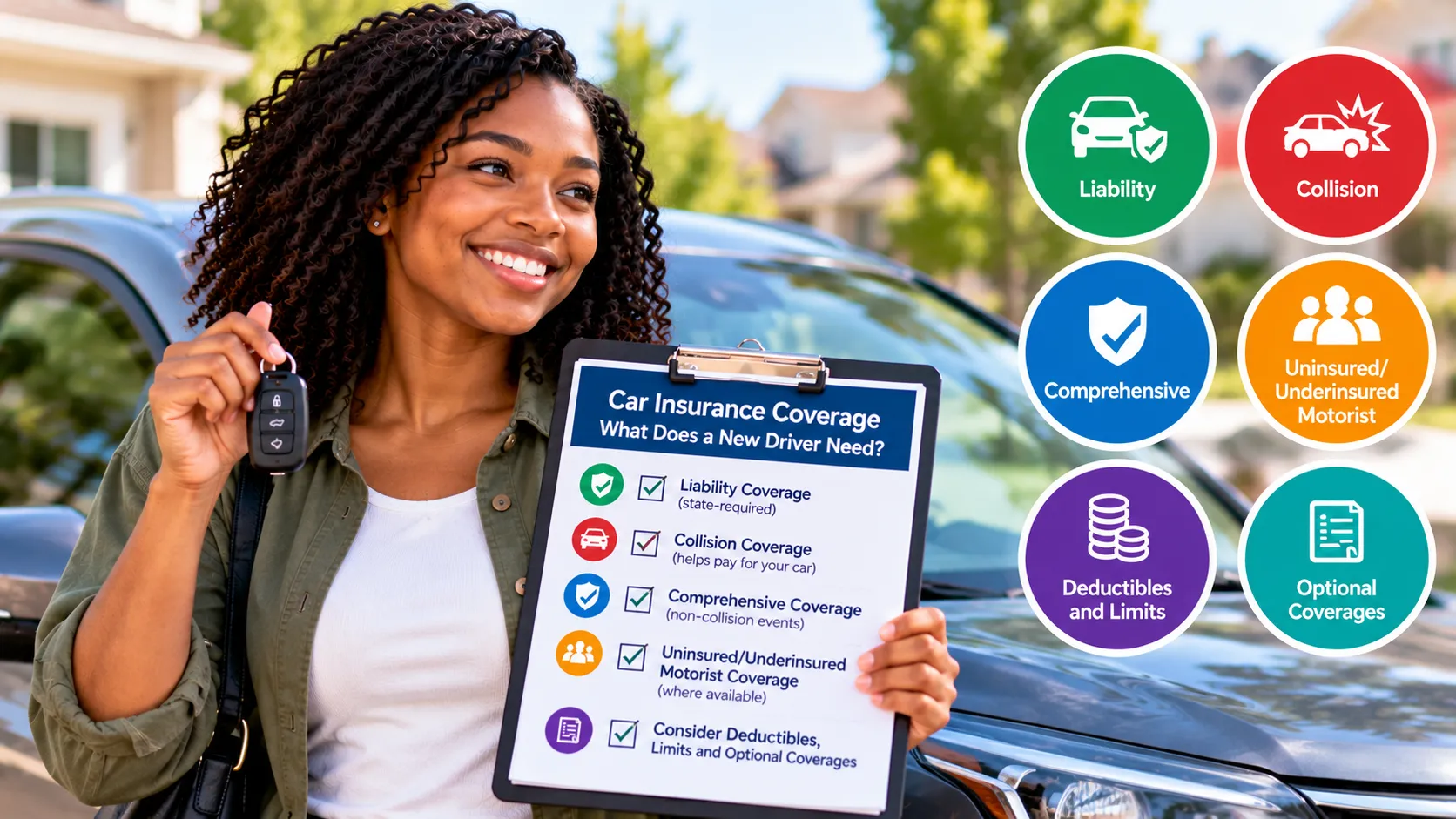
Start with your state’s car insurance requirements
State auto-insurance and financial-responsibility rules vary. Many states require some form of liability protection, but the applicable coverage types, minimum limits, proof rules, and alternatives are not identical nationwide. Verify the current rule with the state insurance department or motor vehicle authority before buying a policy or relying on a summary online.
Liability coverage commonly includes bodily injury liability and property damage liability. Subject to the policy and limits, bodily injury liability can address covered injury claims for which the insured driver is legally responsible, while property damage liability can address covered damage to someone else’s vehicle or other property. A legal minimum is a starting point for compliance where it applies; it is not automatically enough financial protection for every driver.
Main types of car insurance coverage
The labels on an auto policy describe different jobs. What is available, required, or optional depends on the state, insurer, vehicle, and policy terms.
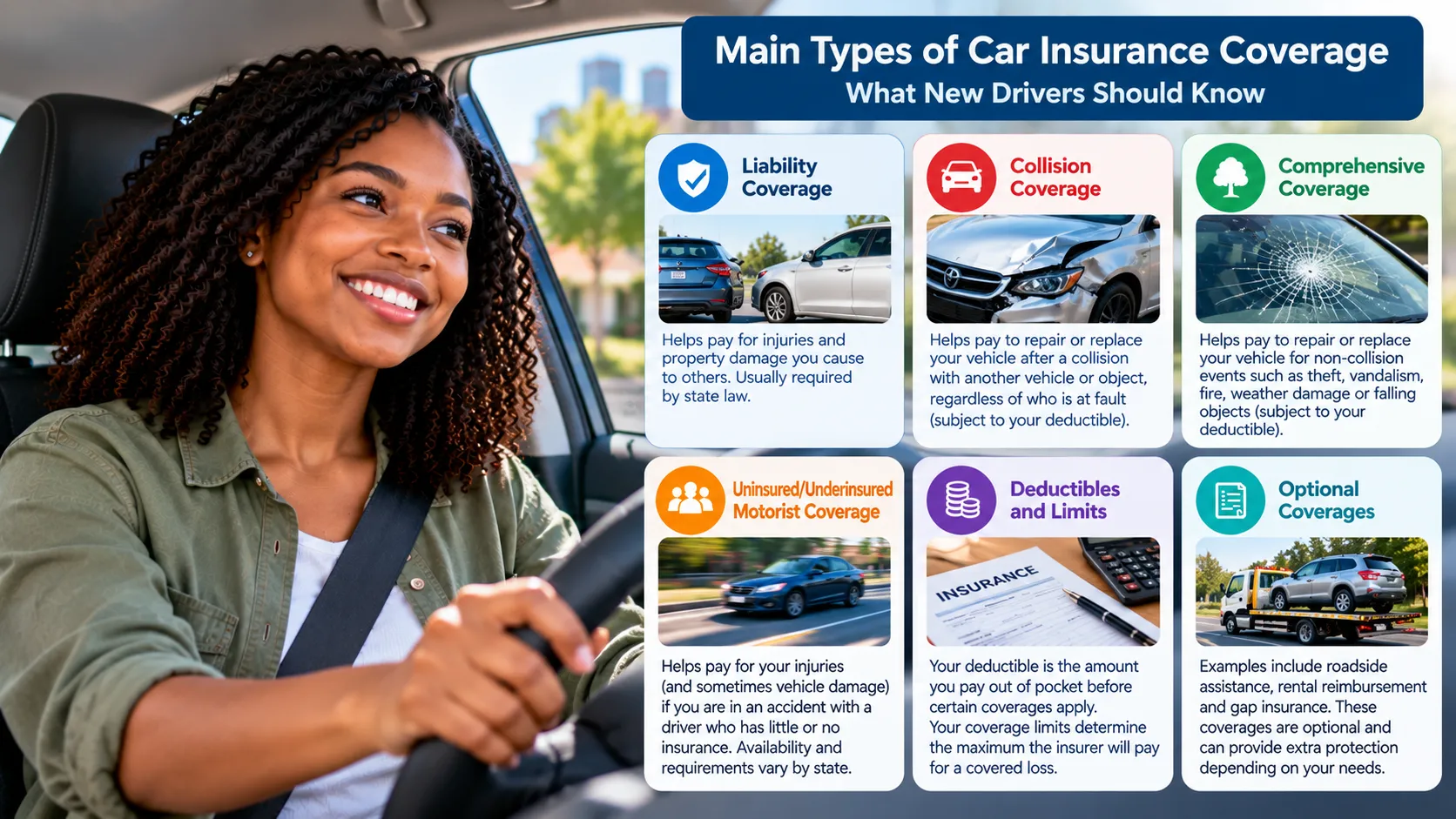
Liability coverage
Liability coverage generally addresses covered injuries or property damage for which an insured driver is legally responsible, subject to its limits and policy terms. It can include bodily injury and property damage components. Our liability insurance guide explains the roles those components can play without treating a policy limit as a universal recommendation.
Collision coverage
Collision coverage generally helps pay for covered damage to the insured vehicle from an impact with another vehicle or object, subject to the policy and deductible. It is not a universal promise of payment: the facts of the loss, coverage, exclusions, deductibles, state rules, and possible recovery from another party can all matter.
Comprehensive coverage
Comprehensive coverage generally addresses certain covered non-collision losses, such as theft, vandalism, weather-related damage, or falling objects, subject to exclusions and deductibles. It does not make every loss covered. Comprehensive versus collision insurance explains why the two coverages should be considered separately.
Uninsured and underinsured motorist coverage
Uninsured motorist (UM) and underinsured motorist (UIM) coverage can help in some situations involving a driver who has no insurance or not enough insurance. Requirements, availability, forms, limits, and scope vary by state. Ask what the quote includes and what selections or waivers apply rather than assuming UM/UIM works the same way everywhere.
How much liability coverage does a new driver need?
The legal minimum and a policy limit are different ideas. A required minimum tells a driver what may be necessary for legal compliance. A limit generally states the maximum an insurer may pay for a covered claim under that coverage, subject to policy terms. A serious crash can create costs beyond a state’s minimum limit, so a new driver should consider personal financial exposure, assets, income, available options, and the actual cost of different limits.
No single dollar limit is right for every new driver. The useful comparison is between equivalent quotes that show the same bodily injury and property damage limits, not a headline premium alone. Reading the declarations page helps identify the limits actually quoted.
Liability limits and deductibles are different
A limit is generally the maximum amount an insurer may pay for a covered claim under a coverage, subject to policy terms. A deductible is generally the amount the policyholder pays toward certain covered losses before or as insurer payment applies, depending on the coverage.
Liability coverage and physical-damage coverage do not necessarily use deductibles in the same way. Collision and comprehensive commonly show separate deductibles for covered damage to the insured vehicle. Check each line of a quote rather than assuming that one deductible applies to every coverage.
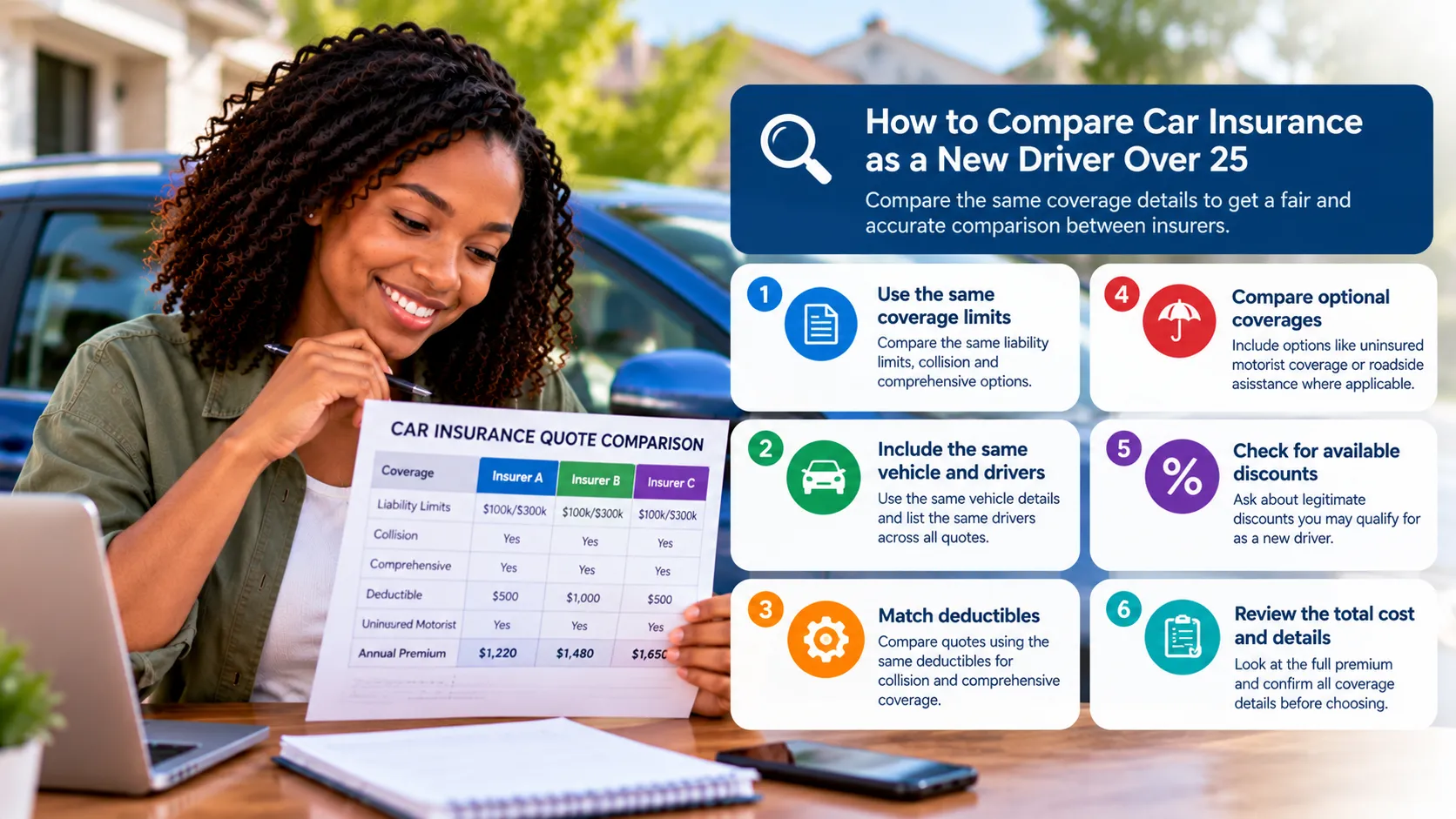
Does a new driver need collision coverage?
Not always. Collision can be worth evaluating when the driver could not comfortably repair or replace the vehicle after a covered crash, but the decision can depend on vehicle value, the deductible, the premium, local repair costs, and the driver’s ability to absorb a loss. A lower-value vehicle does not automatically make collision unsuitable, and a newer vehicle does not automatically make any deductible appropriate.
Collision may also be required by a finance or lease agreement. Before dropping or selecting it, review the agreement, the declarations page, and the actual quote.
Does a new driver need comprehensive coverage?
Comprehensive is another separate decision. Consider the vehicle’s value, deductible, premium, local exposure to theft, weather, vandalism, or other covered non-collision risks, and any lender or lessor requirement. Its label does not mean every non-collision event is covered; exclusions and policy conditions remain important.
What if the car is financed or leased?
A lender or lessor commonly has contractual insurance requirements intended to protect its financial interest in the vehicle. Some agreements require collision and comprehensive coverage while a balance or lease obligation remains, but not every lender or lessor uses identical terms. Check the finance or lease agreement, lender or lessor notices, and insurer documentation for the requirements that apply to that vehicle.
People sometimes call liability plus collision and comprehensive “full coverage.” That is informal shorthand, not one standardized insurance product, and it does not describe every limit, deductible, exclusion, or optional benefit. Do not use the phrase as a substitute for reading the policy.
Does a new driver need uninsured motorist coverage?
It is worth evaluating, but the answer is state- and policy-specific. A state may require a form of UM/UIM coverage, require it to be offered, allow a selection or waiver, or treat related coverages differently. Look at the type and limit shown on the quote, ask how it applies in the state, and compare it with the driver’s other protections and financial exposure.
What about medical payments or personal injury protection?
Medical payments coverage and personal injury protection (PIP) can address injury-related costs under different policy and state rules. Availability, requirements, benefits, coordination with other coverage, and restrictions vary. A new driver should identify what the relevant state and quote provide instead of assuming a label from another state has the same structure.
Optional car insurance coverages a new driver may encounter
Quotes may include roadside assistance, rental reimbursement, gap coverage, accident forgiveness where offered, and other insurer-specific options. These features can have separate prices, limits, waiting periods, eligibility rules, and exclusions.
Gap coverage is generally intended to help with a difference between a vehicle’s value or insurance settlement and an outstanding loan or lease balance in certain total-loss situations. It is not identical across policies or contracts. Compare the specific terms rather than assuming it is included with collision or comprehensive.
How should a new driver choose a deductible?
A higher deductible can sometimes reduce premium, but it also increases the amount the driver may need to pay after a covered loss. A lower deductible may cost more in premium while reducing that immediate out-of-pocket exposure. Neither selection is universally best.
Compare the actual premium difference with an amount that could realistically be paid after an unexpected covered loss. Check collision and comprehensive deductibles separately, because the policy may not use the same amount for both.
Should a new driver buy only the state minimum?
State-minimum coverage may satisfy a legal requirement where it applies, but it does not automatically provide enough financial protection for every driver. A decision about limits can include potential liability exposure, protection for the driver’s own vehicle, available UM/UIM options, deductibles, and lender or lease requirements.
This is not a reason to buy every available option. It is a reason to identify what is legally required, what is contractually required, and what additional protection the driver is considering before comparing cost.
Does a new driver need “full coverage”?
There is no single standardized definition of “full coverage.” It often refers to a combination of liability, collision, and comprehensive coverage, but policies can differ in limits, deductibles, endorsements, and optional protections. It does not mean a policy covers everything, and it is not automatically right for every new driver.
New-driver car insurance coverage checklist
Use this checklist when reviewing a quote or declarations page:
- Verify current state requirements with an official state source.
- Review bodily injury and property damage liability limits.
- Consider financial exposure beyond a legal minimum.
- Decide whether collision and comprehensive make sense for the vehicle and circumstances.
- Check UM/UIM options, requirements, selections, or waivers where applicable.
- Check PIP or medical payments availability where applicable.
- Review finance or lease requirements.
- Choose deductibles that could realistically be paid after a covered loss.
- Evaluate optional features such as rental reimbursement, roadside assistance, or gap coverage on their terms.
- Compare equivalent quotes and verify the driver, address, vehicle, and usage information.
- Confirm the policy’s effective date before driving.
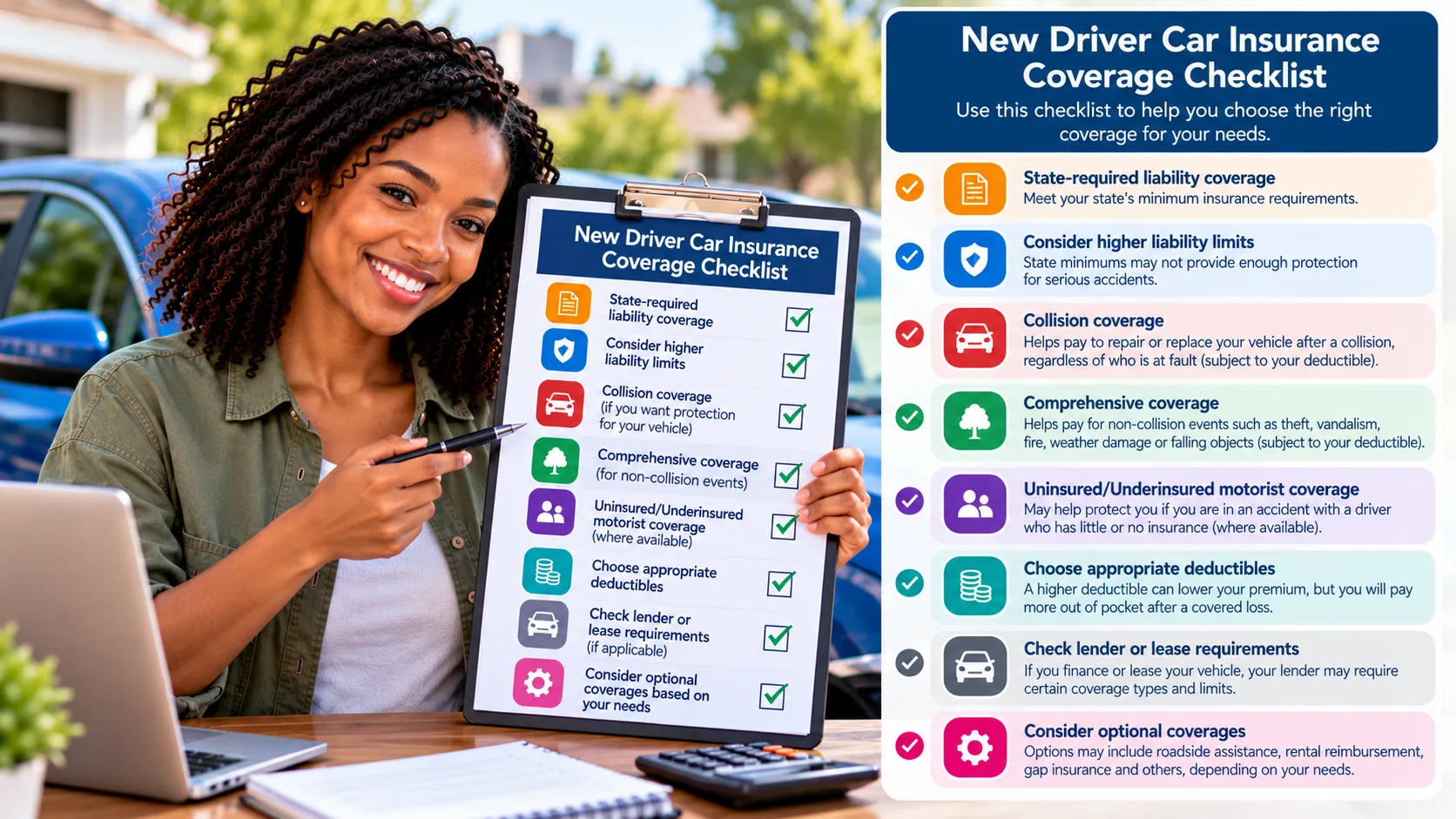
Compare equivalent coverage before choosing an insurer
The cheapest quote is not necessarily the least expensive equivalent policy. Keep liability limits, collision and comprehensive choices, deductibles, drivers, vehicle, and optional coverages consistent across quotes. Then compare the total premium, payment terms, insurer information, and policy details.
How to compare car insurance quotes offers a practical way to line up those variables before focusing on price.
Can new drivers lower the cost without cutting important coverage?
Reducing coverage is only one way a premium may change. Comparing insurers, asking about legitimate discounts, maintaining safer driving habits, choosing a vehicle carefully, considering telematics where appropriate, and reviewing deductible options can also affect a quote. Programs, data use, eligibility, and pricing effects vary by insurer and state, so compare the complete policy rather than assuming a discount or a lower limit is available.
Frequently asked questions
What insurance coverage is required for a new driver?
A new driver must meet the auto-insurance or financial-responsibility rules that apply in the relevant state. The required types and limits vary, so verify them with the current official state source and the insurer’s documents.
Does a new driver need full coverage?
Not necessarily. “Full coverage” is informal terminology, not a standardized policy. The appropriate mix of liability, collision, comprehensive, and other protection depends on the vehicle, finances, state rules, and any loan or lease agreement.
Should a new driver get more than state-minimum insurance?
It can be worth evaluating because a legal minimum is not automatically enough for every driver’s potential liability or vehicle-related risk. Compare available limits and protections against the driver’s circumstances rather than relying on one universal amount.
Does a new driver need collision and comprehensive coverage?
Not every driver does. Consider vehicle value, premium, deductible, ability to absorb a loss, local risks, and any lender or lessor requirement. Each coverage has a different purpose and policy terms matter.
What deductible should a new driver choose?
Choose an amount that balances the actual premium difference with an out-of-pocket amount that could realistically be paid after a covered loss. There is no one deductible that is best for every new driver.
Does a financed car need full coverage?
A lender or lessor may require collision and comprehensive coverage, but requirements depend on the agreement. “Full coverage” is not a precise substitute for the contract or policy terms; check both documents directly.
Does a new driver need uninsured motorist coverage?
Requirements and availability vary by state. Review whether it is required, offered, selectable, or waivable where the vehicle is insured, then consider the coverage and limits shown in the quote.
Is liability-only insurance enough for a new driver?
It may meet a legal requirement in some circumstances, but it generally does not pay for covered damage to the insured driver’s own vehicle under collision or comprehensive. Whether it is enough depends on the applicable rules, vehicle, finances, and any loan or lease requirements.
The bottom line
There is no single coverage package that every new driver needs. Start with applicable state requirements, then consider liability limits, protection for the vehicle, UM/UIM options, deductibles, lender or lease requirements, and optional protections. Compare equivalent policies rather than selecting coverage based only on premium.