

Why car insurance can cost more for new drivers
Being a new driver is not exactly the same as being a young driver. A person can be new to driving at many ages, while a young driver may have only recently started driving. Both situations can affect a quote, but insurers do not necessarily use the same rating approach in every state or for every applicant.
Insurers generally have less individual driving history to consider for a new driver. They may also consider the vehicle, the selected coverage and deductible, where the car is garaged, mileage, vehicle use, prior insurance, and other factors permitted where the policy is issued. The National Association of Insurance Commissioners notes that auto-insurance rating can involve both underwriting and rating, and insurers can price comparable applicants differently.
That does not mean a new driver should accept the first price offered or cut useful protection automatically. The more practical question is how to investigate legitimate choices while comparing the same protection from one quote to another.
1. Compare quotes from multiple insurers
Two insurers can quote different premiums for the same driver and car because their rating methods, underwriting rules, available programs, and state filings can differ. Requesting more than one quote gives a new driver a way to see those differences, but only if the information is consistent.
Use the same drivers, vehicle, garaging address, estimated mileage, coverage types, liability limits, deductibles, policy term, and optional coverages for every quote. Also ask whether a displayed price assumes a particular discount, payment plan, or enrollment in a program. A lower monthly payment can reflect a different total premium, installment fees, a different term, or less coverage rather than a lower price for the same policy.

For a more detailed comparison method, see How to Compare Car Insurance Quotes. Keep copies of the quote summaries and compare them with the declarations page once a policy is issued.
2. Ask about discounts you actually qualify for
Discounts can be useful to ask about, but availability and eligibility vary by insurer and state. A discount shown in an advertisement or offered to another driver is not a promise that it will apply to a particular quote.
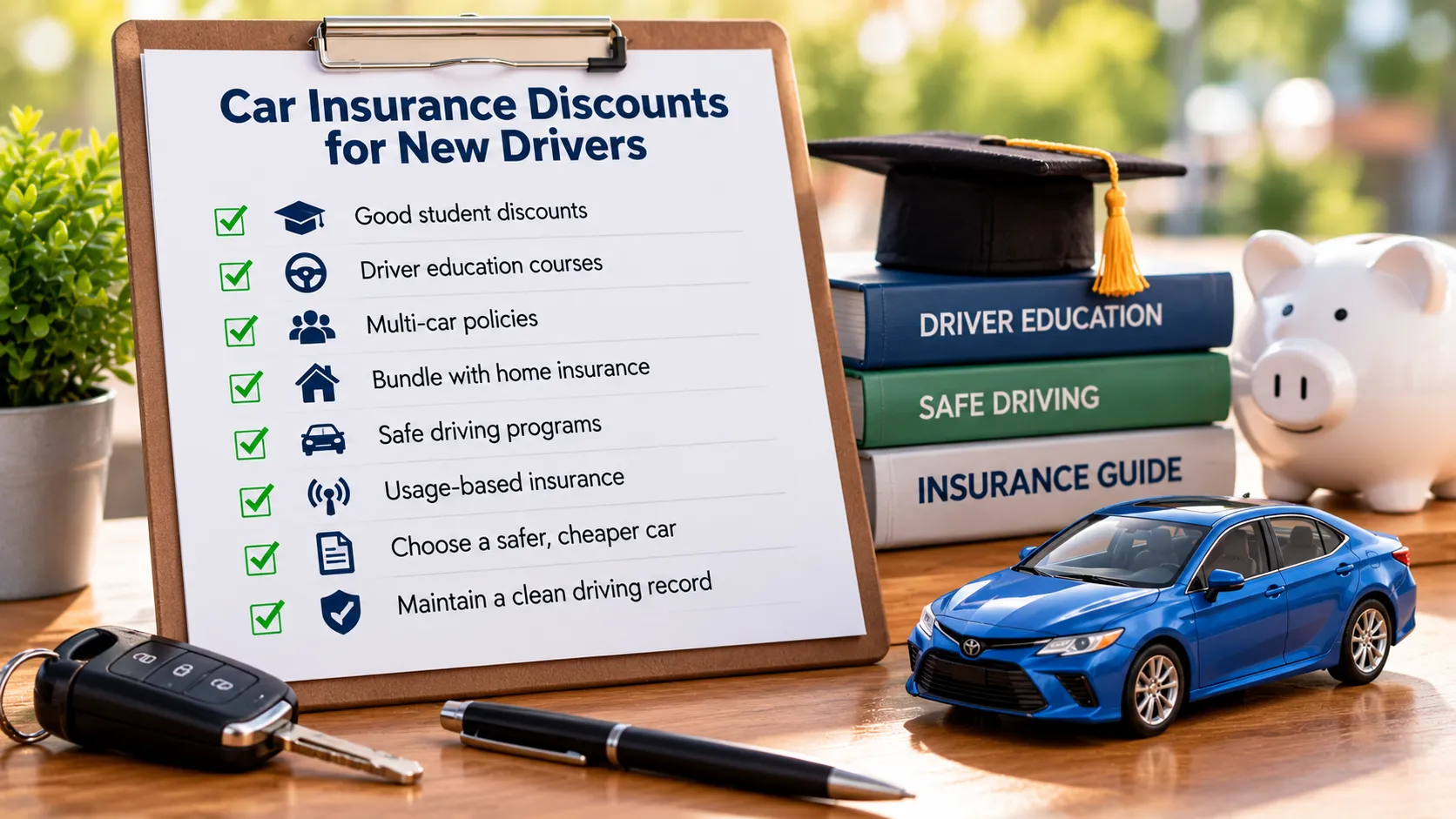
Depending on the insurer and circumstances, a new driver might ask about good-student programs, approved driver education or training, multi-car arrangements, bundling where appropriate, vehicle safety or anti-theft features, safe-driving programs, or usage-based programs. The California Department of Insurance, for example, tells consumers to ask about available discounts, including multi-car and qualifying good-student discounts, while also emphasizing comparison shopping.
Ask what documentation is needed, when eligibility is reviewed, whether the program is available in your state, and whether the quoted price already includes it. Do not provide inaccurate information or take a course solely on the assumption that it will lower a premium.
3. Consider the insurance cost before choosing a car
The car can affect a quote. Vehicle value, repair complexity and parts costs, safety equipment, theft exposure, performance characteristics, and the vehicle’s expected use can all matter. The effect can vary with the insurer, location, coverage, and the driver’s other information.
Before buying or leasing, request estimates for the specific vehicles you are considering using the coverage you expect to carry. Avoid assuming a smaller, older, newer, or more expensive vehicle will always cost less to insure. Compare the insurance estimate alongside purchase price, financing, maintenance, fuel or charging costs, and the condition of the vehicle.
4. Maintain a clean driving record
Driving and claims history can become more informative as experience grows. Avoiding crashes, violations, impaired driving, distracted driving, and other risky behavior helps protect people on the road and can matter to future pricing, subject to the insurer’s practices and state rules.
There is no universal timetable for a premium to change after a clean period of driving. A ticket, crash, claim, policy lapse, and the rules where the policy is written can each affect a quote differently. Focus on safe driving and accurate policy information rather than expecting an automatic reduction at a particular age or after a set number of months.

5. Consider usage-based insurance carefully
Usage-based insurance, often called telematics, uses a device, connected vehicle, or mobile app to collect information about driving. Depending on the program, it can include mileage, time of day, location, acceleration, braking, cornering, or other data. The NAIC explains that program design and the data collected can differ.
For some drivers, a program may create a pricing opportunity if the insurer offers it and the driving pattern fits the program. It is not guaranteed to lower a premium, and some programs may affect pricing in ways that do not benefit every driver. Review what is monitored, how the information is used and retained, whether participation is optional, and how enrollment or leaving the program affects the policy before agreeing.
6. Check whether joining a household policy makes sense
In some situations, a new driver may be added to a parent’s, family member’s, or household policy. Whether that makes sense depends on the living arrangement, vehicle ownership, garaging, insurer rules, state requirements, and whether household drivers must be disclosed.
Do not assume every new driver can stay on or join a parent’s policy. A driver who lives elsewhere, owns a vehicle separately, or has a different principal garaging address may need a different arrangement. Ask the insurer which drivers and vehicles must be listed and how the proposed arrangement affects coverage, pricing, and any proof-of-insurance needs.
7. Review coverage limits before cutting coverage
Buying less coverage may reduce a quoted premium, but it can also change what financial risk remains with the policyholder after a loss. Liability coverage generally addresses covered injury or property damage the insured driver causes to others, subject to the limits selected. What Is Liability Car Insurance? explains the basic role of those limits.
Collision and comprehensive coverage address different types of physical damage to the insured vehicle and are not interchangeable. Comprehensive vs. Collision Insurance provides a closer comparison. A lender or lessor may also require physical-damage coverage while it has a financial interest in a vehicle, so a state requirement alone may not answer every coverage question.
Before reducing a limit or removing a coverage, compare the premium difference with the potential out-of-pocket exposure and the policy terms. State-minimum coverage is a legal baseline where required, not a universal recommendation for the protection a new driver needs.
8. Consider whether a higher deductible makes sense
A higher collision or comprehensive deductible can lower the premium in some quotes, but it increases the amount the policyholder may need to pay after a covered loss before applicable coverage pays. Deductibles, coverage limits, and claim conditions are separate parts of a policy.
Compare more than the premium. Ask whether you could realistically pay the deductible after a covered loss, then review the deductible for each coverage rather than assuming one number applies to the entire policy. A lower premium may not be a good trade if the out-of-pocket amount would be unmanageable.
9. Review the policy as driving experience grows
New-driver circumstances often change. A move, different school or work schedule, mileage change, vehicle change, new household member, or additional experience can make it worthwhile to review the policy and request comparable quotes again.
Premiums do not automatically fall at a particular age or after a particular amount of experience. Compare quotes periodically using current and accurate information, and review the declarations page whenever a policy renews or a material fact changes. How Much Is Car Insurance? explains why vehicle, coverage, deductible, driving history, and other permitted factors can affect price.
Quick checklist for new drivers trying to lower insurance costs
- Compare quotes using the same vehicle, drivers, mileage, limits, deductibles, and policy term.
- Ask which discounts or programs you actually qualify for and what proof they require.
- Get insurance estimates before choosing a vehicle.
- Keep driver, garaging, mileage, household, and vehicle-use information accurate.
- Consider telematics only after reviewing its price terms and data practices.
- Check the financial trade-off before raising a deductible or cutting coverage.
- Confirm any lender or lease requirements before changing collision or comprehensive coverage.
- Review the policy and compare quotes again when circumstances change.
Frequently asked questions
What is the cheapest way to insure a new driver?
There is no single cheapest approach for every new driver. Comparing equivalent quotes, asking about discounts that actually apply, choosing a vehicle carefully, and reviewing household-policy eligibility where permitted can identify options. The lowest price should still be compared with coverage, deductibles, fees, exclusions, and the facts used for the quote.
Is it cheaper for a new driver to join a parent’s policy?
It can be less expensive in some situations, but it is not automatic and may not be permitted for every arrangement. Household residence, vehicle ownership, garaging, insurer rules, state requirements, and the need to disclose every regular driver can matter. Ask the insurer how it would write the proposed policy.
Do driving courses lower car insurance?
Some insurers may offer a discount for qualifying driver education or training, while others may not. Availability, course approval, documentation, state rules, and eligibility can differ. Confirm the program’s terms before relying on it in a quote.
Can good grades lower car insurance?
Some insurers offer good-student programs for eligible students, but they are not universal. Ask whether a program is offered where you live, what academic standard and documentation apply, how long it lasts, and whether the quote already reflects it.
Does the car a new driver chooses affect insurance cost?
It can. Insurers may consider vehicle value, repair cost, parts, safety features, theft exposure, performance characteristics, and expected use, among other permitted factors. Get quotes for the specific vehicles and coverage you are considering instead of relying on a general rule about vehicle type.
Will car insurance get cheaper after gaining driving experience?
It may change over time, but no specific reduction is guaranteed. Insurers can consider driving and claims history along with coverage, vehicle, location, and other permitted factors. Review the policy and compare equivalent quotes as your circumstances change.
The bottom line
New drivers do not have one universally cheapest insurer or savings strategy. Compare equivalent coverage, investigate legitimate discounts, choose the vehicle carefully, and understand the deductible and coverage trade-offs before reducing a premium. Safe driving and accurate policy information can also help make future reviews more meaningful.